Interviews
Federico Simeoni On data visualisation, queer knowledge, democratic participation and AI: mapping the spaces between categories

Federico (Fe) Simeoni’s work sits somewhere between information design, cartography, critical research and queer visual culture. At the centre of it is a deceptively simple question: what happens when the categories we use to represent people no longer correspond to the complexity of their lived experience?
Over the years, this question has led him from maps and geopolitical visualisation to gender, linguistic identity, intersectionality and artificial intelligence. His “diamonds”, the visual systems designed to map positions across a field rather than force people into binary categories, have become both research tools and spaces for conversation.
In this interview, we talk about how visualisation can help people locate themselves, how categories can simultaneously constrain and empower, what democratic deliberation might learn from queer visual cultures, and why sometimes the most interesting AI is not the one that provides the answer, but the one that makes the question more difficult.
Visualising complexity
Olivier: Let’s start from the beginning. How did you develop this relationship with data visualisation and data more broadly?
Fe: I’ve always been fascinated by data visualisation, maps and cartography. Really since I was a child. That fascination was one of the things that eventually pushed me towards art school for my bachelor’s.
The funny thing is that when I studied at the Academy of Fine Arts in Milan, there wasn’t actually a proper course on information design. So when I started working on these things for my bachelor’s thesis, much of it was self-taught. I was learning by doing, experimenting, figuring things out independently. And for me that was extremely enjoyable.
Later, I started collaborating with Sapienza University of Rome, with a study group working around geopolitics. That was important because suddenly the maps were not abstract exercises. I was drawing ongoing wars, geopolitical conflicts, very real and very human situations. You are taking something incredibly complicated and consequential and deciding how it is placed on a map.
After that I also worked for some years on visual design and cartography for Italian schoolbooks.
Then I moved to Aalto University, where there was a much more developed environment around information design. But there was something missing there too. In visual communication design you had, on one side, information designers, who often had this relatively positivist relationship to data and technology, and on the other side people working through much more critical and narrative approaches to communication.
Gender is complex. That’s true. But if there is also a need to create some sort of shared understanding, then you have to ask: how do we do that without pretending that the complexity disappears?
And I was thinking: Okay, I want to be in both worlds.
At the same time, something was happening personally. When I started at Aalto, I thought of myself as a cis man. In Italy at that point there was also much less public discussion about non-binary identities. Then, gradually, I became this non-binary person who was simultaneously working on questions of representation and information design.
So information design became a way of understanding myself.
I sometimes say that I was literally doing psychotherapy on myself through information design. Because my information-designer brain was asking: Okay, but what is the gender spectrum? How does this actually work?
And when I spoke with people, I encountered all these very messy, sometimes contradictory ideas about gender. Of course gender is messy. Gender is complex. That’s true. But if there is also a need to create some sort of shared understanding, then you have to ask: how do we do that without pretending that the complexity disappears? That became my obsession during my master’s, and eventually it became the thesis.
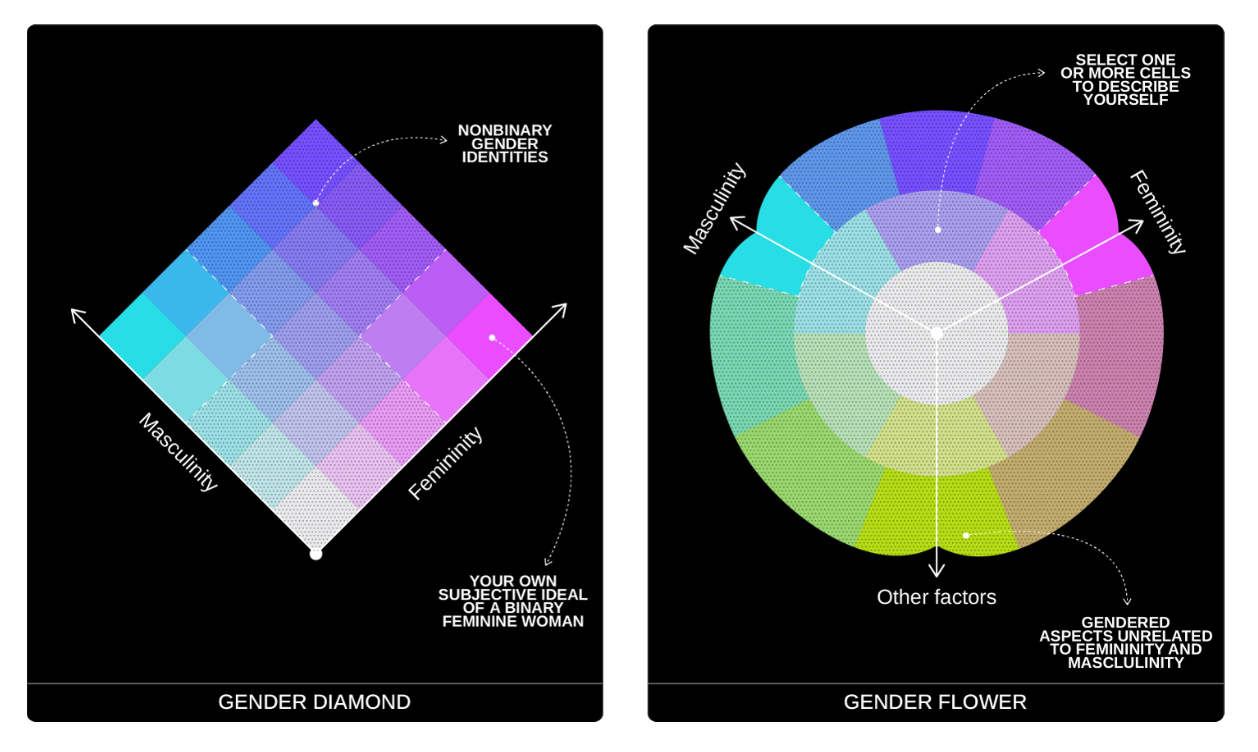
The Gender Diamond and Flower
Simeoni, Fe et al. (2024), Qerying the Qantification of the Qeer: Data-Driven Visualisations of the Gender Spectrum
The visualisation as a conversational interface
Olivier: In that story, the visualisation almost becomes a living object. It begins as a way of understanding yourself and then develops into something that other people can use. What tools do you actually work with?
Fe: I’m not really a hands-on, crafty person. I’m very much a digital creature, so technically I work with coding, D3, digital environments and interactive visualisation. Those are obviously tools. But when I think about the tools that actually matter most in my work, the first one is probably people.
The visualisations I’ve been developing deal with intersubjective concepts. Gender is one example, language identity is another. These are things that cannot simply be measured as if there were a completely objective external reality waiting to be captured. If you want to draw maps of these kinds of concepts, you need to engage with multiple perspectives, situated perspectives and lived experiences. That means interviews are one of my central design tools.
Over time, I also realised that perhaps the visualisation itself was never really my desired output. What I was ultimately interested in was the underlying data structure—the ontology that supports the visualisation. The visualisation became a means through which I could talk about ontology with people.
Because if I sit down with someone and ask, How do you conceptualise the gender spectrum?, that is an incredibly difficult question. It is abstract, almost impossible to answer directly.
But if I put a small visual model in front of you and ask, Does this make sense? What is missing? Where would you place yourself? Could you place some of your friends? Is there something here that feels discriminatory?, then suddenly you have something concrete to react to.
The conversation unfolds through the visualisation. And then, interview after interview, both the visualisation and the structure beneath it evolve. So the image is not necessarily the end product. It is also a conversational interface.
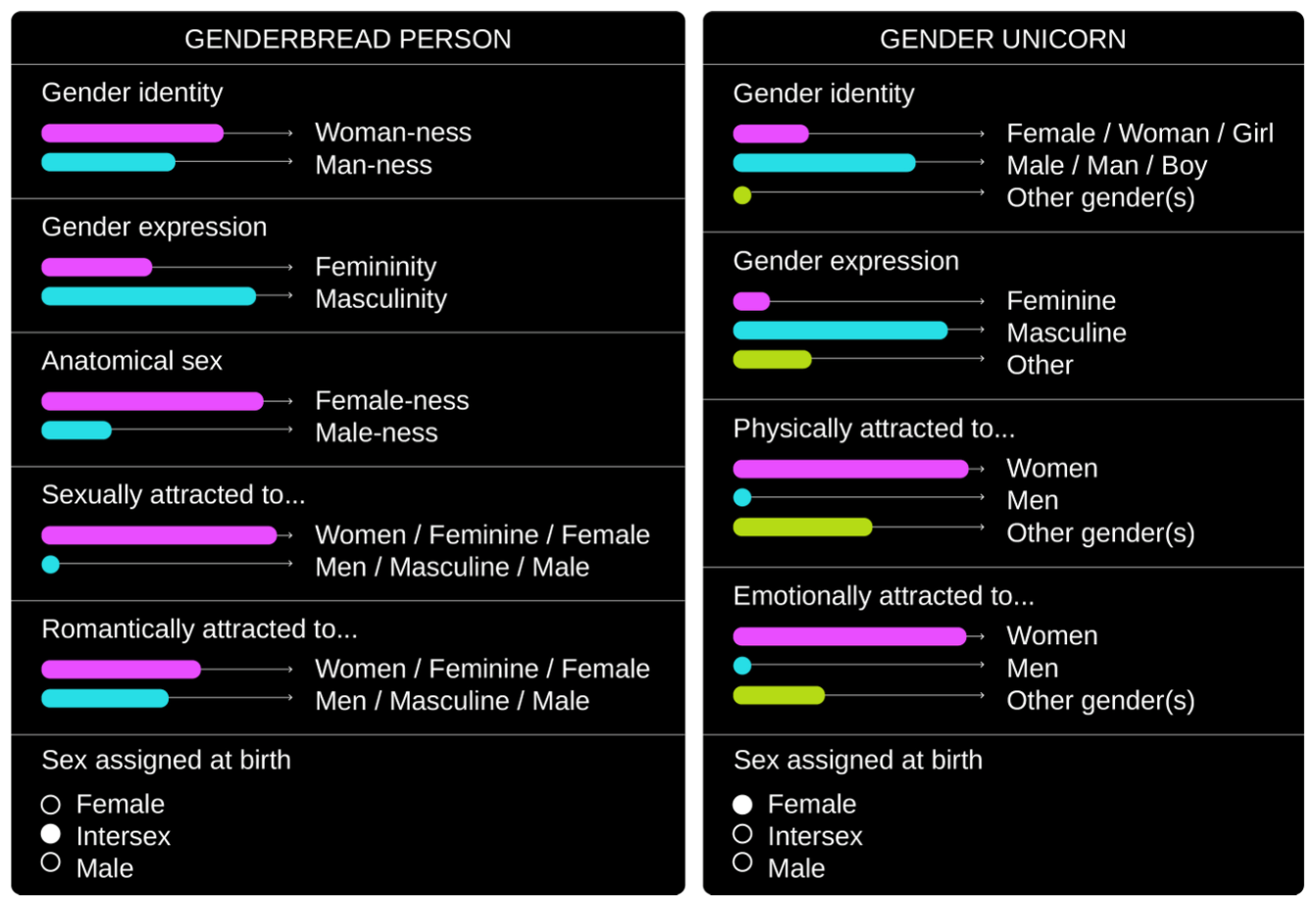
Schematisation of the Genderbread Person and the Gender Unicorn
Simeoni, Fe et al. (2024), Qerying the Qantification of the Qeer: Data-Driven Visualisations of the Gender Spectrum
Olivier: So you were not simply interviewing people about the visualisation. You were using the visualisation itself as part of the interview method.
Fe: Exactly. That was basically how I developed the gender diamond. I would start by reading some literature and developing an initial structure, then create a possible design and take it into interviews.
I would ask people: Do you agree with this? What is missing? Does this structure make sense to you? Is there something here that you think is problematic? Where would you place yourself? Where would you place people you know?
The reactions were fascinating, and they were often very different. Queer people tended to criticise the model: Okay, this is missing. This doesn’t work. This part needs to be more complex. They were very comfortable interrogating the structure.
Cis men, whether heterosexual or homosexual, often reacted quite differently. Some would say something like: Oh my God, Fe, this is beautiful, but you should really conduct this interview together with a psychologist because this is traumatising me.
And I was like: Come on.
Obviously, “traumatising” is too strong a word. But what I found interesting was what created that discomfort. It was often simply seeing femininity and masculinity coexisting in ways they were not accustomed to seeing. And interestingly, I encountered that reaction particularly among men. The visualisation was destabilising something that had previously seemed natural.
Something similar happened later when I developed a diamond around linguistic identity in South Tyrol. The categories were different, but the underlying dynamic was surprisingly similar.
Something similar happened later when I developed a diamond around linguistic identity in South Tyrol. The categories were different, but the underlying dynamic was surprisingly similar.
There, you have this very strong conversation around being an Italian speaker or a German speaker, and around the privileges and forms of discrimination associated with those identities. But then you also have bilingual people, foreigners, people moving between these categories, whose lived experiences are much more complicated than the administrative classification.
And there are also horrible bureaucratic situations. Perhaps your degree is in German and, because of that, you cannot do something within the Italian part of the system, or vice versa. So what appears to be a stable category starts to become unstable once you actually listen to people.
From situated knowledge to democratic participation
Olivier: Most of that development happened through one-to-one interviews. Have you also used these visualisations collectively?
Fe:When I’m developing the tools themselves, I tend to prefer one-to-one interviews. You have more control over the conversation, you can really follow one person’s perspective, and with the transcription you can understand more clearly why somebody is reacting in a particular way.
I have also conducted workshops. I did one recently in Utrecht, for example, where I showed some of my diamonds and then asked participants to develop their own, based on their lived experience. That workshop was with information designers, so the formalisation itself was not really the difficult part. The challenge for them was often choosing the right topic.
I also did a similar workshop with a delegation of minority activists connected to the UN, and there the situation was almost reversed. Each activist already had a very deep knowledge of their own minority or political issue, so finding the subject was easy. They created their own diamonds and mapped forms of discrimination onto them. The difficulty was more in translating that knowledge into a formal visual system.
In both cases, though, people were still working mainly on their own. And I think that matters, because if you want people to develop one of these structures collectively, they need enough shared knowledge around the same issue. They probably also need a certain degree of common ground and trust.
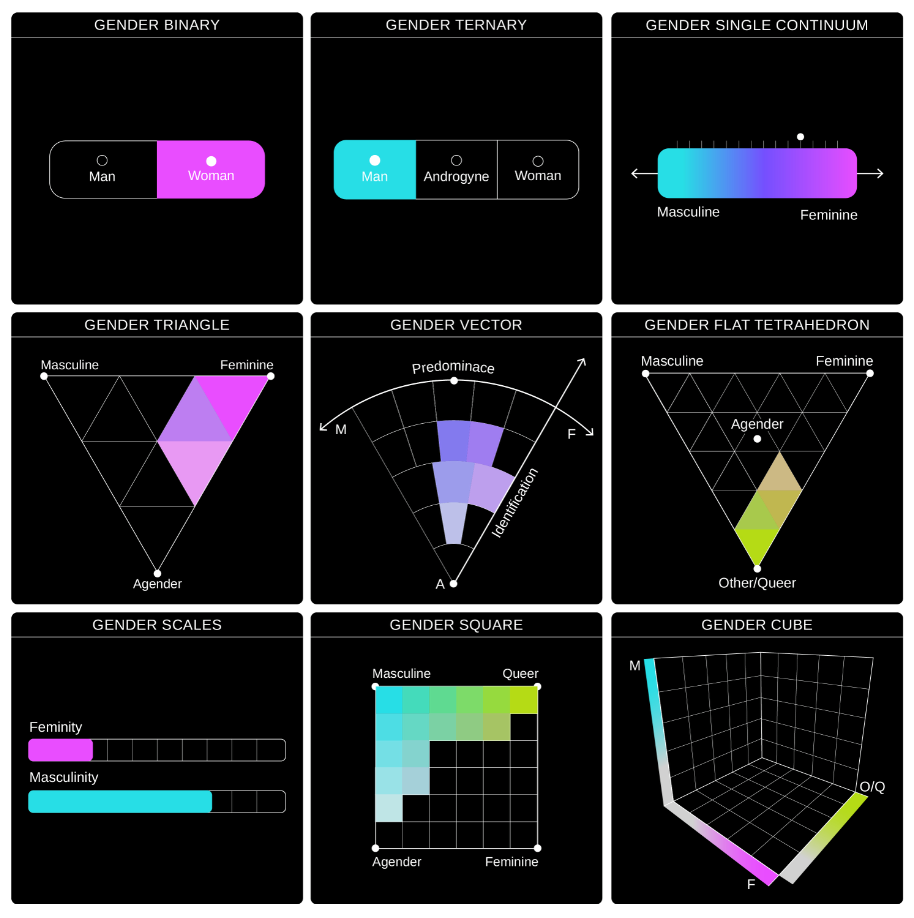
Visualisations of the gender spectrum
Simeoni, Fe et al. (2024), Qerying the Qantification of the Qeer: Data-Driven Visualisations of the Gender Spectrum
Olivier: That brings me to deliberation. I’m interested in what non-standard data visualisation could do inside citizen assemblies or other democratic spaces. Could a model like the diamond become part of a collective deliberative process?
Fe: I think you have to distinguish between collectively using a diamond and collectively creating the entire system from scratch. Creating one of these systems takes a lot of time.
Finding the right labels, understanding how the concepts relate, deciding where something belongs. These things can take years. So if you put twenty people in a workshop and say, Okay, let’s collectively build an ontology in an afternoon, I’m not sure that would work.
The process would probably become too chaotic. But using a visual structure that has already been developed through a participatory process could be very interesting.
Olivier: Citizen assemblies usually rely on sortition and try to create some kind of representative microcosm of the population. But representation there is already complicated. People without papers may not appear in the sampling frame. Migration, identity and other dimensions of difference are often treated weakly.
Assemblies also tend to work on subjects that can supposedly be discussed by everyone: climate, mobility, urban policy. But imagine an assembly around something more difficult: sexual harassment, identity, youth mental health in relation to AI. In those cases, perhaps you first work with the people most affected, develop situated visualisations from their experiences, and then bring those structures into a wider assembly.
Fe: Yes, that makes much more sense to me. I would not ask the assembly to create the diamond collectively. Instead, you could have a diamond that has already been designed—perhaps through interviews, workshops or other participatory methods—and then bring it into the assembly.
People could use it to discuss possible forms of discrimination, placing information biases, experiences or problems onto the diamond. The model would already be there, but the meaning emerging around it would remain open.
And especially when you start talking about something like European democracy, complexity is there from the beginning. The point of the diamond is partly to acknowledge the coexistence of opposites, but also to make space for people who simply do not relate to the dominant majority groups that hold the power.
You need some kind of framework that allows those nuances to exist.
Queering categories
Olivier: This connects directly to intersectionality. We often say that deliberative processes should be intersectional, but once you reach data collection or actual institutional design, it becomes much more difficult.
Fe: This is one of the arguments behind my PhD. Intersectionality made an extremely important intervention by showing that you cannot understand power through a single dimension of identity. You need to consider gender, race, religion, disability and other dimensions together, because power operates through their combination.
The difficulty is that intersectionality does not necessarily tell us how to operationalise each of those dimensions. You can create a dataset where gender is reduced to “woman/man”, race to “Black/white”, disability to “able/disabled”, combine those categories and call the result intersectional. Technically, you are crossing multiple dimensions, but each individual dimension remains completely binary. So the problem has not really disappeared.
My argument is that each realm needs its own situated and contextually relevant operationalisation. Sometimes that might take the form of a diamond, but I don’t think the diamond is universally applicable.
My argument is that each realm needs its own situated and contextually relevant operationalisation. Sometimes that might take the form of a diamond, but I don’t think the diamond is universally applicable.
For biological sex, for example, could I really build exactly the same two-axis structure? I don’t know. I’m not a medical doctor, and I don’t know enough about intersexuality to claim that.
So the point is not to impose one universal visual model onto every aspect of identity. The model itself has to remain situated.
Olivier: And there is another paradox. Many digital participation platforms deliberately use high levels of anonymisation, which is important for privacy. But that also means you cannot gather very meaningful intersectional information. So to understand inequality you need data, but gathering the data can itself produce vulnerability.
Fe: Exactly. This problem becomes even more serious once you move into AI.
Because there is always this tension between being visible enough to be represented and being visible enough to be targeted.
Olivier: Before going into AI, I want to stay with queer visual culture for a moment. Your work suggests that identity is never simply represented. It is designed, negotiated and performed. What could democratic participation learn from queer approaches to representation?
Fe: My relationship with the idea of queer knowledge is quite complicated. Queerness often means taking a system of meanings and escaping it, subverting it, destroying it or destabilising it in some way. My diamonds do that: they take an older system—the binary—and subvert it.
But at the same time, they create another system. They introduce another simplification and establish other categories. So I sometimes describe my work as simultaneously queer and anti-queer, and I think I have to accept that contradiction as a researcher.
In the end, I am still drawing boundaries. I am still deciding that there are certain positions and certain relationships. But I don’t think that is automatically negative.
If we look at social identity theory, social groups are partly defined through stereotypes. Social categories are built through semantic associations, and we continuously perform those associations through social roles, aesthetics and behaviour. Whenever we provide a label for a group, we activate a series of stereotypical associations.
But the label also provides visibility, and visibility can produce political power.
So for me, the important question is not simply: Are categories good or bad? It is: Who is using the category? For what purpose? With what intention?
Olivier: So even a queer visualisation can become a device of control.
Fe: Absolutely. Radical queer people sometimes criticise my work because they see a system and immediately reject the idea of the system. And I understand that criticism.
If someone said tomorrow that we should put my gender diamond into passports, I would be terrified. I would not want that at all. So when we use this queer or anti-queer visualisation, the question has to be: for what?
If we use it to expose gender biases in artificial intelligence, I think that can be very valuable. If someone uses it to say, Great, now we have nine consumer identities and we can create a fashion collection for each of them and make more money, then perhaps that is very different.
If it is used to research bullying in schools, perhaps it becomes interesting again. The politics depends entirely on the context in which the visualisation is used.
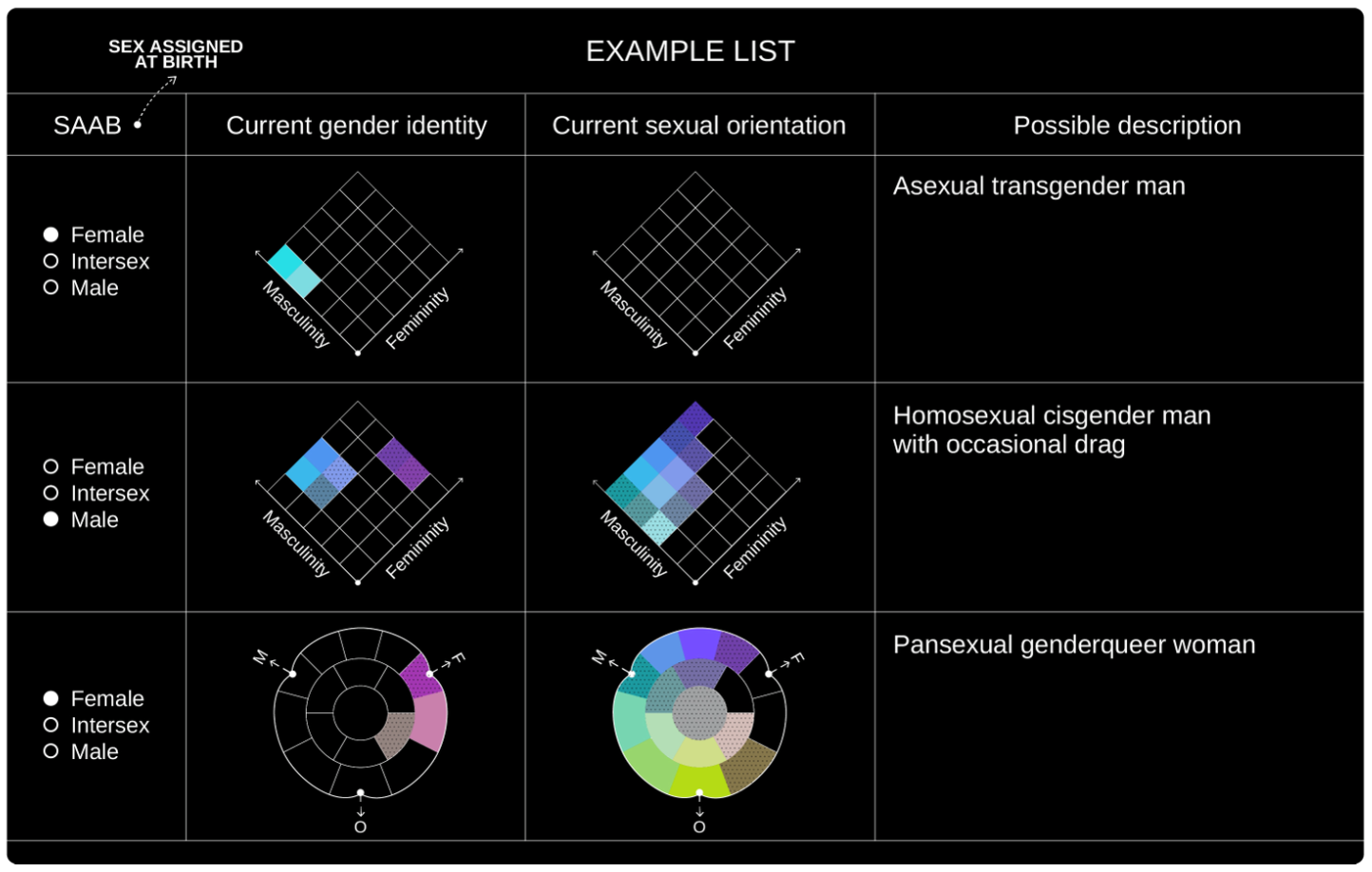
Example list of sex/gender identities
Simeoni, Fe et al. (2024), Qerying the Qantification of the Qeer: Data-Driven Visualisations of the Gender Spectrum
Mapping the spaces between positions
Olivier: One thing I find particularly interesting is that your model moves away from two opposing camps.
Fe: Yes. If you only have two options, the boundary between them becomes incredibly strong. Look at US elections: you basically have two dominant parties, and the tension between those two sides becomes extreme. When a structure only allows two positions, the border itself starts to become the most important thing.
But if instead you have a semantic plane with nine positions, or twenty-five, depending on the issue, you can develop a much more relaxed relationship with the categories. Maybe today I am here, tomorrow I am slightly over there. Whatever. You do not have to attach yourself so seriously to a single position.
You can even mock the categories a little, because you understand that those nine points are not naturally existing truths. I chose nine partly for pragmatic reasons. They are simply positions inside an open space.
And I think that changes the possibilities for interaction. If democratic debate gives you only two categories, it creates an ideal structure for antagonistic conflict: there are two sides and they have to fight.
If you have a semantic plane of mixed possibilities, you might create more room for collaboration and for temporary communities.
Olivier: So rather than consensus, you could have positive tensions. The diamond becomes a sort of prism through which you can look at somebody else’s position.
Fe: Yes. And I think this becomes particularly important in the current conversation around gender.
Queer discourse, especially some of the more radical versions of it, can become completely disconnected from the mainstream conversation, including from the very problematic far-right conversation around gender.
The idea behind my gender diamond, but also the South Tyrolean diamond, is partly to say: Hey, we actually live together in the same space.
Femininity and masculinity can also be brought back into queer thinking rather than treated only as concepts that queerness must destroy.
We can be on opposite sides of the map and still have something in between. There may still be room for conversation. One of the messages in a paper I’ve been working on is that the diamond might create some dialogue between queer positions and more traditional Christian, Islamic or other understandings of gender.
Not because the political differences disappear. They do not. But because femininity and masculinity can also be brought back into queer thinking rather than treated only as concepts that queerness must destroy.
Olivier: What changes when the people who are normally represented by others become the authors of the representation themselves? What do people learn when they actually construct or work through these maps?
Fe: I think there are two quite different experiences. On one side, you have people with what we could call more unitary identities, binary identities, for example. On the other, you have people who already experience their identity as complex.
For people in that second group, the process can produce a feeling of finally finding a place. If you have spent years, perhaps your entire life, feeling excluded or misunderstood, suddenly seeing a position where you can locate yourself can be extremely powerful.
That was part of my own experience when I was designing the gender diamond. I was thinking: Okay, if I am non-binary, where exactly am I?
And this brings me back to cartography. When you see a map, one of the first things you often do is locate yourself. I’m from Treviso, so if I look at a map of Italy, I look for Treviso. Where am I?
People do the same thing with the diamond. And for somebody who has spent years without finding themselves inside the dominant categories, finally being able to locate themselves can create a real sense of belonging.
Olivier: You saw that with language identity too?
Fe: Very strongly. In South Tyrol, you may have somebody who is bilingual and was bullied at school because in one environment they were considered too Italian and in another too German. Or someone from South Tyrol goes to Rome and suddenly experiences being treated as not Italian enough.
Those situations can resonate surprisingly strongly with non-binary experiences. You are continuously told that you are not fully one thing and not fully the other.
Then suddenly you see a map where that in-between position exists. That does not solve the political or social problem, of course. But it produces a sense of place. It tells you that your experience has meaning within the map.
Olivier: And what happens to people whose identity already corresponds quite comfortably to the dominant categories?
Fe: For them, the effect can be almost the opposite. Instead of producing a sense of belonging, the visualisation can be destabilising. They suddenly realise that reality is much more complex than they had assumed, and I think that can become a moment of learning.
But it is not necessarily a comfortable moment. Sometimes there is guilt. You may realise that perhaps you discriminated against people simply because your own understanding of reality was binary, and you assumed that everyone else experienced the world in the same way.
Sometimes there is also rejection. I have had exhibitions where people interfered with the work, almost vandalised it, although sometimes in more subtle ways. So perhaps I have some enemies. But maybe that also means the message is strong enough to provoke something.
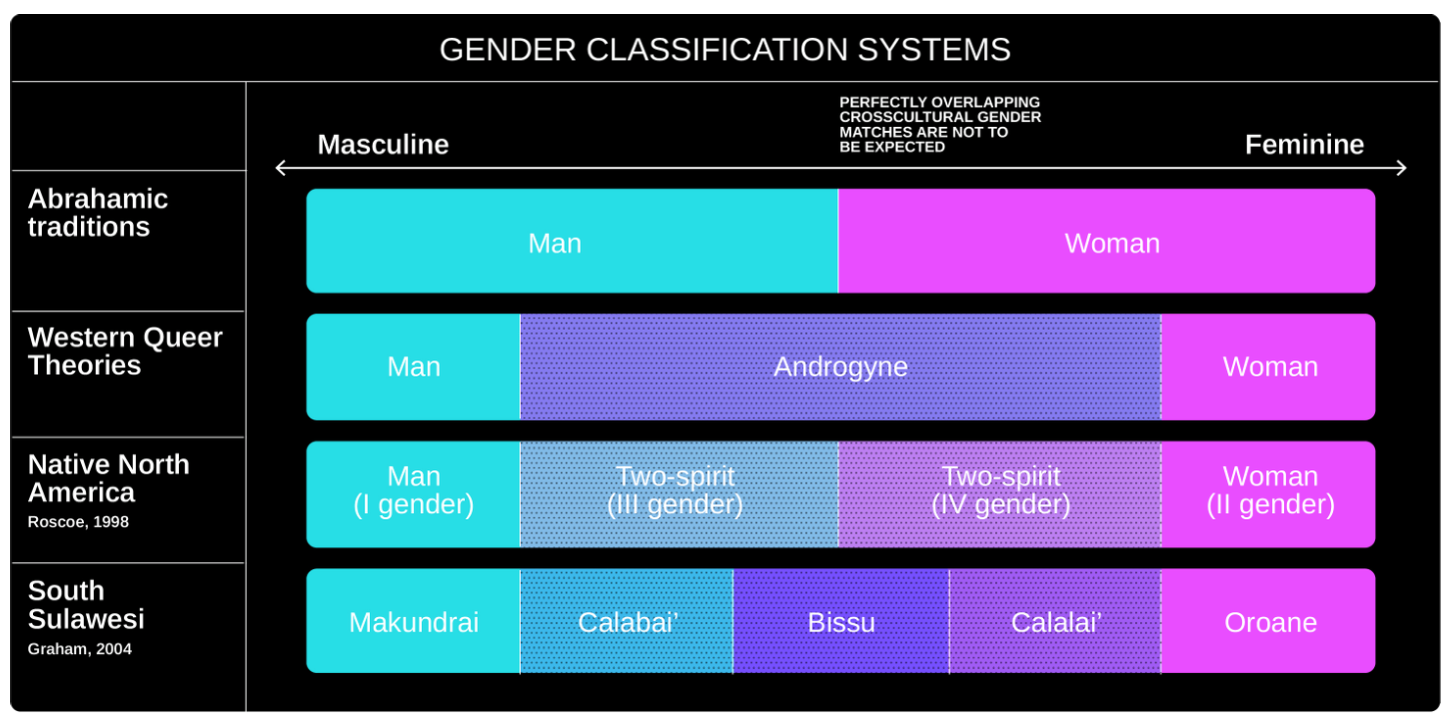
Visualisation of four gender spectra from diferent cultures
Simeoni, Fe et al. (2024), Qerying the Qantification of the Qeer: Data-Driven Visualisations of the Gender Spectrum
Olivier: And not every kind of hybridity seems to generate the same resistance.
Fe: Exactly. The mixing of linguistic identities is relatively easy for many people to accept. You can say somebody is bilingual and people generally understand that.
But when you talk about mixing or destabilising gender categories, especially when gender is intertwined with religious traditions, the reaction can be much more negative. You can encounter a very strong refusal even to understand the proposition.
And of course, I don’t always encounter those responses directly because I also live in my own bubble. If I present the work publicly, somebody who completely rejects it may not come to me and explain their position.
But I have also had the opposite experience many times. People come to me after seeing the diamond and say: Oh my God, my son is going through something like this. I need to show this to him. So the visualisation can also become a bridge.
AI, visibility and the right not to be classified
Olivier: Let’s move into AI. Most AI systems classify people before they understand them. You have worked on bias and identity classification. What would a queer AI do differently? Would it refuse classification?
Fe: I think the answer has to be context-based. There are situations where I might want an AI system to understand something about my identity, and others where I absolutely do not want that.
Maybe I want Netflix to understand some of my preferences because I want better recommendations. Fine. But if Saudi Arabia implements a facial-recognition system based on gender, I probably do not want that system to understand my identity at all.
When an identity is included, recognised and validated, that can be empowering. But the same information can later be used against the community it was supposed to empower.
This is what I describe as the paradox of exposure. When an identity is included, recognised and validated, that can be empowering. But the same information can later be used against the community it was supposed to empower. Visibility is never automatically good.
Olivier: Invisibility itself can therefore become a form of power.
Fe: Sometimes invisibility is power, and sometimes it is a weakness. It depends on where the source of power is, what its intentions are, and how those intentions relate to the values and interests of the minoritised community.
That is why I don’t think there can be one single answer. There is not one AI, but an ecology of AI systems, and each of those systems creates a different relationship with visibility, classification and power.
Olivier: Are grassroots or community-controlled AI systems potentially safer?
Fe: They can be interesting, but I would still be cautious. Here in Turin there is a group working around grassroots AI models, and I think that is a very interesting initiative.
But even with micro-projects, you immediately have to ask: who is actually involved? Who controls the infrastructure? How is the information going to be used? Where will companies enter later? Where does profit enter?
A project does not automatically become safe because it is small or because it calls itself grassroots, the political questions remain.
Olivier: There is a very difficult dilemma here. LGBTQ+, racialised and trans communities are frequently underrepresented in training datasets. So one response is: collect more diverse data. But more data can also mean more surveillance and exposure. If you had to choose between collecting more data to improve representation, only collecting data under community control, or collecting less data even if the model becomes less accurate, how would you approach it?
Fe: This is almost exactly the problem I’m dealing with in a paper I’m revising. There is a very interesting feminist approach to bias that describes a tension between accuracy and discrimination.
Accuracy, in this context, is about how much the model reflects reality, even when that reality is imperfect or unfair. Discrimination, on the other hand, is about whether the model produces outcomes that are problematic for minoritised communities. Depending on which one you prioritise, you can arrive at completely different answers.
Imagine that we prioritise non-discrimination. Perhaps the objective is not to teach the AI the most statistically accurate gender stereotypes. Perhaps the objective is to communicate that gender is socially constructed and should not determine certain outcomes.
In that case, I might actually want the AI to give me random answers in relation to gender. If gender should be irrelevant to the question, randomness might be more ethical than accuracy. The system would effectively be saying: This category should not determine the answer. That was actually one of the results that emerged from my study.
Olivier: And what happens if accuracy is what you want?
Fe: Then another problem appears. Perhaps you want the system to accurately reflect the stereotypes that exist in society.
We have some broad shared cultural idea of who is perceived as a man, who is perceived as a woman, and perhaps increasingly who is perceived as non-binary. But once you move into all the shades between those positions, the social stereotype itself becomes much less stable. People do not necessarily share a precise understanding of those identities.
So what would accuracy even mean? You cannot perfectly reproduce a social stereotype that does not exist in a coherent form.
Maybe then accuracy becomes useful in a different way. Perhaps I want to see the AI’s biases because I want to understand how biased the internet is. In that case, the disturbing answer itself becomes evidence.
Olivier: So perhaps the most interesting AI would not necessarily give an answer.
Fe: Exactly. Perhaps the most interesting option is an AI that prompts critical questions, an AI that sparks discussion rather than giving you a definitive answer.
Instead of presenting itself as the machine that knows, it could make the assumptions behind the question visible. Of course, sometimes you genuinely need an answer, so again, context matters.
But I find this idea much more interesting: AI not simply as an answer machine, but as something capable of creating critical discussion.
Olivier: That connects with an experiment we are developing. We have an AI agent with three different personalities, one of which we call the Joker, borrowing the role from Legislative Theatre. The Joker is essentially a facilitator who avoids simply answering. It may force people to reformulate a prompt, introduce humour, create silence or destabilise the assumptions behind the question. I can imagine something similar with your diamonds: put one physically on the floor, remove the devices, and ask people to move through it. Perhaps people who appear to be on opposite sides discover an intermediate space where dialogue becomes possible.
We are exploring these setups especially around youth mental health, and also thinking about the right not to speak, not to appear physically or even temporarily to disappear from the process. The difficulty is that AI models continuously try to become agreeable. Even when you design the agent to behave as a Joker, it suddenly starts flattering the participants or retreating into safe generic answers. Have you experimented with anything similar?
Fe: Unfortunately, not really. I’m already overwhelmed by the projects I’m working on. But conceptually I think there is a strong connection. Especially the idea that the system does not need to resolve the problem. It can instead help people remain with the complexity of the problem.
__
This interview is part of a series contributing to a paper by Szilvia Nagy and Olivier Schulbaum exploring visualisation and spatialisation as practices of co-design, participation and democratic decision-making. The paper is currently being developed for the CoDesign Special Issue, Designing Democratic Innovation: Co-design and the Futures of Participation in Governance.