
Marginalised communities don’t wake up thinking about decentralised identity. A hotel cleaner finishing thirty rooms in a day doesn’t wonder whether her credentials are self-sovereign. A migrant street vendor running from the police isn’t thinking about federation protocols. A woman deciding whether to share her testimony of gender-based violence isn’t asking for a new blockchain. They wake up asking different questions.
- Will I be heard?
- Will I be safe?
- Will I keep my home?
- Will our movement survive?
A manifesto on decentralized governance, written after DWeb Camp
Let’s kill a myth that keeps getting resurrected at every crypto conference, every DAO Discord, every whitepaper promising to finally get politics out of politics: code is law.
It sounds hard. Inevitable. Clean. Deploy the smart contract, walk away, let the protocol enforce itself while humans go back to bed. No committees. No politics. No mess. It’s the governance equivalent of a Roomba: buy it once, never think about the floor again. Except the floor is a treasury, and the Roomba occasionally votes itself a raise.
It’s also a trap, and DWeb Camp is exactly the place to say so out loud. I spent my two sessions there watching people discover, in real time, that governance refuses to stay automated, no matter how earnestly the pitch deck insists otherwise.
What “Reaching Home Base” Actually Feels Like
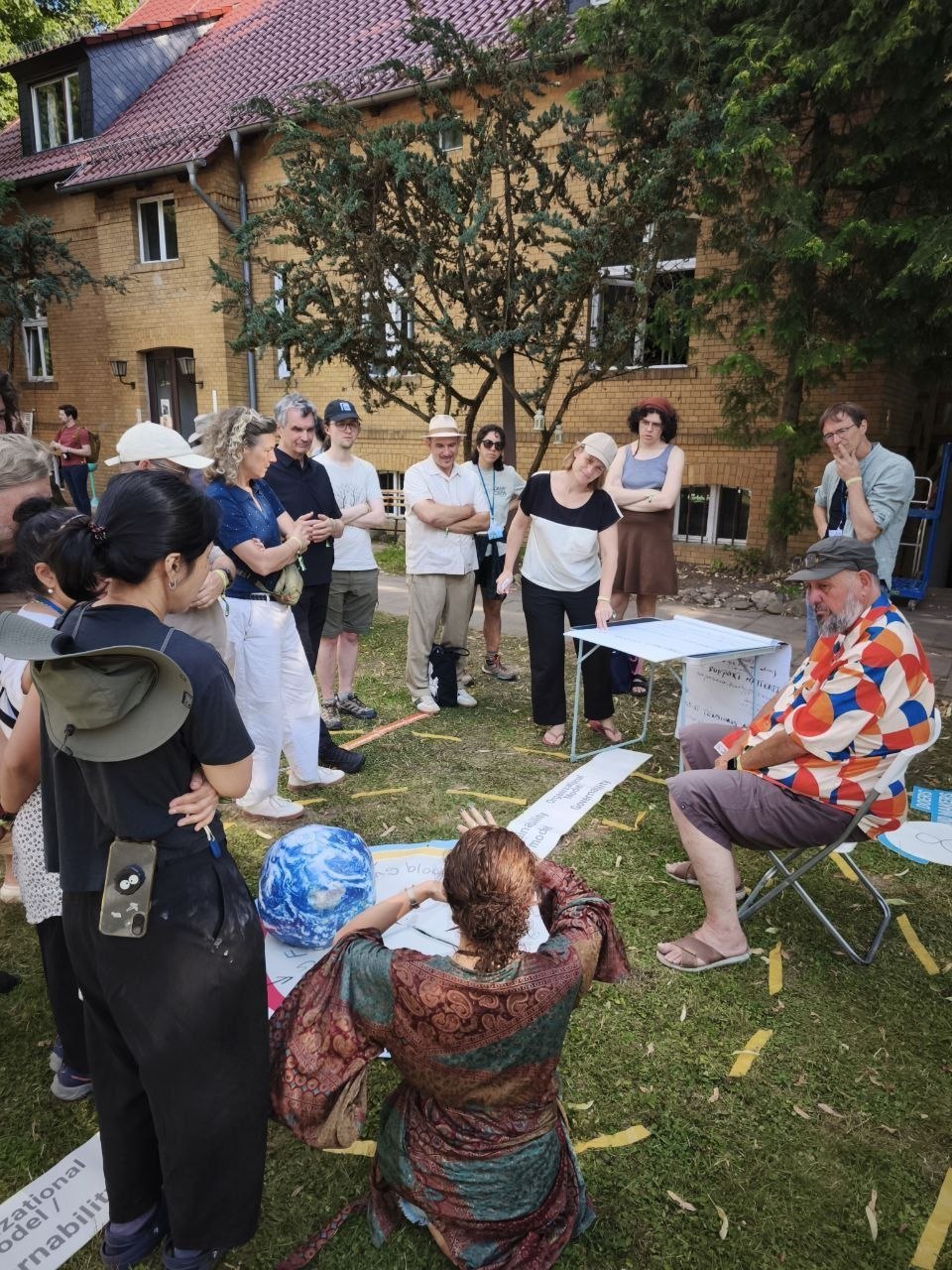
My first session was a workshop with the Democratic Tech Fund on governing democratic technologies. We didn’t open with governance models or org charts. Mercifully, because nothing kills a room faster than a slide titled “Stakeholder Matrix.” We dropped people straight into a role-playing game instead: Running the Bases of Democratic Tech.
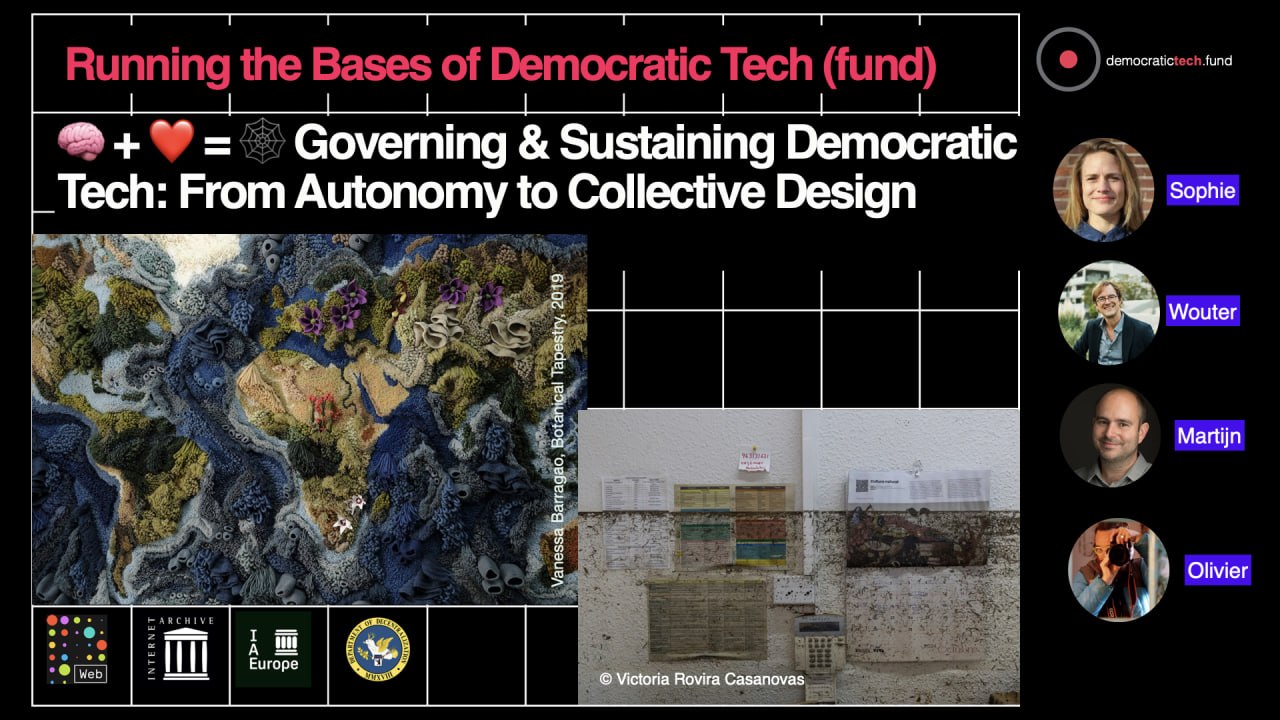
Everyone became part of a living ecosystem: communities, maintainers, developers, funders, institutions, stewards. As they moved from base to base, crises hit without warning: burnout, a grant that vanished, an opaque institution stonewalling, a community whose needs shifted overnight, contributors who stopped speaking to each other. Nobody “won” by reaching home. If anything, the people who reached home fastest were usually the ones who’d just abandoned someone at second base. The point was to feel, in your body, that sustaining democratic infrastructure isn’t a technical optimization problem. It’s a continuous negotiation of care, legitimacy, responsibility, ownership, and trust, and also, occasionally, of who forgot to pass the funding memo.
Governance stopped looking like a diagram. It started to feel like choreography: the kind you have to keep dancing, not the kind you can freeze into a chart, laminate, and hang in a Notion doc no one opens again.
Governance stopped looking like a diagram. It started to feel like choreography: the kind you have to keep dancing, not the kind you can freeze into a chart, laminate, and hang in a Notion doc no one opens again.
That’s the whole argument. Everything else is just evidence.
cc-by-sa Platoniq
The Fantasy of the Self-Running Commons
Here’s the seduction “code is law” sells: if we can just encode the rules tightly enough (voting weights, quorum thresholds, a treasury multisig, a token curve), governance becomes infrastructure you build once and scale forever, like a CDN. No boring Tuesday-night calls about moderation policy. Just execution. Set it, forget it, tweet about decentralization from a beach.
It’s flattering to engineers and irresistible to funders. Automate the governance, ship the deck, move to the next raise. Somewhere a term sheet is being signed on the strength of the phrase “no humans in the loop,” which is a strange thing to promise a room full of humans holding the token.
But go stand in any DAO that’s lived past its first treasury drain, and you’ll find the opposite of automation. Humans arguing about what the code was supposed to mean, at 2am, in a Discord channel with forty unread messages and at least one person typing in all caps. A “benevolent” multisig quietly overriding a trustless outcome because the trustless outcome was a plutocratic disaster. Benevolent, it turns out, is a word that in crypto governance mostly means “the five people we still trust with the keys.” Forks born not from bugs but from irreconcilable values no Solidity function had a variable for.
Code doesn’t resolve disagreement. It moves the disagreement somewhere less visible: into who wrote the contract, who holds the admin keys, who gets to call an outcome a “bug” versus a “feature” depending on who it favors. Convenient, that the bug always seems to favor whoever’s holding the keys.
That’s not law. That’s politics wearing a hoodie and calling itself trustless.
Goteo Taught Us This Before Any DAO Did
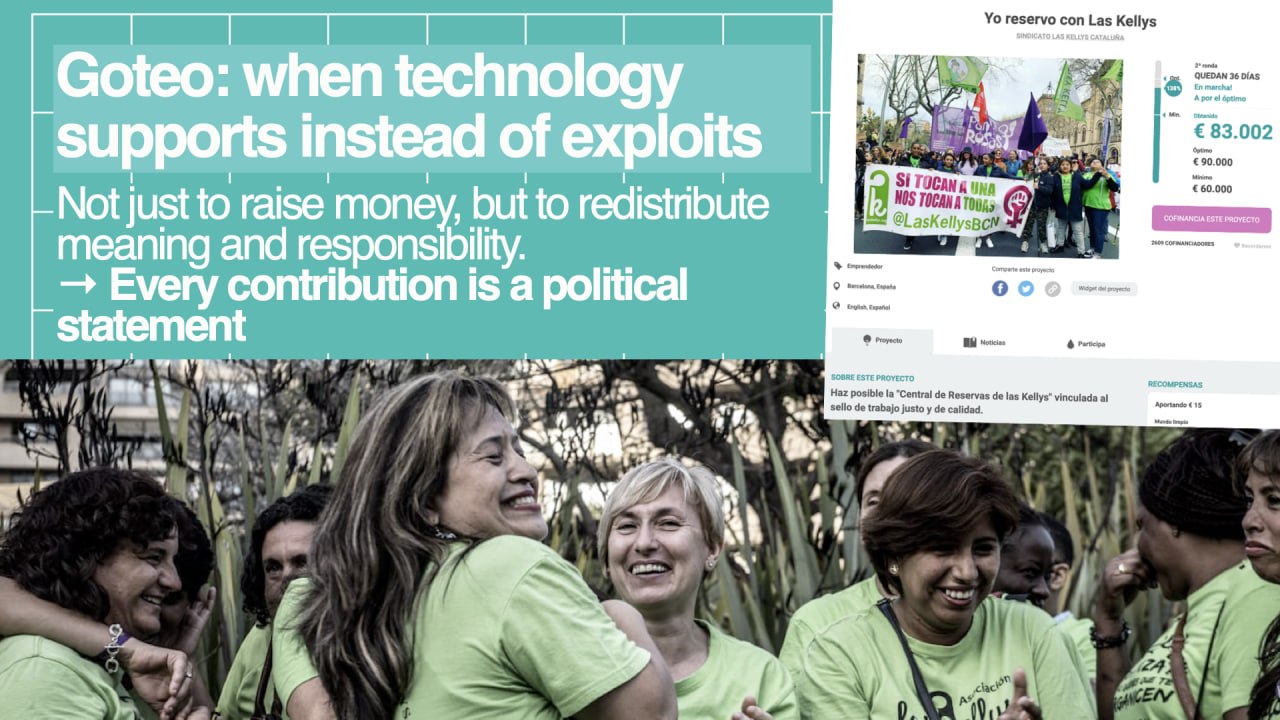
At Platoniq, we’ve watched this play out with money, not just governance theater, and we got there years before anyone had minted a governance token to argue about. A civic crowdfunding campaign on Goteo looks, from the outside, like the same automation fantasy: post a goal, set a deadline, let the platform disburse funds when the threshold clears. Code is law, deployed as a progress bar.
But the campaigns that actually mattered never worked that way, and the progress bar was the least interesting part of the story.
The Popular Union of Street Vendors didn’t just run a crowdfunding campaign. They used it as a lever to build an organization: they launched their own ethical fashion brand, created employment, rewrote the public narrative around migrant street vending, and helped generate the momentum behind one of Spain’s largest regularization processes for undocumented migrants. The campaign closed. The organizing didn’t. Nobody automated that. It took years of people showing up to argue, strategize, and negotiate with institutions that had no reason to listen to them otherwise, and absolutely no smart contract was going to negotiate a residency permit on anyone’s behalf.
La Nuestra tells the same lesson from a different angle: memory as infrastructure. Between 2015 and 2025, feminist movements like #MeToo, #Cuéntalo, and #NiUnaMenos built one of the largest testimonial archives against gender-based violence ever assembled, but it lived on corporate platforms with zero accountability to the movement, which is a polite way of saying it lived at the mercy of whichever algorithm update decided testimonies of survivors were bad for engagement. It started disappearing. A first Goteo campaign rescued millions of data points from the earliest days of #Cuéntalo before they vanished for good. A second campaign is now raising more than three hundred thousand euros to build a 100% women-led technical infrastructure around that archive, plus a Feminist Tech Academy so other movements can learn to steward their own data and collective memory instead of renting it back from a platform that never asked permission to host it in the first place.
The money moving through a platform means nothing without an organization willing to keep governing what that money is for, long after the campaign page stops updating and the confetti gif has stopped rendering.
Neither of these was “just” a crowdfunding campaign. Both were exercises in democratic institution-building: proof that the money moving through a platform means nothing without an organization willing to keep governing what that money is for, long after the campaign page stops updating and the confetti gif has stopped rendering.
That’s the same lesson the Democratic Tech Fund workshop taught with a game board instead of a treasury: the infrastructure isn’t the tool. It’s the maintenance. It always was. The tool just gets the keynote slot.
What Digital Commons Actually Require
A commons, a real one, the kind Elinor Ostrom spent a career documenting instead of speculating about from a hackathon stage, isn’t sustained by a rulebook. It’s sustained by institutions that keep adapting the rulebook, in public, with people who have standing to contest it. Fisheries don’t self-regulate because the quota is written down. They self-regulate because there are monitors, sanctions, appeals processes, and forums where the community renegotiates the rules when conditions change. Remove the maintenance and the smartest quota system in the world collapses into a tragedy anyway: an expensively engineered tragedy, but a tragedy nonetheless.
Digital commons are no different, except “just automate it” is a much better fundraising pitch than “you will need to keep paying people to argue in public forever,” and nobody has ever closed a seed round on the slogan “sustainable long-term human maintenance costs.”
Scale without maintenance isn’t governance. It’s abandonment with better uptime.
cc-by-sa Platoniq
Metagov Is Building the Counter-Architecture
This isn’t only a Platoniq argument or a workshop exercise. It’s showing up in working code, too. The Metagovernance Project has spent years building tools that treat governance as infrastructure needing maintainers, not deployers, and it’s worth being specific, because specificity is what “trustless” rhetoric conveniently avoids in favor of a nice clean diagram with arrows.
D20 Governance takes the least sacred format imaginable, a Discord bot, a tabletop-style “quest,” and uses it to force communities to feel modular decision-making before they encode it. Groups embark on quests deciding their name, purpose, and way of speaking, using “culture modules” that scramble the default admin-user hierarchy Metagov researchers call “implicit feudalism,” a term that should honestly be printed on a T-shirt and worn to every “flat hierarchy” startup all-hands. It’s the same instinct as Running the Bases: rehearse the governance before you calcify it into code, ideally with dice involved.
PolicyKit is the rebuttal to “the code just executes the rules.” It replaces blunt admin/user hierarchies with policies communities author themselves: majority votes, ranked-choice procedures, designated boards, even a deliberately chosen “benevolent dictator” option, which is refreshingly honest compared to the DAOs that install one by accident and call it decentralization. Inspired by Ostrom’s polycentric governance work, PolicyKit treats governance as something written, contested, and rewritten in short scripts, not something that gets to stop being a political object the moment it’s deployed and everyone goes back to arguing about gas fees instead.
The Metagov Gateway is the unglamorous plumbing that makes any of this portable: an open API layer connecting decision-making tools (voting systems, juries, reputation scores, treasuries) to the platforms where communities actually live. It exists because interoperability, not lock-in to one chain or one contract standard, is what lets a commons survive a platform’s death, and platforms die a lot more often than manifestos would like to admit.
CollectiveVoice, built on PolicyKit and routed through the Gateway, tackles the part every DAO pitch pretends is already solved: money. It lets Open Collective communities attach real governance processes (juries, term limits, deliberative assemblies, rotating consensus) to financial decisions that would otherwise sit behind a single admin’s login, which is a lovely way of saying “one person’s laptop.” Automated transparency, yes. Automated accountability, yes. But not automated decision-making. The disbursement isn’t determined by a bonding curve; it’s the output of a process a community chose and can revise. That’s the entire argument, in one plugin nobody’s put on a hype video yet.
None of these tools remove humans from the loop. They promise the opposite: better loops, with visible seams, that communities can reach in and repair, the same principle Goteo campaigns prove with money and the Democratic Tech Fund workshop proves with a game board. Somewhere, a venture capitalist is reading this sentence and quietly closing the tab.
Seth Frey Already Ran the Numbers on All of This
If the Metagov section reads like an argument, that’s partly because it is one. The person running Metagov’s research shop has spent years testing it against actual data. Seth Frey is a professor of Communication at UC Davis, an affiliate of the Ostrom Workshop at Indiana University, and Metagov’s own Research Director, which means his day job is comparing thousands of Reddit forums, Minecraft servers, and DAOs the way a biologist compares species, looking for what actually keeps a self-governing population alive. His DWeb talk opened with the question everyone in the room was too polite to ask out loud: AI is in a revolution, democracy is in crisis, is that a match made in heaven, or two strangers stuck next to each other on a train?
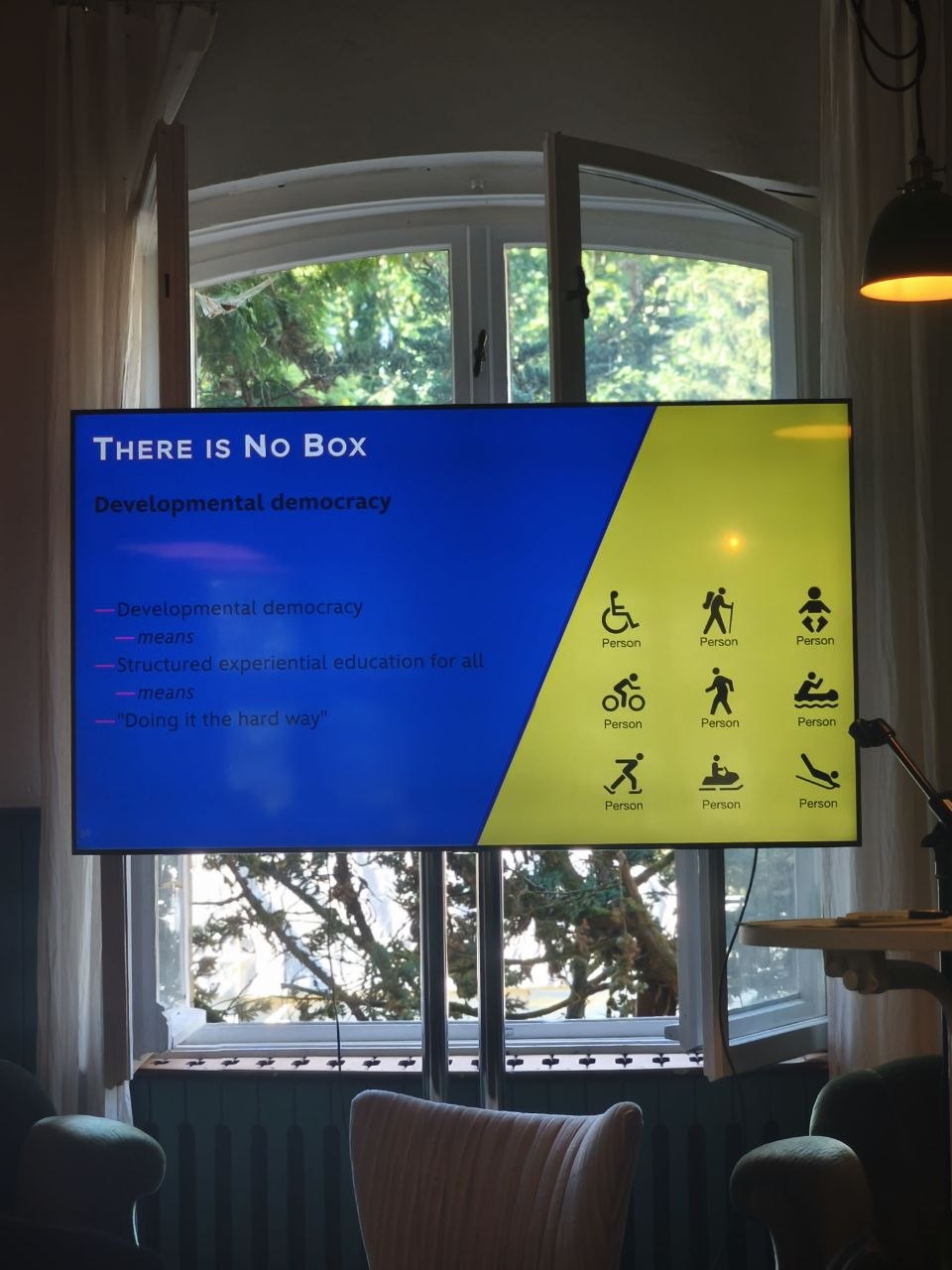
Seth Frey presentation
Dweb Camp 2026
His answer, delivered slide by slide, was basically this whole “code is not law” argument with better data behind it.
Frey’s central move is to treat self-governance as a literacy, not a feature. We forget, he argued, how radical universal reading once was: that everyone could do it, that it eventually felt so natural nobody remembers being trained for it. He put up a 1950s pamphlet, “A Short Course in Parliamentary Procedure,” published by the education department of the International Ladies’ Garment Workers’ Union, as proof that unions used to teach ordinary people how to run a meeting the same way schools teach reading: deliberately, repeatedly, as a basic skill everyone was expected to acquire. His question for the DWeb crowd was pointed: what if governing is already as easy as writing a letter to a friend, for the small number of people who were ever actually taught how?
Democracy isn't a structure you get squeezed into, it's a social capacity for easy association, something you build, like a muscle, not something you're issued, like a badge.
That reframes “democracy as a box for putting people in” as exactly the wrong metaphor. Frey’s alternative: democracy isn’t a structure you get squeezed into, it’s a social capacity for easy association, something you build, like a muscle, not something you’re issued, like a badge. Which is why his “developmental democracy” isn’t a formal system at all. It’s structured experiential education for everyone, accessible by design, and it is, in his own words, “doing it the hard way” on purpose. No box, no exceptions.
cc-by-sa Platoniq
His most useful borrowed framework here is the Inner Development Goals (Being, Thinking, Relating, Collaborating, Acting), a set of standards for developing people at scale that originated in sustainability leadership circles and that Frey is recruiting for governance training instead. It’s a very on-brand move for a researcher whose broader public position is that DAOs don’t fail from bad tech, they fail from a lack of community managers, and decentralization without culture is just chaos with better uptime, a line that could be stitched directly into this manifesto’s thesis and nobody would notice the seam.
Then he did the thing that should embarrass every tokenomics deck in the building: he put the takeaway on a single slide, in brackets, like a regression result. Protocols, structure, systems, rules on one side. Skills, culture, legitimacy, experience, intentionality on the other. His conclusion: structure has a very small effect on its own. You can write the most elegant governance contract in the world, and it will do almost nothing without the second list, which is, not coincidentally, the list nobody has ever figured out how to put on a bonding curve.
He closed with a warning that lands harder now than it would have two years ago: AI is very good at the summative side of work (the notes you end up with) and much less reliable, so far, at replacing the formative side (the way doing the work changes you). Notetaking to have notes is not notetaking as thinking. A community that lets AI handle its governance “notes” without doing the underlying formative labor of actually governing together isn’t automating maintenance. It’s skipping the one part of the process that was ever going to produce a self-governing community in the first place.
Which is, again, the entire argument of this manifesto, now with a regression-style slide to back it up: the plumbing can be automated. The politics (the skills, the culture, the legitimacy, the intentionality) has to be practiced, like reading, by people who show up.
Frey wasn’t finished, either. Commenting on a recap of the talk by Martijn de Waal, he sharpened the thesis with two additions that deserve to travel with it. First, the argument was never for classic civics class, the kind where you memorize how a bill becomes a law and promptly forget it. It’s experiential training in self-organization: actually building and sustaining organizations, or what he calls network nations, the kind of practice no textbook substitutes for. Second, and this is the one worth sitting with: highly trained people need very different tools than untrained ones. Windows versus Linux. Legos versus carpentry. Voting, in his own phrase, as “toddler-stage self-governance,” a line that should retire at least three “just add a voting module” roadmaps before lunch. His conclusion is a loop, not a lecture: trained people build better tools, and better tools help train more people, a co-formative relationship between communities and the systems, network nations included, they build for themselves. Skip that loop, optimize the tool without training the people who use it, and you haven’t automated governance. You’ve built a very sophisticated toddler and handed it the keys.
Ben Cerveny Already Drew the Org Chart We Said We Didn’t Need
Remember the joke a few sections back, about how nothing kills a room faster than a slide titled “Stakeholder Matrix”? Ben Cerveny would like a word. He’s president of the Foundation for Public Code, and his DWeb talk, “Making Things Public: the Public Product Organization as a Vehicle for Infrastructural Stewardship”, spent forty-five minutes making the case that the org chart is, in fact, the technology, and everyone rolling their eyes at governance diagrams has been rolling their eyes at exactly the wrong villain.
His framing is disarmingly simple: humans invent things, and for the first thirty years we call them technology and treat them as luxuries. Then, if they work, we call them infrastructure and start treating them as rights. Software, on his account, doesn’t stay software for long. It becomes policy. And policy, once it’s stable enough, gets re-encoded back into software, which becomes policy again. Round and round, forever, with no exit ramp where a smart contract gets to declare the loop finished and go home.
If software keeps turning into policy and policy keeps turning back into software, there is no version of "deploy it and walk away" that survives contact with reality.
That loop is his rebuttal to “code is law” stated more elegantly than this entire manifesto has managed: if software keeps turning into policy and policy keeps turning back into software, there is no version of “deploy it and walk away” that survives contact with reality. Somebody has to keep stewarding the seam where the two keep swapping places, and Cerveny’s answer to “who” is refreshingly unglamorous. He calls it a Public Product Organization, or PPO, a nonprofit vehicle built specifically to steward an open digital public asset, the kind of entity that becomes a hub for a constellation of public and private partners instead of a protocol that pretends it doesn’t need any.
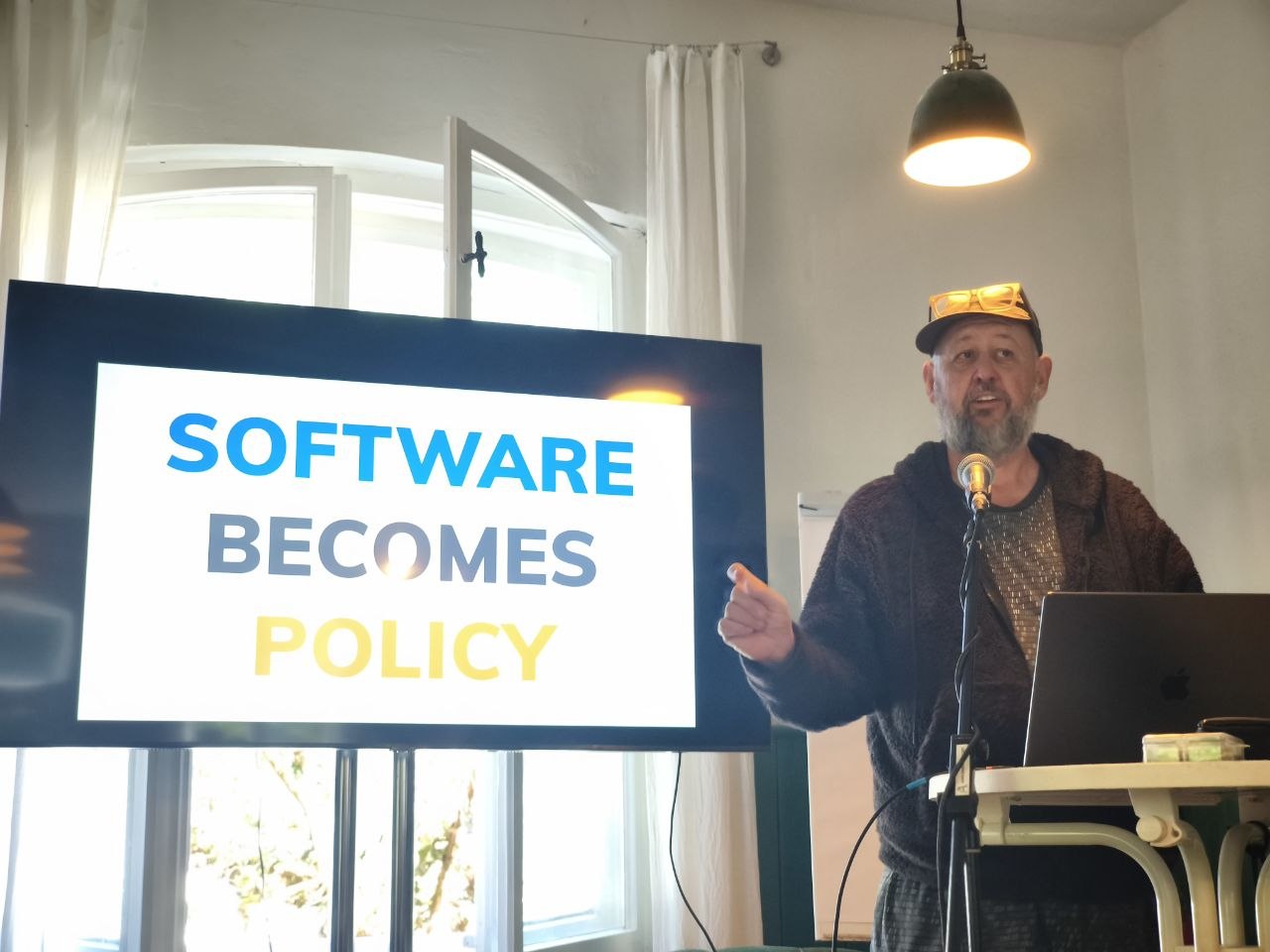
Ben Cerveny
Dweb Camp 2026
His slides drew the PPO as a hexagon, which is either the most or least exciting shape a governance diagram has ever taken, depending on your tolerance for shapes. The six sides: a governance model (a general assembly of members setting a roadmap), a financial model (membership fees plus a relationship with EU and national structural funding, because somebody has to pay the electricity bill for the commons), a community of practice (capacity building and vendor certification, i.e., teaching people how to actually use the thing), codebase stewardship (continuous integration and an open license, the part engineers actually enjoy), an organizational structure (elected directors and a core team stable enough to answer email), and awareness and communications (branding and coordination with public procurement offices, the part everyone forgets until the funding round depends on it). Notice how little of this hexagon is code. Most of it is paperwork with opinions, which is exactly the point.
And there’s a rule that should be tattooed on every “one chain to rule them all” roadmap: a PPO needs at least three implementing public administrations, plus their local dev vendors, before it counts. Not one visionary mayor. Not one captured agency. Three, minimum, so that no single institution’s political mood swing can take the whole thing down. In Cerveny’s network diagram, the PPO sits at the center of a small constellation: the European Sovereign Tech Agency on one side, OSPOs and public procurement offices on another, EDICs like the Digital Commons EDIC on a third, and Horizon and other EU funding frameworks filling out the rest. It is, structurally, the least “trustless” diagram imaginable. Every line on it is a relationship somebody has to actively maintain, which is the entire thesis of this manifesto rendered as an org chart nobody wanted to draw and everybody now needs.
Here’s the part that made me sit up in my DWeb Camp folding chair: Cerveny is describing, in EU policy language and with a fresh acronym, something Platoniq and its European neighbors have been running for a decade without waiting for anyone’s grant program to bless it.
Decidim is the textbook case, and it didn’t need Cerveny’s hexagon to draw itself one. Built originally by Barcelona City Council and rewritten in 2017 into a generic participation platform, it now runs on a nonprofit, the Decidim Association, formed in February 2019 specifically so the project wouldn’t be hostage to any single city council’s next election. It has a governance model (a general assembly of member institutions), a community of practice (the Metadecidim process, where anyone can propose a feature and the Product Team has to actually answer for it), codebase stewardship (an AGPLv3 license and a formal contribution pipeline), and, crucially, well more than the minimum three implementing public administrations: over 450 organizations across 240 cities and governments in 30 countries, originally bootstrapped by Barcelona alongside the Catalan government and Localret, a consortium of Catalan municipalities. Decidim has been a working, funded, multi-institution PPO since before the term existed. It just called itself a Social Contract instead of a hexagon.
Goteo is Platoniq’s own answer to the same question, and it predates the acronym by more than a decade. Launched in 2011, spun off into the nonprofit Goteo Foundation in 2012 specifically to steward the platform and its AGPLv3 open-source code, Goteo has spent years building the financial model (matched funding partnerships), the community of practice (the crowdvocacy work with the Popular Union of Street Vendors and the #Cuéntalo archive, described earlier in this manifesto), and the multi-institution roster Cerveny’s rule requires: Ahora Madrid, the Barcelona City Council, Fiare Banca Ética, and the University of Málaga have all run their own funding channels on the platform, alongside Goteo Foundation’s own governance and Platoniq’s founding stewardship of the codebase. Nobody at Goteo has ever called this a Public Product Organization. It has simply been one, with the receipts to prove it, since before most of the DAOs in this manifesto had a whitepaper.
So when Cerveny says the future of European digital infrastructure runs through boring nonprofit vehicles with governance models, financial models, and community stewardship instead of protocols that scale without maintenance, Decidim and Goteo aren’t hypotheticals waiting to be built. They’re the pilot program that already ran, quietly, for a decade, while everyone else was arguing about gas fees. The org chart wasn’t the enemy of decentralization. It was decentralization, filed correctly with the tax authorities.
The Provocation
So here’s the uncomfortable question for every DAO tokenomics deck and every “governance minimization” roadmap: if your system is designed so no one ever has to show up again, what you’ve built isn’t a commons. It’s an appliance. And appliances don’t hold power accountable: they fail silently until someone notices the treasury is gone and the group chat has gone very, very quiet.
Ask what happens in your system when the rules turn out to be wrong. Not hacked. Wrong. Written in good faith for conditions that no longer hold. If the honest answer is “we fork and start over,” you haven’t built governance. You’ve built a rules dispenser with extra steps, outsourcing the actual political labor to whichever faction is willing to do the ugly work of coordinating a fork while everyone else tweets about it from the sidelines.
The Actual Frontier
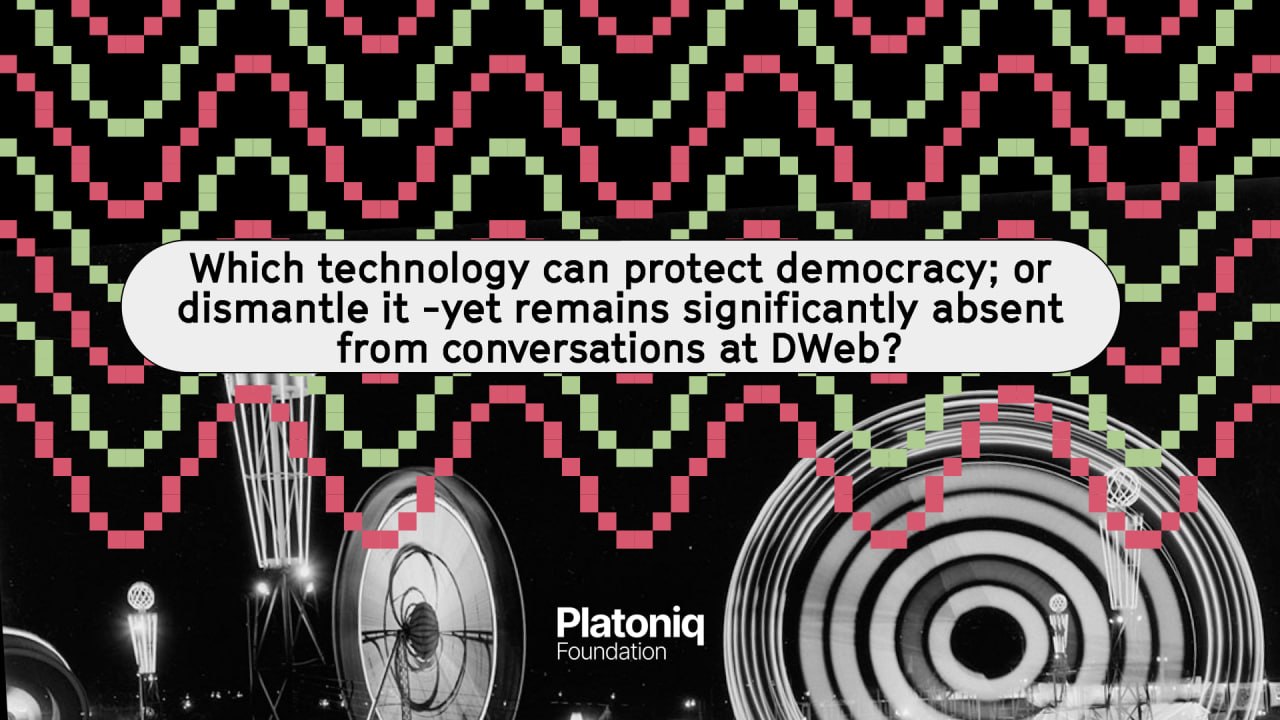
Which brings me to my second DWeb session, which opened with a provocation of its own: which technology can protect democracy, or dismantle it, yet is almost absent from DWeb conversations?
Not encryption. Not AI. Not decentralization.
Public policy. The least glamorous word in the entire building, and somehow the one doing the most actual work.
Movements don't disappear when the consultation closes, no matter how satisfying that closing ceremony felt. They still need members, governance, funding, collective memory, negotiating power.
Public policy is a technology for distributing rights, resources, recognition, and protection. It can open doors or seal them shut. And the communities most affected by policy decisions usually have almost no organizational capacity beyond reactive campaigns. Civic tech has gotten very good at enabling participation inside institutions: consultations, participatory budgeting, crowdsourced legislation. But movements don’t disappear when the consultation closes, no matter how satisfying that closing ceremony felt. They still need members, governance, funding, collective memory, negotiating power.
This is why I’ve been developing the concept of Digital Citizen Unions: democratically governed digital organizations through which renters, care workers, migrants, feminist networks, and neighborhood communities can deliberate, organize, finance themselves, preserve their collective knowledge, and negotiate collectively with public institutions. Goteo showed what this looks like when a crowdfunding campaign becomes a founding document instead of a donation form. Metagov shows what it looks like when the underlying software refuses to let “governance” collapse into “permissions.” The Democratic Tech Fund workshop showed what it feels like in your body when you rehearse it under pressure. Seth Frey showed the data confirming all of it: structure alone barely moves the needle. And Ben Cerveny showed what it looks like when the European Union tries to give this whole pattern a legal form and a funding line, only to discover Decidim and Goteo had already been living proof of it for years.
None of that scales the way a smart contract scales. It scales the way a union scales, or a tenants’ association, or a fisheries cooperative: slowly, through legitimacy earned in public, through people who keep showing up to the boring meeting because the alternative is letting the loudest wallet decide everything by default. There is no pitch deck slide for “legitimacy earned slowly,” which is precisely why nobody’s built a unicorn out of it yet, and precisely why it keeps working anyway.
Encryption protects a message. Federation protects a network topology. Neither builds an organization that can hold a treasury accountable, resolve a dispute, or renegotiate its own rules when the world changes around it. That’s the maintenance work “code is law” was invented to let us avoid, and it’s the only work that actually produces a commons instead of a museum piece with really good uptime.
The next frontier of the decentralized web isn’t a more elegant contract. It’s the unglamorous, recurring, fundable work of keeping institutions alive: modular enough to adapt, portable enough to survive a platform’s collapse, and staffed by people willing to keep showing up after the initial hype clears the room and the influencers have moved on to the next chain.
Not simply decentralizing technology. Decentralizing democratic power.
Automate the plumbing. Never automate the politics. And for the love of everything, stop calling a spreadsheet “trustless” just because nobody wants to own it.

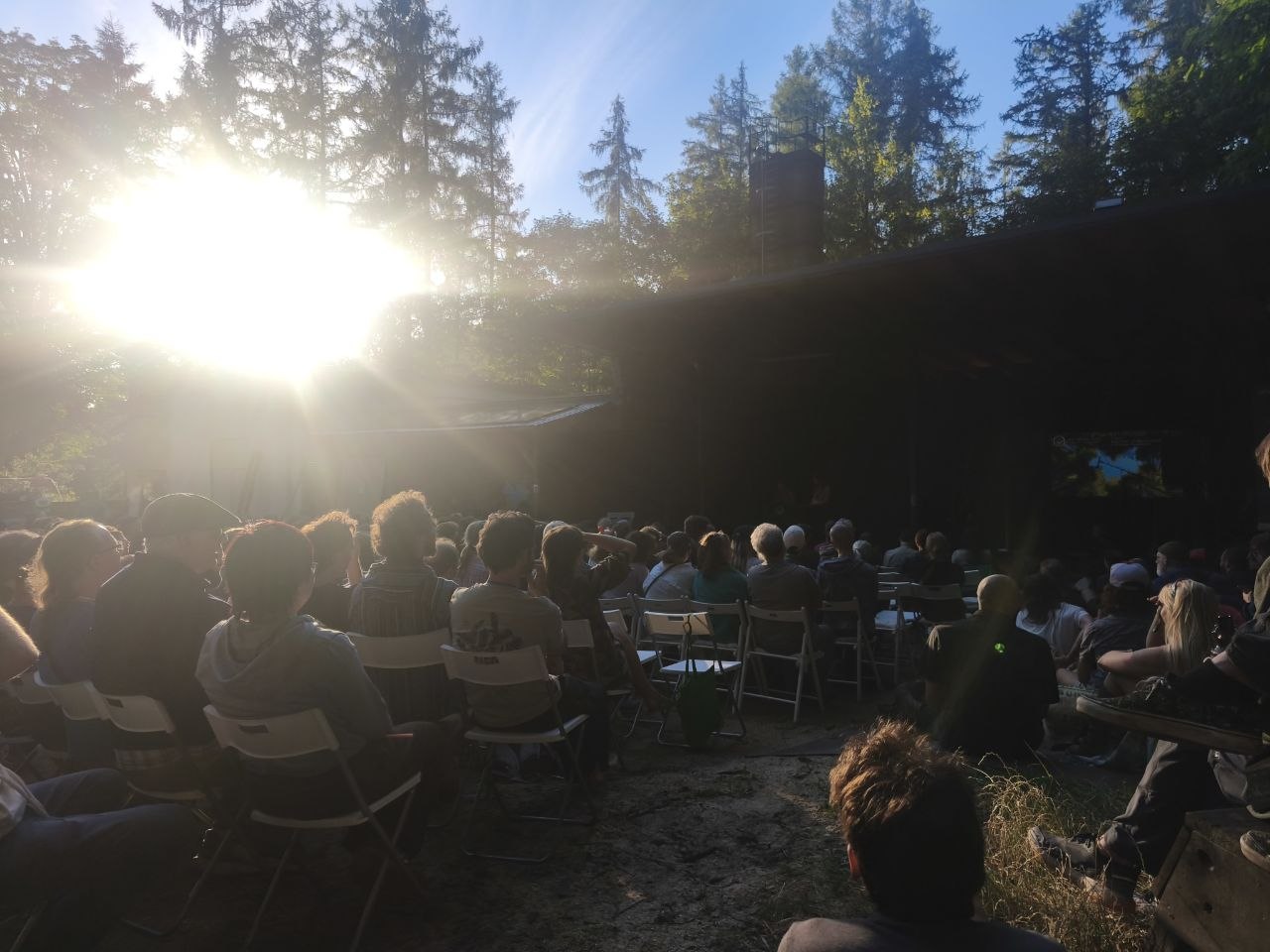
Teen Camp area
Dweb Camp 2026
* DWeb Camp is a multi-day international gathering dedicated to imagining and building a decentralised web – that is, an internet that is less dependent on a handful of companies, servers or centralised platforms. Launched by the Internet Archive following the first Decentralised Web Summit, held at its San Francisco headquarters in 2016, it subsequently evolved into a collaborative camp bringing together developers, archivists, researchers, artists, activists and public policy makers. In this edition, sponsored by the Department of Decentralisation, the programme has combined workshops, debates, technology demonstrations and open sessions on distributed storage, community networks, digital identity, privacy, resistance to censorship, data sovereignty and new models of governance. Rather than a conventional technology conference, it seeks to create an international community that designs digital infrastructures based on trust, individual autonomy, mutual respect and sustainability, in line with the Internet Archive’s mission to preserve knowledge and ensure open and lasting access to information.
Our participation focused on these two sessions on ‘Solidarity Tec’: 1) Sustainable infrastructure: Exploring network infrastructures created and maintained by and for small, trusted communities, designed to foster privacy, trust and security on a human scale; 2) Movements. Exploring approaches to sustaining free and open-source decentralised technologies through social and solidarity economy practices and other models of community governance and funding. This report aims to document our experience.
We would also like to thank Mai Ishikawa Sutton, senior organiser at DWeb; Elisabeth Barry, our lead on ‘Sustainable Infrastructure and Movements’; and, most especially, all the volunteers at DWeb Camp 2026.
Read the review by the Free Knowledge Institute,* here*
Sources: Metagov: D20 Governance, Documentación de D20 Governance, PolicyKit, PolicyKit: GitHub, Metagov Gateway: GitHub, Resumen de diseño de Metagov, Metagov News: CollectiveVoice Spotlight, Metagov News, julio de 2023: D20 Governance Playthrough, Seth Frey: Metagov, Seth Frey: CV de UC Davis, Governance Futures: Scaling Local con Seth Frey, Inner Development Goals: Framework, Martijn de Waal: Root Systems, hacia un internet descentralizado en DWeb Camp, Ben Cerveny: página de ponente de DWeb Camp 2026, FOSDEM 2026: The Public Product Organization, Ben Cerveny en Revolution.Social: Social Media Should Be Public Infrastructure, Comisión Europea: página de política sobre EDIC, Digital Commons EDIC, Documentación de gobernanza de Decidim, Ayuntamiento de Barcelona: Decidim como estándar digital, FOSDEM 2025: FLOSS as a Public Policy, the Case of Decidim, Goteo: Wikipedia, Goteo Foundation: GitHub.