Interviews
Jean-Paul Gagnon The river has a vote: a conversation on languages, landscapes and futures of democracy

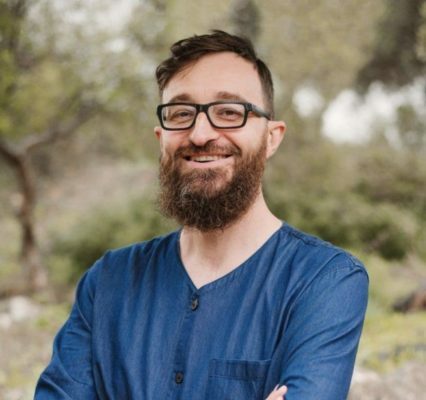
Jean-Paul Gagnon is a philosopher of democracy at the University of Canberra and co-editor of Democratic Theory, whose work has pushed democratic theory beyond its familiar institutional and Western boundaries by investigating democracy’s many linguistic forms, its neglected histories and its possible manifestations beyond the human world.
In this conversation with Olivier Schulbaum, strategic director of Platoniq, Gagnon invites us to think of democracy not as a single concept but as a vast and still largely unexplored ecosystem of meanings: an archive scattered across languages, cultures, artefacts and practices that conventional political theory has often failed to recognise. The discussion moves from the colonial and universalising assumptions embedded in democratic theory to embodied and non-discursive forms of political expression; from the collective decision-making of honeybees to forests understood as multispecies democracies; and from the disappearance of languages as a loss of democratic imagination to the political, ecological and labour conditions underlying artificial intelligence. What emerges is an expansive account of democracy as something that may be spoken, embodied, sensed, shared across species and technologically mediated and a challenge to rethink not only how democracy should work, but where, and in what forms, we are willing to recognise it.
Democracy as a living ecosystem of meanings
Olivier: You say that when we talk about democracy, we don’t know exactly what it is because it’s a concept with many disputed meanings. So let’s start with that block. You have documented 5,000 of descriptions or epistemologies of democracy. At what point did you stop thinking democracy was a concept and start seeing it as a living ecosystem of meanings?
Jean-Paul: Oh, it was embarrassingly late. I find it very difficult to think of any graduate programs or any tradition of scholarship on democracy that offer such an open and programmatic study that we might call a linguistic approach, an epistemologically uncertain approach, or one that celebrates ontological differences and, in particular, blurring of boundaries. But we’ll get to that.
These grad programs still are fixated on this idea that democracy seems to have always meant something coherent for the vast majority of people. In fact, a lot of people have that strange attachment to universalism, which, as we know from Castro-Gómez and others, this is very hard to maintain as a defensible position if you’re, you know, taking an honest and open approach to what democracy is, has been and could be across time and space.
It’s even more complicated if you start thinking of the meanings of democracy across individuals and groups, indeed, species. So, in short, you know, I think we’re still very much training in that manner that works quite well to serve, for example, interests of—and it’s not necessarily all bad. Some say there’s some kind of evil cabal or clique of states, billionaires, or whatever, trying to control the narrative. And that’s not the case at all. In fact, there are a number of countries that like to call themselves “procedurally fair” and “institutionally sound” liberal democracies, and so on, and they want people to protect that, to defend it, even if they lack the resolve to do so. We’re seeing quite a lot of this sensitivity in major grant programs, within NGOs, within IGOs.
I think it's no surprise that more people appreciate, for example, the depth of, say, Monkey D. Luffy from *One Piece*, rather than, for example, John Rawls's theory of justice
When I came to this, it wouldn’t even be a realization. It was genuinely just, I think, the rewards that one gets from trying to be quiet and trying to read as well as they can. And I must admit to being quite a poor student in this regard. When you’re so time-poor, there are many others that are just tremendously sensitive to existing literature.
Beyond that we’re talking about these questions of why are there such dominant figures that keep coming up again and again and again in the so-called archive of democracy, right? Marx, Arendt, Rawls, Habermas. It’s pretty difficult to keep revisiting these people and upholding them because, in many ways, they created theories that were very exclusive and exclusionary, very self-referential.
I think it’s no surprise that more people appreciate, for example, the depth of, say, Monkey D. Luffy from One Piece, rather than, for example, John Rawls’s theory of justice, not to mention other books.
Olivier: They both have horror tyranny. And both have comics about them.
Jean-Paul: I like that. But you see, if you bring this up in certain places, people will think: “are you ridiculous?”
You know, Rawls was such a tremendous intellect and made so many great contributions. But so did many other people. And Rawls’s book, the big one anyway, came out in 1971. What happened over the few years before that?
Well, it was the civil rights movement in his colonial country. And yet, he makes at best a cursory motion toward race. Does not address whatsoever the extremely tense position of racial abuses historically and contemporaneously to his time. We can think of just the amount of Americans that rely on cheap labor from South and Central America to this day.
So we realize that, at some point in the 1960s or 1970s or thereabouts, arithmetic, statistics, variables, and the questions at stake became rigid and closed-ended. You can’t dare change a question in a survey. I mean, gosh, try doing that in something Pippa Norris is involved in. Drives them crazy.
But that’s what Arnais came to diagnose. And that’s what I picked up on: that we lost somehow an interest in the meaning of words. And we started adopting the strange, simple narratives that really do strengthen the hand of particular empires and particular capitalist interests.
So where are we at now? If, in English, you were to take a very simple linguistic approach to analyzing adjectives, we would obviously use the words differently. We ascribe meaning to this thing called democracy without even using the word. And this is a very, very limited way of looking at conceptual diversity.
You just look at prenominal or postnominal positions. “Black democracy” is prenominal; “democracy undressed,” let’s just say, is postnominal. Well, what do these things mean?
If you start asking that question and you start collecting those names and, as a good, okay, practicing Taoist would say, a name is but a guest, a placeholder for the real thing. So it’s only ever a sign, right? And what does it point to? In our case, it points to archives. It points to art, it points to sound, it points to whatever, lots of different things that you can find, that other people can find, that you can help. You can help guide other people to.
Is Funny, and I’ll wrap up here that the limitation, again, of this work is that’s just done in English. What about other languages? What about across non-textual media? We don’t do that yet.
There’s a great amount of other words in the world that mean democracy. And I think we're literally just not even scratching the surface, looking at it from a distance.
There’s a great amount of other words in the world that mean democracy. And I think we’re literally just not even scratching the surface, looking at it from a distance. I dare say I think there’s something there. As far as we can see, it’s a catastrophic amount of data that we, as students of democracy, have fundamentally, systematically and consistently failed to take seriously. Why is that?
Well, I think, for example, our friend Ramon van der Dohe’s has probably the correct diagnostic here. And Ramon would say there are just too few of us. There aren’t enough democratic theorists of this sort in the world, and even not of that sort.
Olivier: Could we bridge a bit more looking at practitioners or even, like, affected communities by certain terms, or revising terms by themselves? So that has also to do with how to do the collecting of these epistemologies, of these expressions. It’s at, in a meta level, also some kind of a democratic archive-making, or is the ontology a common? So I would love to know about that.
Jean-Paul: Well, I mean, you’re completely right, Olivier, in that thinking. So it was Eva Crick and Norma Ulstaba Kaufman, to memory, who were very vocal earlier on, a few years ago, about, well, if we have these limitations, our only recourse is to try to partner, to find others in the world that are interested in doing similar things, and to try to craft some kind of citizen science approach here.
So we are in that motion. The ideas are, at the moment, of trying to work with the European Commission to get some basic amount of funding to develop a citizen science-based approach. I mean, we might say that we could craft something quite democratic in nature, or at least defensively so on some meaning of democracy.
The vision there is that hopefully we can start a few languages, maybe one from each major populated center or sub-region globally, work with partners there to collect these different linguistic artifacts.
We’re treating them like pot shards, and then trying to build archives around them and trying to make sense of where these things come from: what land, what people on those lands, which context, which reasons, and then ultimately, are these viable ideas? That was a big critique earlier on in this project. Quite a few people have said, “This is crazy.” It could be a deliberation process in itself, I would say.
Linguistic artifacts and non-verbal democratic practices
Olivier: Let me come back to something I think is very interesting. You mentioned also data around democracies. I’m not talking about the definitions, but also, like, the data that may be associated to these definitions. But I’d like to come back to the idea of what you call “the linguistic artifacts”. What democratic practices become visible when we stop translating everything through English political vocabulary? And that would also: is there any artifact you would think of that would be non-discursive? So some kind of a translation of these phenomenologies or terms or glossaries into visual languages that could be associated more with community practices.
Jean-Paul: Given your question, I think you know the answer of this. I follow other anthropologists, especially those that are more in political sociology or radical and activist critical theory work. So when you look at how they express some sort of democratic action, usually this has more to do with that Luffy style of pursuing freedom, embracing anarchy, pursuing joy. Right? We know that hope and joy are big themes in democratic theory these days, and for good reason.
When they carry out their work, we see, for example, that they pay close attention to how different people behave in specific spaces of action. That is why the Occupy movements were described in great detail by researchers who focus on embodiment positioning.
Apparently American anarchists or North American anarchists really like to touch each other. They’re very tactile: massages, hugs. And others in different parts of the world, you know, are far more just about sharing space together, being open to a diversity of people types.
There’s an illusion about who is in and out of the room. Nowadays we have a lot, of course, of focus on people that are transgendered, people that are very young, and also people that have, let’s say, some form of neurodiversity or very deep… I hesitate to use the word disabled. Some people identify as such. Others say differently abled, so let’s just say differently abled, to be very inclusive. But again, if you look at Habermas’ work, which is such a celebrated root of deliberative theory in attempts at practice today, despite having a cleft lip himself, he shut the door to that in his formal work. So we have that real problem of trying to find ways of opening deliberative spaces, trying to democratize that more.
That’s one example of just the embodiment.
But I’ll leave this topic to others, especially since I’m currently working on a manuscript for Princeton titled Non-Human Democracies, which is based on that vast visual and verbal, non-human space that we share with animals. Plants, microbes, and fungi, when observed closely, reveal not just one type of democratic practice, but many different types.
Non-human democracies: bees, forests and plants
Olivier: Could you go into a little more detail on that topic: the decision-making process of bees, for example?
Jean-Paul: Everybody loves bees.
Olivier: Of course, everybody, unless the pollinators debate from the European Commission with young people, we could also connect to an easy one.
Jean-Paul: So I’m happy to, but only if I can encourage your lovely readers to understand that this is literally too exclusionary. The Western honeybee is not the alpha and omega of the bees or the arthropods that do these things. But bless Tom Seeley, bless his book, Honeybee Democracy. If you don’t have it, from Princeton, it’s like a coffee table thing to have. It’s beautiful. And Tom is a really nice guy.
That book led to a great many other projects, especially those aimed at communicating directly with honeybees. They’ve created something called a “robobee.” It doesn’t look like a bee. It’s like a small piece of plastic mounted on a sort of metal shaft, and it’s placed on top of a real beehive. The device moves in a way that mimics the bees’ so-called “waggle dance.” And if you’re able to understand this dance the way Tom Seeley does, he can tell you, in broad terms, what the different dancers are “signaling”—though perhaps “signaling” is too strong a term; they’re more likely sharing where they’ve found a potential new home. Or, for exemple, if the hive has reached saturation and it’s time to create space for more bees. Or if it’s time to look for food.
If, for example, you and I were bees, and you came across an incredible field of sunflowers, like the ones I saw near Geneva when I was there. Huge, mind-blowing, still in bud, with no other bees around. You’d go back to the hive and would say, “Man, have I struck gold?” And you would do this huge, vigorous, energetic dance. In that moment, apparently, the energy, the enthusiasm, would draws the attention of others in your society. And they say, “Wow, Olivier is really freaking out about something. This is incredible.This must be good.” So, you know, I’d look at your instructions and fly there myself, wherever you tell me to go.
Here I believe, and people might object to the use of that word, that there is a process, a very strong process, I’d say it’s the strength of honeybee democracy, of independent verification.
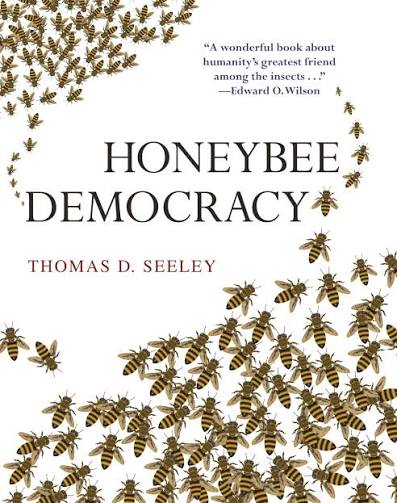
Olivier: Imagine honeybee literature in public policy like this. Would you do the dance moves in the parliament? That would be cool.
Jean-Paul: Well, more to the point of mimesis. So this, my book, it starts that way. We have an anthropocentric arrogance when it comes to democracy. We think it is the invention of our species. This is false.
I think because of that we have not done what many other colleagues in different disciplines have done for a long time and continue to do, which is to pay very close attention to what other animals are doing, and to see if there’s anything that we can learn from them. Simply.
I do think that if we carefully look at the way others, like Apis mellifera, the Western European honeybee, and particularly their emphasis on independent verification, and if we ramp that up inside our parliaments, if we ramp that up inside our echo chambers, our social media, and went, “Wow, this or that” You know, verify a lot of our problems I think we’ll see a dramatic reduction in policy failure.
Sadly, I do think that we trust each other too much, or we show too much deference to people that say they know better.
Olivier: So you meant, you like to talk about the bee case, but it was probably not the best example of the horizontal democracy we could have. What’s a good example of a non-human agent that would be even more relevant than the bee one?
Jean-Paul: Look, I think they’re all, in their own way, relevant, because they each don’t do a universal democracy thing. They all live so close to, in many ways, on the brink of starvation. It is such a fine-tuned requirement to be sensitive to the land they’re on, to the context they’re in.
So, with each example I look at, what I try to do, just to be convincing, is to pick one from each major part of the family tree, bacteria included.
So I think perhaps the most popular at the moment, and this may be a nice entryway for those readers that might not be so familiar with this body of discussion, is how intertwined a forest is. We really take that for granted.
We go for a walk in the woods, especially old growth or something that has regrown and been left more or less to its own devices for 30 or 40 years. It’s incredible. And we are so insensitive that we cannot even understand or accept the ideas that neurobiologists, plant neurobiologists, are empirically demonstrating.
It’s not the kooky 1960s, “I’m going to blow cigarette smoke on a plant and put a polygraph to it and see if it reacts with some electricity” work. You know, that appeared in this movement called The Secret Life of Plants. Most of it was sham stuff, just hippie nonsense. But it did inspire a lot of people to see thant plants, maybe, aren’t as dumb as a lot of us think.
In short, people do see forests more and more now as multi-species democracies, where there is a working together, there is an exchange of resources, there is no chief or king or boss. There's a shared circumstance.
When you give them credence, you see that they work within a different informational landscape of time. They have, at the cellular level, different sorts of receptors. One of them is for chemicals. And we know now, with many different types of plants, that they do use these chemical signals, either through their roots or through their leaf structures, they use that to communicate with one another.
For example, if you and I were pretty birch trees, and it turned out that you were closer to the spot where a giraffe had escaped from the zoo and was starting to eat your leaves. I don’t know if birch trees recognize giraffes. It’s a pretty far-fetched example. But let’s suppose they recognize the sound of chewing. It’s almost certain that the birch would release a hormone to other birches—and possibly even to other plant species—to signal that a herbivore is present. And then I, further away, upon receiving your message carried by the wind, might start producing, as quickly as I can, bitter substances—something that would simply make me less appetizing.
We know that they talk to each other. More to that, there are things at the cellular level that suggest that they have an auditory capacity, that plants can receive sound and emit sound. Like the potato plant, which makes a sort of snapping sound.
There’s all of these things you can dig into and see various forms of plant intelligence. And there’s all these people working through whether plants can actually be intelligent. And the evidence seems to show yes, they have their own forms of this and we’re not so special.
It gets more exciting. I’ll end just by saying that you can see the interrelationship, very well documented now, between fungi and plants, and how there is a lot of information exchange, that there are compromises, that there are signals, and that there is a reduction of mistakes that can be made in terms of having a friendly exchange.
So, in short, people do see forests more and more now as multi-species democracies, where there is a working together, there is an exchange of resources, there is no chief or king or boss. There’s a shared circumstance. And, well, the discussion is ongoing.
Democracy and artificial intelligence
Olivier: So we do need to do the forest of humans too, you know, if the threat is authoritarianism and extreme right, we probably need to learn from these, you know, almost invisible communication channels we could raise.
But, anyway, I’d like to open up the discussion on AI, specifically, on whether we can improve deliberation with AI.
Just so you know, as part of the “Inspire” project, which I’m working on with Sonia Bussu, we’re building something that’s really about trying to avoid the “Habermas machine”, and that obsession with consensus, and opening ourselves up to conflict. To that end, we have different people working together, such as a philosopher; a deliberative practitioner—which I suppose is more along the lines of what you started out doing; and we have the Joker, which is basically the legislative theater from Boal’s “Theater of the Oppressed.”
What dangers emerge when we ask AI not merely to inform democracy, but to participate in democratic reasoning?
Jean-Paul: I’ll try to be brief. If we do really want to avoid reproducing intentional exclusions, even, I would say, colonial and imperialist working patterns, if we want to take that seriously, then we have to embark on a broader project of what some called the democratizing artificial intelligence.
And it starts in the ground, literally. Who in the world is digging, and where? Do they have the right to dig there? Are they abusing Indigenous sovereignty? Are they taking huge risks?
Young people, especially poor families with children, pull out of school to try to get out of poverty with artisanal mining. Then, okay, you look at that. Can you democratize that? Can you make, say, a workers’ cooperative? Can you have this somehow?
There are different Indigenous nations that are interested in extractivism. They don’t see a problem with that. So maybe they could lead here, and that could then create a first foundation for fighting the middle people.
That's my concern, the small language model. Do we know that if it's working off of an unfiltered large language model that it won't start dog-whistling in ways that we can't possibly understand?
So we know that artisanal miners make next to nothing and take so much risk. So if they have a stronger co-op, maybe they can then get a fairer, much higher sale rate for these minerals.
Okay, let’s leave the hardware behind very briefly and move to the software and training side. We know that in the companies, these are the playgrounds of oligarchs. They have, as we all know, vast amounts of power.
We know that inside the company, there are those who have skills that are obtained—and this is not to cheapen their experience because they have worked hard. They’ve studied hard. They’ve fought massive exams in different parts of the world to come out on top, and they’ve put themselves successfully through interviews to go to the very highest, the highest technical echelons of Google, Anthropic, etc.
But they get the lion’s share of the money, and they need partners to do a lot of this sense-testing of humanizing content. And what do you see?
Well, it’s back to Facebook 101. You go to the poorest countries that have some reliable internet. You put typically non-white people in front of screens with no mental health support, and you ask them to sit, even for a week, with some of the most heinous material humans create.
And then you ask them to detail things like bullet wounds so that a product can be made to help police somewhere else have an AI that can diagnose very quickly what sort of gunshot, what bullet, what does an exit wound look like.
This is not okay.
So you see, then you go through to access, let’s say on the user side, if we’re using an AI for deliberation: is it an open source? Is it trained off of, say, a small language model that is more appropriate to what you are doing?
That’s my concern, the small language model. How do we know that if it’s working off of an unfiltered large language model that it won’t start dog-whistling in ways that we can’t possibly understand?
That’s the brief answer to question one.
Question two, in terms of how to use this AI in the deliberation, I think it’s critical that the machine knows it is there to support our angels. As people that run NGOs, as people that have busy labs, as people that have deans who turn them over annually and shake them to see what money falls out of their pockets and publications, the devils on our shoulder are not friendly to time, are not friendly to problems in methodology, are not friendly to anything that could unreasonably disturb what we are meant to produce. That’s a problem.
Linguistic extinction and democratic imagination
Olivier: Let me just end with a provocation: what if democracy’s biggest crisis is not declining participation, but linguistic extinction?
Jean-Paul: You’ve been reading Michael Saward.
Olivier: And yours.
Jean-Paul: Oh, they were just grabbing lines from Mike or different anthropologists. I just like to open it up.
Yeah, well, I do think that they’re very convincing. Wade Davis in particular is very strongly minded about this. He doesn’t mean to take attention away from ecological crises at all. What he’s trying to say is that there’s actually a much faster form of extinction occurring. It’s a human form of extinction. I’m not sure if the stats are the same, but it’s roughly one of those very depressing sayings, like, you know, every week the last surviving speaker of a language dies, and that language dies with them.
And when we think about language, it is the entirety of those of us who speak this way. Like, there are sign languages, there are Blissymbolics, whatever, there’s other ways of communicating. Those are still languages, right? I’m not excluding nonverbal forms.
But whatever it is, it is a whole codex that typically takes years or even a lifetime to get close to mastery. It’s all about trying to use whatever: our bodies, our words, our symbols that we can draw, to express what’s happening, to express things that are generating on the inside, that we’re feeling from the outside, that we can feel and make alone or together.
And you see this in countless cultures, and also in non-human species groups, a distaste for tyranny. Right? Nobody likes a tyrant. Even monkeys don’t like tyrants. Chimpanzees do not like tyrants. It’s an interesting thing to look at.
We have all these different languages, full of concepts we don’t know. So when engineers or medical scientists lament the extinction of a species, we should lament the fact that those genetic technologies and that expertise are no longer in the world for us to interact with, try to understand, support, and build a relationship with.
I believe that one of the greatest crises we face is not simply the extinction of languages, but rather that we are dramatically impoverished in terms of our understanding of what democracy can be. And that is a huge limiting factor because, as Benjamin Studebaker, a former doctoral student of David Runciman, says in a recent article, it stifles our imagination.