Interviews
Miquel Joan Far Ferrer Egalitarian Masculinities, Mental Health, Loneliness, and Democracy

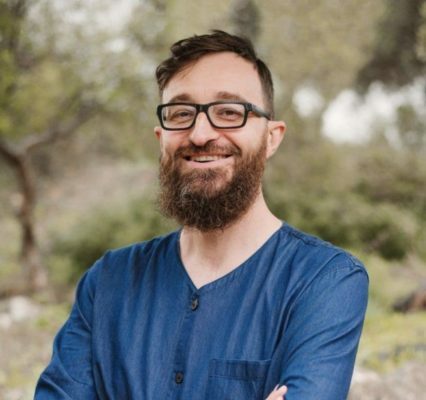
What’s Happening to Young Men? As loneliness, anxiety, and a sense of uncertainty grow among many young people, a digital ecosystem is also gaining ground—one that offers quick answers, prefabricated identities, and easy scapegoats. The so-called “manosphere” presents itself as a space of belonging for some young men who feel that no one is listening to their doubts, fears, or confusion in the face of a rapidly changing world.
To explore these questions, we spoke with Miquel Joan Far Ferrer, a psychologist, educator, and leading expert on egalitarian masculinities. We discussed men’s mental health, vulnerability, frozen intimacies, the “manosphere,” a culture of care, and how to create spaces where young people can reflect on who they want to be without getting trapped between guilt and resentment.
The interview also engages with another parallel conversation held with playwright and facilitator Tony Cealy on masculinity, mental health, and democratic participation. Together, these two perspectives raise a question that runs through all of our work at INSPIRE: if we want healthier democracies, what kind of men do we need to nurture?
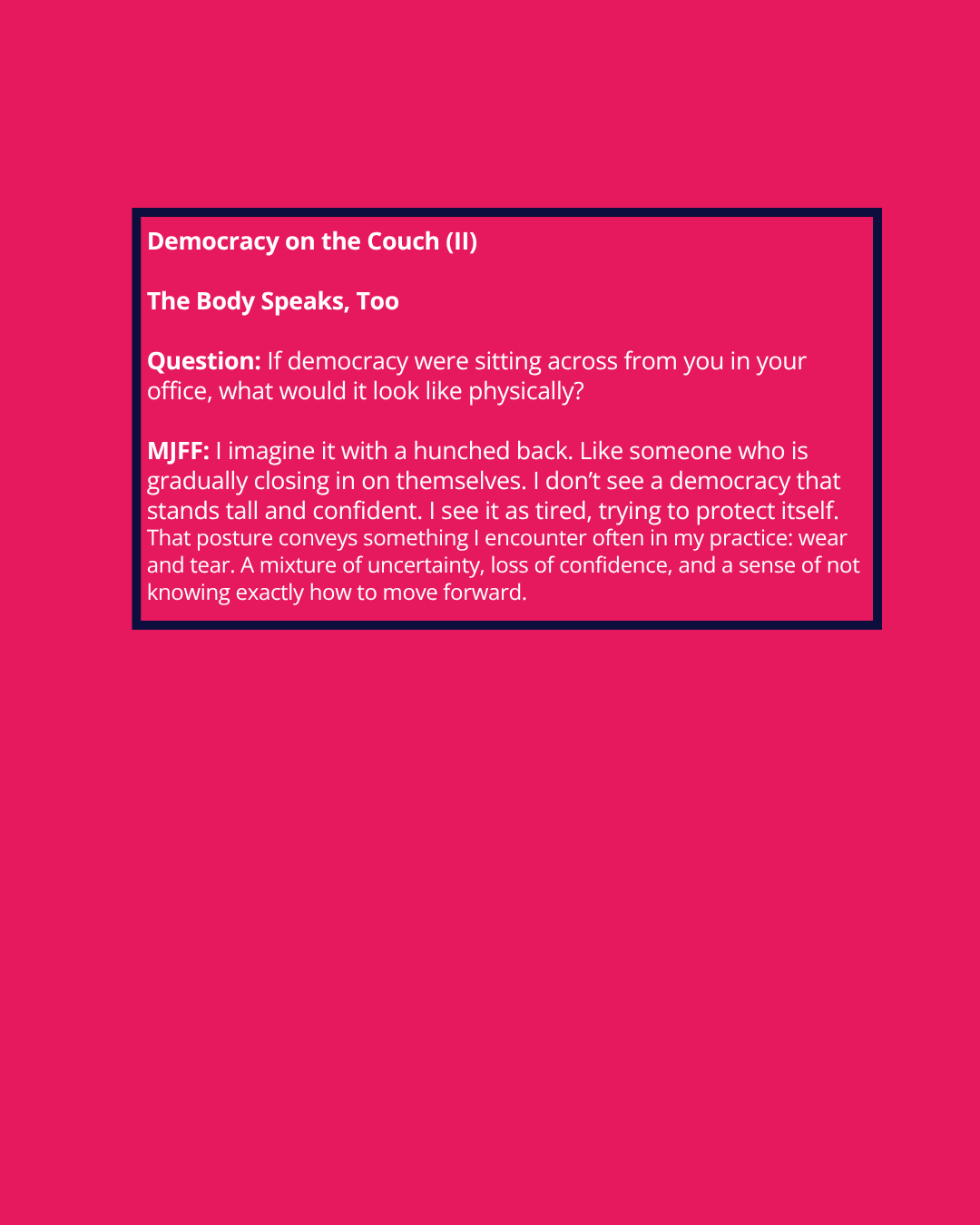
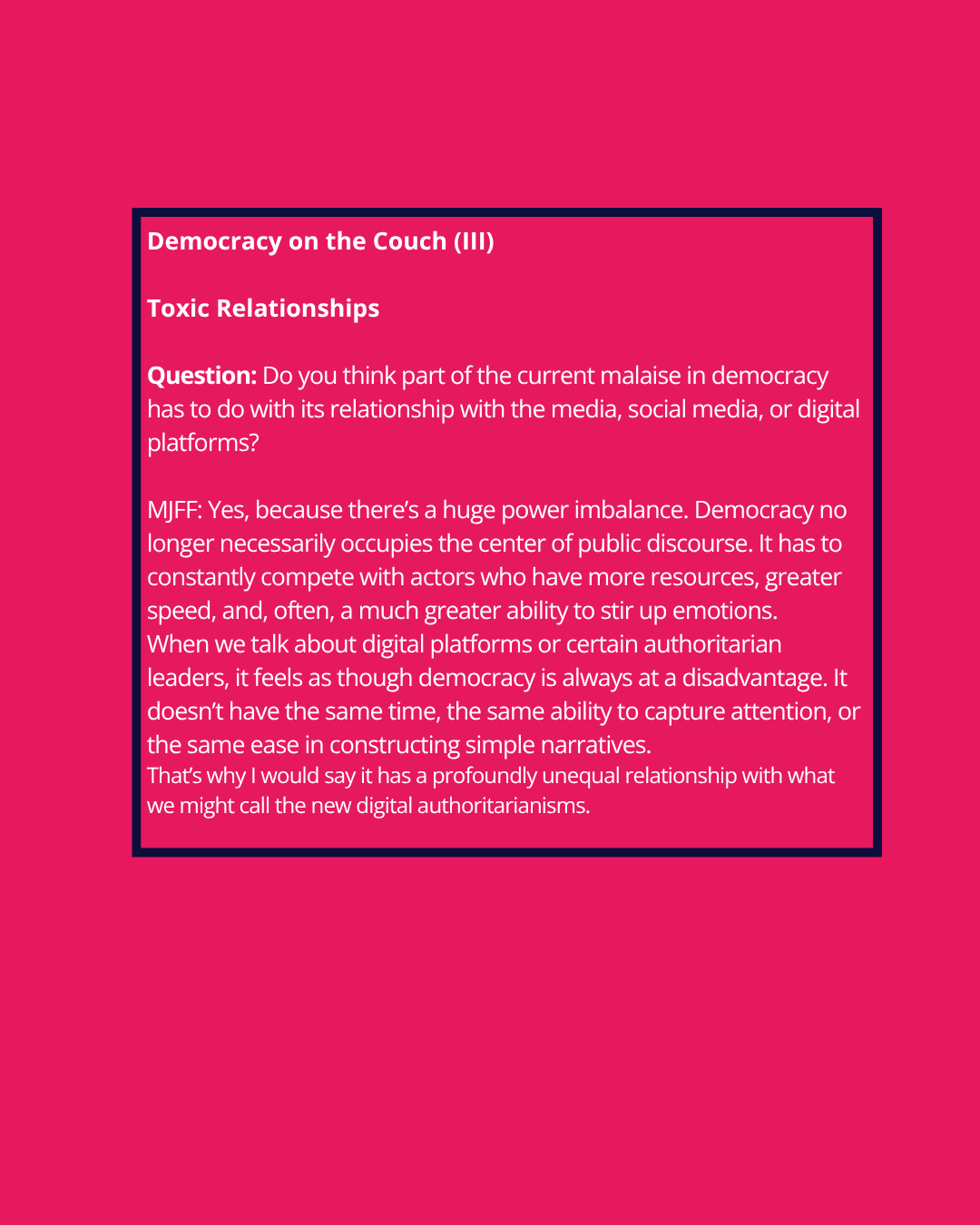
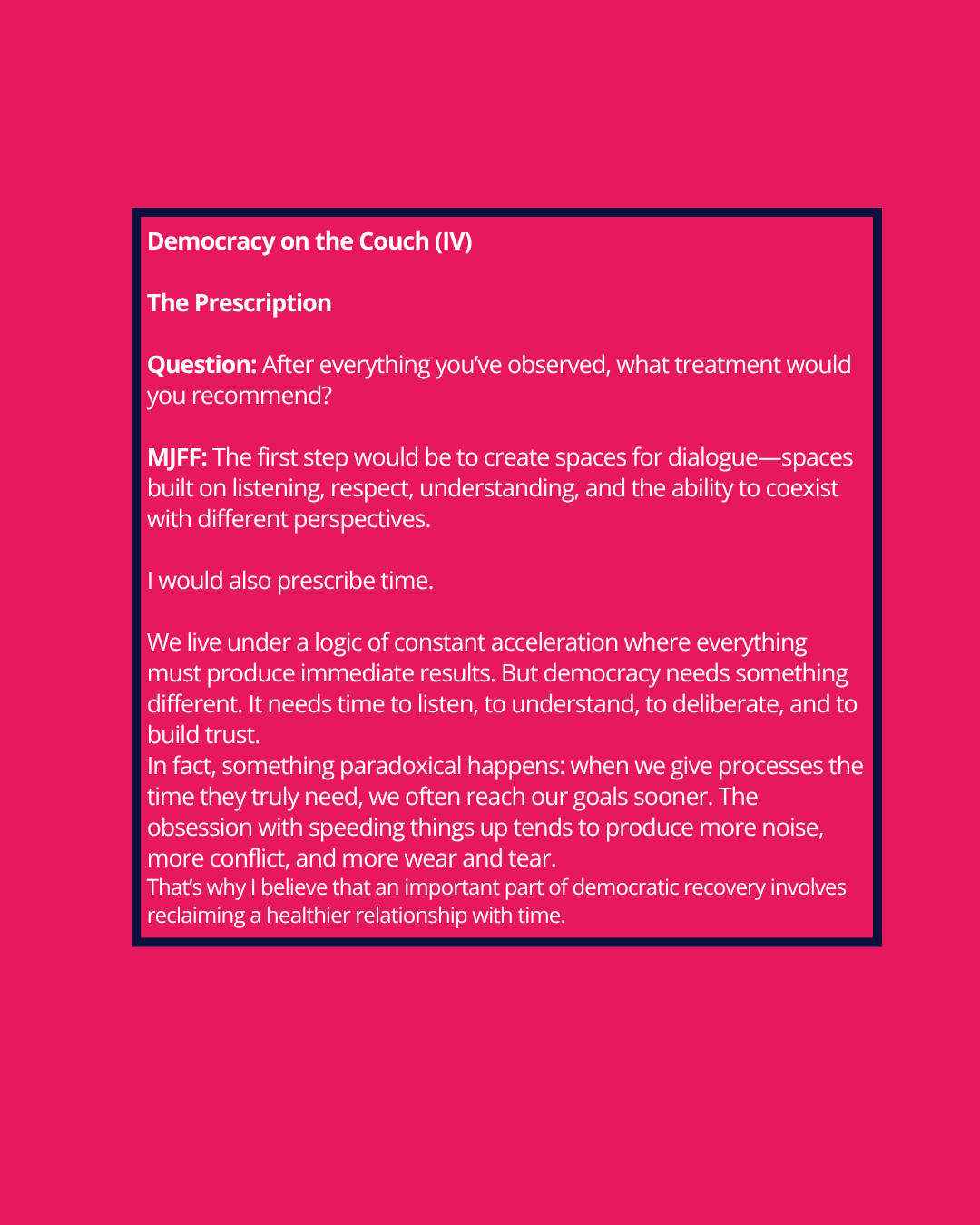
Inspired by philosopher and psychoanalyst Cynthia Fleury and her reflections on the pathologies of democracy, we proposed an additional experiment to Miquel. We asked him to imagine that democracy itself was knocking on the door of his office seeking professional help. Rather than presenting that conversation as a separate section, we’ve woven in short vignettes throughout the interview, following the flow of the topics as they emerged. It’s as if democracy were sitting discreetly on the couch while we discuss vulnerability, care, polarization, trust, or male loneliness.
Las respuestas de Miquel componen así un segundo relato que atraviesa toda la conversación: el retrato de una democracia cansada, desorientada y necesitada de cuidados, cuyos síntomas no son tan distintos de algunos de los malestares que observamos hoy entre los jóvenes.
Sailing Toward Other Masculinities
In Manuscript for Crew Members Sailing Toward Equality, you constantly use the metaphor of a journey and a logbook. Before getting into the heart of the matter, why did you decide to use the image of a journey specifically to talk about masculinity?
MJFF: There’s a concept from the world of sailing that I’ve always found very evocative: circumnavigation. It refers to a twofold journey. On the one hand, the journey you take toward a destination; on the other, the inner journey that takes place as you travel that route.
I found it a very useful image because processes of personal transformation work in a similar way. We may have certain coordinates, goals, or points of reference, but at the same time, each person follows their own intimate and unique path. Both journeys take place simultaneously.
Feminism has done extraordinary work in this regard, creating alternative frameworks and expanding the possibilities of what it means to be a woman. Men, on the other hand, are still in a much earlier stage.
The idea was precisely to play with a world that was foreign to me: the world of sailing. If I was able to approach that language and familiarize myself with it, any man could also approach what we call alternative, dissident, or egalitarian masculinities. That’s where the metaphor of the journey comes from.
Building an Alternative Culture
What are the main obstacles men face when they try to challenge traditional models of masculinity?
MJFF: Creo que el gran obstáculo sigue siendo la falta de una cultura alternativa suficientemente consolidada. Lo que llamamos masculinidad hegemónica no es únicamente una suma de comportamientos individuales; es una cultura completa, con sus referentes, sus modelos de éxito, sus expectativas y sus recompensas.
The great challenge lies precisely in building a counterculture capable of offering alternative life scripts. Feminism has done extraordinary work in this regard, creating alternative frameworks and expanding the possibilities of what it means to be a woman. Men, on the other hand, are still in a much earlier stage. We are laying the groundwork.
We need references, narratives, practices, and role models that allow us to imagine other ways of being a man. Without that cultural infrastructure, it is very difficult to sustain individual changes.
In fact, part of the current rise of neo-machismo can be understood as a reaction to the emergence of these alternative narratives. When a dominant culture perceives that other possibilities are emerging, it tends to retreat and defend its privileges.
Loss of Rights or Loss of Privileges?
Is there a risk that some men might perceive discourses on equality more as a loss than as an opportunity?
MJFF: Yes, absolutely. We live in a society marked by uncertainty, precariousness, and the feeling that many of the promises of well-being are no longer guaranteed. In the face of this insecurity, certain discourses offer simple explanations and point to specific culprits.
We see this with immigration, but also with feminism. Scapegoats are created onto whom people can project frustrations that actually have much more complex causes.
The problem is that we continue to operate under a zero-sum mindset: if someone else wins, I lose. From that perspective, when women or certain groups expand their rights, some men interpret this as meaning they are necessarily losing something.
But that is a fallacy deeply rooted in macho culture. The fact that other people have more rights does not mean that you lose rights. What might happen is that you lose privileges. And that’s not the same thing.
Vulnerability, Mental Health, and Frozen Intimacy
What taboos still exist among men when it comes to mental health?
MJFF: I think it all revolves around vulnerability. One of the key tenets of traditional masculinity is self-sufficiency—the idea that a man must be able to solve any problem on his own, without anyone’s help.
When you internalize that expectation, asking for help can easily feel like a failure. Admitting that you’ve reached your limit, seeking professional help, or relying on others can feel like a sign of weakness. That’s why many men wait too long to seek help. Not because they aren’t suffering, but because they feel they shouldn’t need support.
Emotional language has not historically been an area in which men have been socialized. When a person tries to put into words what is happening to them and has never practiced that skill, they may feel not only vulnerable but also awkward, lost, or incapable.
Added to this is another important factor: emotional language has not historically been an area in which men have been socialized. When a person tries to put into words what is happening to them and has never practiced that skill, they may feel not only vulnerable but also awkward, lost, or incapable. For a long time, talking about emotions has been associated with a realm considered feminine. And that, too, has created distance.
Why are so many men able to talk for hours about work, sports, or politics, but find it hard to talk about fear, sadness, or loneliness?
MJFF: Because we’ve been raised to look outward.
From a very young age, we learn to relate to others through action, productivity, performance, competition, or achievement. These are the areas where we acquire vocabulary, experience, and confidence. In contrast, our inner world remains much less developed. Intimacy, vulnerability, and dependence seem like uncharted territory.
That’s why I like to use an idea put forward by Paco Abril: the existence of “frozen intimacies.” We men have enormous difficulty accessing certain spaces of intimacy. I sometimes say that men are intimidated by intimacy. But those intimacies can be thawed.
Experience shows that when safe spaces, warm relationships, or support networks emerge, many of those barriers begin to fall. That is why I so strongly advocate for tenderness as a political and relational value.
Women have historically created spaces of sisterhood. Perhaps we need to create more spaces of brotherhood: places where closeness, care, and vulnerability are legitimate. It is these spaces that allow us, symbolically, to unplug the refrigerator.
Generational Differences, the “Manosphere,” and Young People Caught Between Discourses. A More Diverse Generation Than We Realize
There’s often talk of an increasingly polarized youth. However, you work with teenagers and young adults every day. What differences do you observe compared to previous generations when it comes to mental health and masculinities?
MJFF: Contrary to some prevailing narratives, I’m actually quite optimistic.
What I find when working with young people is, above all, diversity. There are young people who perpetuate deeply misogynistic narratives, but there are also many others who speak naturally about mental health, who view affective and sexual diversity as normal, and who demonstrate a social sensitivity that was hard to find a few decades ago.
Sometimes the most extreme positions make a lot of noise and seem to represent an entire generation, but my day-to-day experience doesn’t reflect that.
When I was a teenager, I suffered from depression and had to live with it practically in secret. I didn’t talk about it in high school. I couldn’t just casually say that I was seeing a psychiatrist. There was a sense of shame associated with needing help.
I’m also speaking from personal experience. When I was a teenager, I suffered from depression and had to live with it practically in secret. I didn’t talk about it in high school. I couldn’t just casually say that I was seeing a psychiatrist. There was a sense of shame associated with needing help.
Today, I see many young people talking much more naturally about these issues. Seeing a psychologist is no longer necessarily seen as something unusual or stigmatizing.
Of course, difficulties and contradictions still exist, but there are significant cultural shifts that we shouldn’t ignore. Nor do I recall hearing conversations about gender, inequality, or masculinities during my adolescence. I didn’t come to these issues until much later, practically in college.
That’s why I speak of optimism. Not because the problems have disappeared, but because I see more tools, more ways of expressing ourselves, and more opportunities for reflection than there were when I was young.
In our recent work with young people as part of the SoReDi project—which focuses on youth well-being, artificial intelligence, and digital environments—we have encountered a recurring concern. We often analyze the manosphere for its effects on women or on democratic coexistence, but we talk much less about how it might affect the young men who inhabit those spaces themselves. Do you recognize situations in your work where young men feel pressured by certain models of masculinity promoted by the manosphere? What forms of distress, insecurity, or suffering can these discourses generate in those who try to conform to them?
MJFF: Yes, absolutely. And I think this is a reality that cuts across much of the Western world. The first thing we must acknowledge is that there is a structural dimension to the problem. We’re talking about digital environments governed by algorithms that are extremely effective at capturing attention and reinforcing certain narratives.
It’s very easy to come across content linked to the manosphere. You don’t even have to actively search for it. The algorithm works very well. There’s a responsibility here that goes beyond individuals. We’re talking about major tech platforms and business decisions that have profound effects on the socialization of young people.
But I also believe we must be capable of self-criticism. Perhaps some educational or egalitarian strategies have not always been the most effective. Maybe at times we haven’t judged the timing or the approach correctly.
In recent years, there have been attempts to drive very profound cultural changes in a relatively short period of time. Meanwhile, neo-macho discourses have rapidly gained traction and constructed simple, emotionally compelling narratives that are highly appealing to certain young people.
This has led some young men to experience certain educational settings as places where they are accused before they are even heard.
And when a person feels they are being judged, they are unlikely to be open to reflection.
Understand Before Judging
What do you think we’ve learned from working with men and young people that can help us address this phenomenon?
MJFF: There’s a very important lesson we learned from working with men who commit acts of violence. We don’t justify violence. But we try to understand it. Understanding doesn’t mean excusing. It means understanding the processes that have led a person to act in a certain way so that we can address them. If we don’t understand how certain behaviors are formed, we’ll have a hard time changing them.
Critical reflection takes time. It requires context. It requires complexity. It requires contradictions. And that’s much less appealing in a digital ecosystem designed to reward immediacy.
I think something similar happens with many young people today who are drawn to the rhetoric of the manosphere. Before pointing fingers or assigning blame, we need to understand what needs they’re trying to meet, what discomforts they’re expressing, and what questions they’re trying to answer. Then we can address the issue of responsibility. But if we reverse the order, dialogue becomes much more difficult. That’s why I believe so strongly in creating safe spaces—spaces where a young man can express his discomfort without immediately feeling labeled or judged.
Not because everything he says is correct, but because only from that starting point can meaningful reflection begin.
The “manosphere” and “hamburger messages”
What makes this kind of discourse so appealing to some young people?
MJFF: Because it offers simple solutions to very complex problems. The manosphere works very well on an emotional level. It creates spaces where many young men feel that someone is listening to them, understands them, and doesn’t question them right off the bat. It also offers quick, easily digestible explanations. Journalist Carmen Ruiz uses an expression that I find very apt: she calls them “hamburger messages.” They’re messages that are easy to consume—quick, immediate, and emotionally effective.
Critical reflection takes time. It requires context. It requires complexity. It requires contradictions. And that’s much less appealing in a digital ecosystem designed to reward immediacy.
That’s why the challenge isn’t just about debunking those narratives. It’s also about building alternative spaces that are meaningful, welcoming, and emotionally relevant to young people.
Building Democratic Antifragility
If we think about young people who want to resist that pressure from the manosphere, how do we build that critical capacity or that kind of antifragility?
MJFF: I start from a fairly simple idea: most young people want to be good people. Sometimes we forget that.
The vast majority do not want to deliberately cause harm or build relationships based on violence or domination. What happens is that they need spaces where they can explore their doubts and contradictions. That’s why it’s so important to build communities of trust.
There are some very interesting initiatives that are moving precisely in that direction. I’m thinking, for example, of initiatives like Broders, led by Leonel Delgado, which creates safe spaces where young people can talk about their experiences without feeling constantly scrutinized.
From there, reflection can take root.
And then come the tools: emotional education, communication, conflict management, the development of more flexible identities, and a culture of care. We aren’t inventing something completely new. We have decades of experience in how to strengthen people and communities. The question is how to make those tools as accessible and emotionally appealing as the simplified narratives circulating on social media today.
The Muscles That Are Atrophying
Which emotional and democratic muscles atrophy when models based on competition, domination, or individualism predominate?
MJFF: I believe that the very muscles that allow us to recognize our interdependence are atrophying. Trust, cooperation, the ability to ask for help, the ability to offer it, empathy, listening, and the ability to see ourselves reflected in others. When everything boils down to competing or surviving as individuals, those muscles stop getting exercised. And a society where mistrust prevails is also a society that’s much easier to manipulate.
That’s why I’m concerned that responses to deeply collective problems are increasingly framed in individual terms. It seems that all solutions revolve around personal work, individual improvement, or self-optimization. However, the major challenges we face require precisely what we’re failing to practice: the ability to build community, foster mutual trust, and sustain shared spaces.
The Muscle of Care
You’ve spoken about care and trust. How does that translate into concrete democratic muscles?
MJFF: A few weeks ago, I was working with young people at a high school in Calvià, and I asked them what it meant to them to feel cared for. One boy gave a very simple answer: “I feel cared for when someone spends time with me.” I found that to be a very powerful response because it reminds us that care isn’t just about protection. It’s also about presence, attention, and availability.
We live in a fast-paced society that constantly pushes us to produce, rush, and move on to the next task. In that context, dedicating time to another person becomes a profoundly countercultural act. That’s why I believe that a fundamental part of building democratic strength has to do with regaining the ability to dedicate time: time to listen, to understand, to connect with one another, and to build lasting bonds.