Interviews
David Bollier “The problem isn't human engagement with nature, it's capitalist engagement with nature”

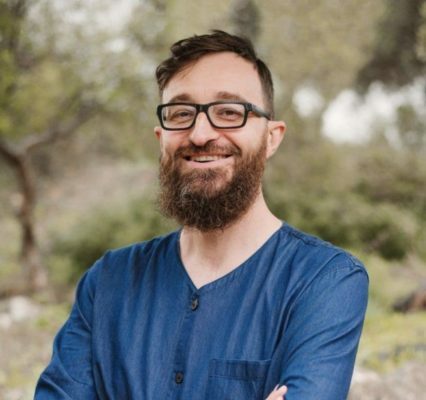
Few thinkers have done as much as David Bollier to move the commons from the margins of political and economic thought into a living framework for understanding how communities can govern resources, create value, and organize life beyond the conventional binaries of market and state. An author, activist, strategist, and long-standing international voice on the commons, Bollier has spent decades documenting and connecting forms of commoning across culture, technology, land, finance, governance, and ecology, while helping to build an intellectual and practical vocabulary around them.
This interview is particularly valuable because it catches that thinking in motion: rather than simply revisiting the ideas that made Think Like a Commoner influential, Bollier pushes them into new territory, reflecting on relationality, bioregionalism, “transvestment” and relationalized finance, the uneasy relationship between commons and state power, and the promises and dangers of artificial intelligence. What makes a conversation with Bollier important today is precisely this combination of historical perspective and conceptual restlessness: he does not present the commons as a finished model or an ideological blueprint, but as an evolving social practice capable of helping us rethink value, power, technology, ecological relations, and the infrastructures through which we collectively shape our futures.
Thinking like a commoner, ten years later
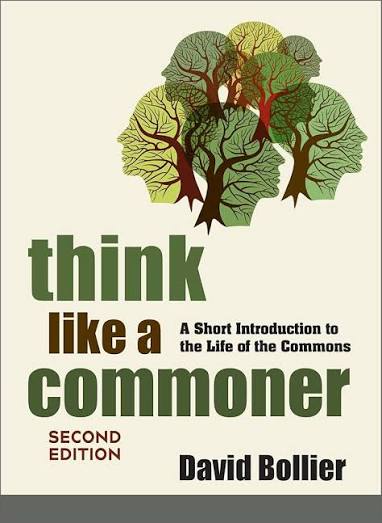
Olivier Schulbaum: Let’s talk about revisiting Think Like a Commoner, right? So if someone read the first edition ten years ago and picks up the second edition today, what has fundamentally changed, not only in the world, but in your own thinking?
David Bollier: It’s both. I got an invitation from my editor at New Society Publishers to do a second edition. The first edition came out in 2014. This one came out in 2025. And when I went back and read it, I said, Oh, man, this feels old. This feels dated.
And there were several reasons. One was, of course, the proliferation of self-styled commons out there. Second, there were a lot of changes, especially in places like digital spaces. Another was my own understanding of the commons, especially the shift in how I understand it. I had never regarded the commons as just a resource, even though that’s the standard economic approach and political approach. At the same time, I hadn’t, in 2014, done the work about relationality that I did with Silke in 2019 with Free, Fair and Alive.
And so that book just sort of cracked open the nut. And I said, you know, if it’s a relational social phenomenon at its core, and the resource is kind of a secondary issue. Yes, it has an impact and its own dynamics in how you manage or steward something, but it’s really the interactions among groups of people. Let’s think and talk about that. And then, of course, I later came to see that that was more profoundly connected to Gaia and the Earth. And that if we’re, you know, a subset of Gaia and the Earth, all of these things are alive.
And I’ve come to see through friends like Andreas Weber, the biologist and eco-philosopher, who himself stands on the shoulders of people like Francisco Varela, and others, that life itself is symbiotic and relational. And once you start to see that at the cellular level, at the level of evolutionary science, at the global planetary level, you start to see that the whole reification and objectification of things that modernity and capitalism puts forward may be functional, quote-unquote, but it’s limited or wrong. It misconstrues reality at the most profound level. And so I sort of situate the commons in that larger arc of relationality. And once you do that, you have a whole different perspective of what the strategic intervention should be, how you try to advance the agenda. For example, my idea of relationalized finance, getting beyond conventional capitalist finance and lending and investment, which treats everything as static as objects disconnected from context and the Earth, et cetera, et cetera.
And so relationalized finance is an attempt to integrate money and finance on a peer-driven relational basis to grow the necessary dynamic infrastructures for advancing the commons. We could say much more about that. But so those are some of the key changes that occurred between the first edition and the second. I also took what had been sections in the first edition and grew them into their own standalone chapters, because enough had developed that topics like localism or bioregionalism, I thought, deserved a full chapter. And here, let me just grab a copy of the book. I might be able to explain a little bit more.
I developed the sections I had on nature as relational and on humans as part of that, and made them much bigger. “The Commons as a Relational Organism” is the chapter title; one of the section subtitles is “The Metaphysics of the Commons Is Relational.” So I just sort of enriched and went into more depth on that. I also updated the tech material, while keeping a lot of the old history, because I think that that history is so seminal and important. And yet I confess, in an introductory book, I did not give as much depth to cosmolocalism, digital autonomous organizations, and infrastructures. I have material on them, but there’s much more to be said, but it’s so fast-paced and changing, I didn’t go too far. And similarly, expanding the material, I did a new chapter on relationalized property and finance and a new chapter on reimagining state power.
In other words, that’s the fraught relationship between commons and the state. I went into more depth about those tensions, and how ultimately it comes down to finding some workarounds, new buffers, intermediaries between the state and commons, or new ways to reconfigure state power, because it all backs up to the state and its alliance with capital ultimately. And that has to be dealt with.
Commons, State and Capital: An Uneasy Relationship
Olivier Schulbaum: Speaking of which, you mentioned that a little bit. Can we go a bit deeper on the relationship between institutions, markets and the commons? And if some of the cases you identified years ago have been privatized along the way, are there some lessons learned from it? Or, you know, has the relationship between commons, markets, and institutions fundamentally changed, or are we still under the same kinds of forces?
David Bollier: It hasn’t fundamentally changed. But let’s just say that when Silke and I, and Michel Bauwens, did a deep-dive workshop, I think it was in 2016 or 2017, on state power in the commons in Germany somewhere, it was really an eye-opener for me. It was like, oh, wow, okay—this helps situate my understanding in a deeper way. But, you know, state power is as entrenched as ever, but I think the dysfunctions of its political alliance with capital are becoming clearer and clearer, and the social and ecological disruptions and pains are more obvious. If anything, it has become more urgent to deal with this issue. And in fact, there are some cities that are dealing with commons–public partnerships, as you well know, in Barcelona, which I think has important prototype value at the regional level, not the national level. I think the national state is still too entrenched and driven by ideology and raw political alliances with global capitalism. So, the final thing I’ll say, though, is in my understanding of all this, is that we have to acknowledge the deep tension of worldview and ontological commitments that the state and its capitalist partners have versus commoners, and deal with that, as opposed to having some sort of happy, happy sense that we can just have a partnership. And so, I wrote an essay for a book, an anthology that hasn’t been published yet, by some Belgian academics about commons–public partnerships and the experimentation there.
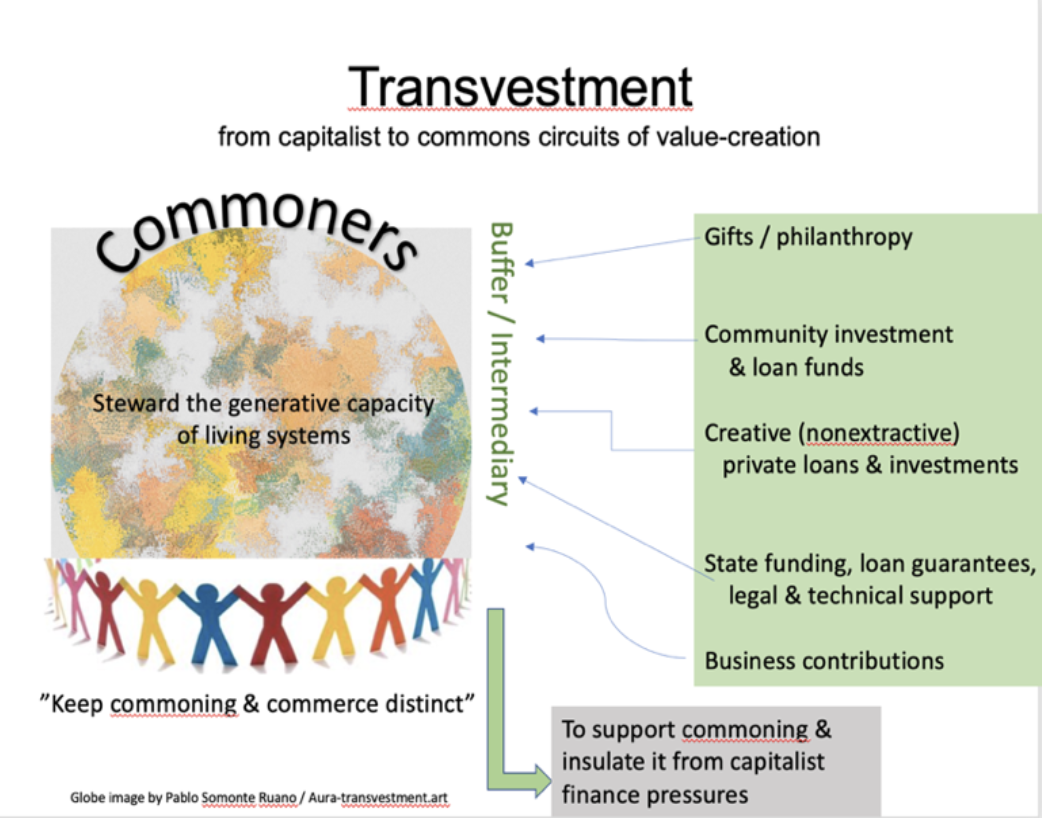
My idea is that there need to be some buffers or intermediary organizations, much as embassies and diplomacy are intermediary spaces between nations, in which you tamp down the power of the big players, you give respect to everyone, including the small players.
And my idea is that there need to be some buffers or intermediary organizations, much as embassies and diplomacy are intermediary spaces between nations, in which you tamp down the power of the big players, you give respect to everyone, including the small players. That’s why you have these protocols and ways of behaving to have meaningful interactions. And I think some version is needed between the state and commons to sort of allow a more fruitful collaboration without the state just dictating, we got the money, we’ve got law, legality on our side, go screw yourself. And the state has to start to realize that its legitimacy crisis and distrust could be fruitfully dealt with by having partnerships with commoners. And the commoners, if they had, for example, the equivalent of corporate charters that corporations have that allowed state recognition of the commons, and perhaps even money support or other support, legal support, administrative support, cultural validation, that would be beneficial for everybody involved. If the state could acknowledge that inhuman, impersonal bureaucracies cannot accomplish certain things, even though obviously there are other things that they can accomplish that are important.
So I have a richer sense of state–commons relationships, but we’re still a long way from having some constructive conversations or innovations in that area.
Who owns the digital world?
Olivier Schulbaum: Taking it back to digital commons: before we started the interview, you mentioned why digital social-media commons would be necessary, versus the right wing taking the lead. I know you’ve discussed that before, but could you frame it for us? How can we deal with it, and what would be the importance of it?
David Bollier: Well, I think that to the extent that you can have social media and other self- and peer-organized digital communities that don’t have to be so beholden to the traditional sources of money and capital, that begins to open up a new social space and public dialogue that has more honesty and integrity than the gamified situation we have now, where the oligarchs own the platforms, the oligarchs control the algorithms, the oligarchs control all the big data sets, and they can skew it to serve their political purposes, à la Silicon Valley fascism. So finding a way for people, in the original vision of open source and the internet, to have genuine control over mutually constructed value is, I think, the important thing. Whether the state will assist that is a more difficult question. Which is one reason I see relationalized finance and transvestment as important, because we need to have a certain sovereignty and integrity of vision and practice and operation in these alternative digital commons.
The state will only go so far, but let me just add without going too much into it, I think all of this implicates the idea of constitutional liberal democracy as an honest broker and as the framework for it all, because we’ve seen how it’s kind of a sham, a joke that can be abridged whenever the oligarchs or capital investors decide, nope, we’re going to go somewhere else. We’re going to say, fuck you, because we hold more cards than you do. So I think some sort of decentralized pluriverse that has some organizational cohesion and shared vision will be necessary to force the state to reimagine its alliances and indeed start to deliver in more substantive, consistent ways for the citizenry who are pawns in a larger political game.
They’re being screwed right and left, and even the political parties are not being able to deliver for them. And so I think you have to have a reimagining of the political forms to engage with the state. It’s not going to be the parties because we’ve seen what happened in Greece, we saw what happened in Bolivia, you know, international capital just trumps it all. And so somehow the state needs to find a different footing with the people, however that is construed. And what’s sort of in play right now is: how do we imagine “the people”? Well, the state imagines it as the only legitimate representative body of the people, whereas I think commons do a whole lot better job of actually meeting needs and representing people than the state does. I’d say that in a crude general sense, because of course there are certain things the state does that, you know, that do serve the people.
So I guess what I’m saying is this is all in an interregnum space of how we reimagine the people’s needs being met in durable ways without the vagaries of political parties and big money corrupting the whole thing.
Beyond Sustainability: Regeneration, Value and Transvestment
Olivier Schulbaum: So let’s get to the positive side. I’d like to dig into the concept of transvestment, and also how it fits the relational finance and regenerative economies framework, which is basically kind of everywhere, right? And people now talk about regenerative economies more than commons. So if you could define and frame the concept of transvestment a little, I’d also like to use it to ask: how do you distinguish regeneration from sustainability? Is regeneration simply a better environment model or does it imply a different ontology of value?
David Bollier: Well, okay, you raised a lot of questions here. I think on the first point, sustainability and all these green words have a diminishing half-life of credibility. And sustainability increasingly became something people saw as a marketing tag with little substance or meaning or structural definition. And so of course people move to regenerativity, which is I think a modest improvement, because at least it starts to acknowledge the dynamic living character of things. But in terms of what it actually means for something to be regenerative, it’s kind of an empty vessel without much meaning.
We need to talk about value in terms of how living systems are generative
But look, that’s the lead-up to why I wanted to talk about transvestment. David Graeber said years ago, at a workshop Silke and I did with him about alternative theories of value: “The problem with the left is they don’t have a theory of value.” That deeper philosophical level explains what’s valuable as a counterpoint to market price. And so market price by default is the definition of value. And we know of course that that’s highly misleading and doesn’t capture lots of important existential value. To sort of condense, I won’t even tell the longer story, I’ll just cut to the chase. I’ve come up with a provisional theory that needs much more development, that we need to talk about value in terms of how living systems are generative.
The value they create, however, is usually not monetized or propertized. Or if it is, it has to be done in very careful ways, so that it doesn’t corrupt the value generating capacity of nature, of social collectives. If you think of open-source communities, nature, especially nature in conjunction with human beings, ecosystems on their own, gift economies, academic communities, all of these are living collectives that generate value in which it’s not a transactional thing with money and property rights. It’s this symbiotic joining of interests around shared purpose and positive—what economists would call positive externalities—nourishing other species without a transaction necessarily going on. So I guess what I’m saying is the complexity of how living systems generate value cannot be captured in Western, modern, capitalist categories of thought. And they’re just unfathomably complicated.
And yet, we see how all sorts of things in nature appear as if by magic through the integrity of the system, whether you believe in Gaia as a living system, or in Gaia as an Earth system, to take away that valence of metaphysics or mythology, there is something going on there that is not being captured by standard economics. So I think if we’re going to regenerate, we have to understand and respect that mystery. And then there are parts of it that we do understand in certain crude ways. And if we’re going to have finance for it, we need to do what I call “transvest” (check the paper) the money to support it, meaning you’re not going to get a standard return on investment the way a capitalist would do, because that’s extractive, almost by definition, or at least doesn’t respect limits until it’s too late.
And so the idea of transvestment is to identify and name the alternative ontology of that living system, or ecosystem. And to note that the money is transferred under a different set of social expectations. And it’s partly philanthropy, it’s partly a long-term investment for the stability of the system. It’s partly you could even argue like a potlatch donation by the big players for their own prestige. It’s partly investment in common. And I don’t think we fully understand what the transvestment would be to make investments in these larger systems. I suppose conventionalists would say, oh, it’s a public good, but that doesn’t begin to capture it either. So I guess my larger point is that we need to rethink the parameters of finance itself, and embed it in various types of long-term relationships.
And this doesn’t mean we can’t, as human beings, benefit from some of what nature’s creating or the rest. It’s just that we need to understand that nature is not a thing or object, or there’s not natural capital that we can just exploit the way we exploit other capital.
Olivier Schulbaum: Could you give a practical example where transvestment becomes clear and easy to apply to specific commons?
David Bollier: Well, I think that… I think we see that right now in certain ways, but it’s just not named transvestment. You see institutional philanthropy helping certain ecosystems. Is that an investment? Is that do-gooding for volunteerism or something? I don’t think they have a theory of value that properly understands what they’re doing when they give money to ecosystem restoration or rejuvenation.
I think my friend, Bram Büscher, who’s the big advocate of convivial conservation, is trying to develop nature-compatible and stable forms of human engagement with the environment, that instead of locking it up the way conventional conservation either locks it up as pristine wilderness or as something that has to pay its way in the market through ecotourism or genes that can be exploited for market sale, he says, no, the problem isn’t human engagement with nature, it’s capitalist engagement with nature. And so, just as Indigenous people and traditional communities have shown us for centuries or millennia, you can have entirely constructive symbiotic relationships with land.
So I think that there are already types of transvestment already occurring. They’re just not named transvestment with all the implications that that word has. Because people have, as collectives, what should I say, protected and invested in these systems for a long time. So I don’t think it’s a radical idea, but our cognitive social meaning system for that kind of investment doesn’t yet exist.
And I think that’s the problem. The problems are in our heads—in how we think about, behave toward, and relate to these phenomena. And we don’t quite have the vocabularies or the living examples to refer to. And so they come across as crazy. But I think they’re real.
From bioregionalism to the parallel polis
Olivier Schulbaum: You haven’t mentioned the bioregional dimension or lens. Could you elaborate on that as well?
David Bollier: Yes, I mean, I’ve recently, along with many other people, gotten more interested in bioregionalism as a frame for talking about all this, because it first of all deals with these ecological realities in our human relationships with nature and its vast diversity, and situates us within nature, as opposed to separate from nature, which I think is a profound, important need that modern humans and capitalism just don’t want to admit or acknowledge. So I think bioregionalism helps us get there. And it is compatible with all the things I’ve just been talking about as well. So I see a need to reconceptualize human activity within a bioregional framing with all the ontological shifts that that requires.
So that means rethinking how markets behave, not in a rip-and-run extractive way, but as benign, non-capitalist markets that have privileged or preferential treatment for one’s bioregional partners. There are interdependencies. In fact, I think markets can even blur beyond market exchange into all sorts of social neighborly help and exchange that’s not necessarily kept track of through money or property rights.
I explained some of these things in my December 2025 paper with Natasha Hulst about relationalized finance and bioregionalism. It’s on my website and Substack. So I guess I could say more, but I think that this is bioregionalism, a different theory of value, new types of bioregional commerce that are more respectful of people and ecosystems, and then relationalized finance as another element. I think they all go together, but this is a work in progress. This is a work of imagination drawing on many examples.
Existing examples may or may not have the self-awareness that they have the capacity to move in different directions with different vocabularies to describe what they’re doing.
Olivier Schulbaum: For example, it’s pretty clear how bioregionalism on the land could apply to land and food. That’s pretty clear. Even talking about cooperatives. How can bioregionalism inform digital infrastructures?
David Bollier: Digital infrastructures can go many ways. I think that’s entirely important because we need to make commoning less heroic, less aberrational, and easier. And I think that digital infrastructures, for one, could help with governance. It could help with commercial exchange. But given that we are dealing with existing political jurisdictions that are very jealous of their power and don’t want to surrender it, and they’re very tightly allied with existing capitalist-driven businesses, I think that a lot of this is going to have to incubate as a parallel economy that has its own sovereignty and integrity within the larger system.
And so, for example, I know people, for example, in the US, who are starting to develop these kinds of regional interdependent trade systems like in agriculture. And if you get sufficient diversity of farmers who are growing food, middlemen who can process it or grind wheat or be distributors, and relationships with schools and institutions that need food, you can start to have a self-made, homegrown alternative economy that is mutually interdependent and self-sufficient without the state getting involved, except later when they say, Oh, shit, you guys are doing something that is taking the moral high ground and doing what we ought to be doing.
And of course, they’ll try to co-opt it—
Olivier Schulbaum: —and shake my foundation as an institution.
David Bollier: Yes, exactly. But I don’t see any other way to make the transition because the state needs an external jolt and competition, you might say, or at least developing these things has to take place in a safe space where they’re not threatened and there’s room for experimentation, which the state and its policies will never be able to allow. And capitalism has such a short-term investment horizon, they’re not going to do it.
So, you know, when I came across this phrase by Václav Havel, when he was a Czech dissident in the 1970s, and was asked, how do you deal with a totalizing system that’s not amenable to civic action or rational persuasion? He said, you build a parallel polis. And the idea is you have the horizontal relationships with people who share your vision and values, you’re allowed to pursue wholesome ends without compromising yourself from the get-go or being co-opted.
And you bravely do what you feel you have to do and hope for the openings in history or the dysfunctions or disruptions that occur from the existing system, which will occur because climate change is the grand—the royal—disruption. So, you know, I think in some ways developing the strategy might seem utopian, but I think it’s a long-term safety net for humanity to develop these systems on a different logic, rather than just trying to incrementally get changes without altering the fundamental logic of the prevailing system. That’s just the way I see the strategic way forward.
Legal hacks: protecting the commons from power
Olivier Schulbaum: Maybe let’s open up a very small parenthesis, which is also an obsession of mine. You’ve talked about the power relationship between commons projects or commons movements and state power, right? And my favorite participation scheme is litigation against governments. So, do you know any specific case that has to do with protection or defense of a commons versus the state’s exploitation of it? Is there any litigation case or movement that would have stopped some kind of privatization or a specific law on managing assets in the city? Do you have any?
David Bollier: No, but you’re pointing to the generic problem, which is the state’s sense of the commons as a moral and political rival. Commoners need protection; that’s why legal hacks are so important to try to defend the commons using the prevailing terms of the existing system. But for example, that’s what the Creative Commons licenses were all about, and the licenses for free and open-source software. But it’s also what the rights of nature legal hacks are all about, to try to pursue Indigenous people’s ends within the legal infrastructure of Western modernity. And, you know, people correctly point out that it’s not pure enough, it’s not true enough to the meaning of rights of nature. And yet, we don’t have a choice really, because the state holds too many cards.
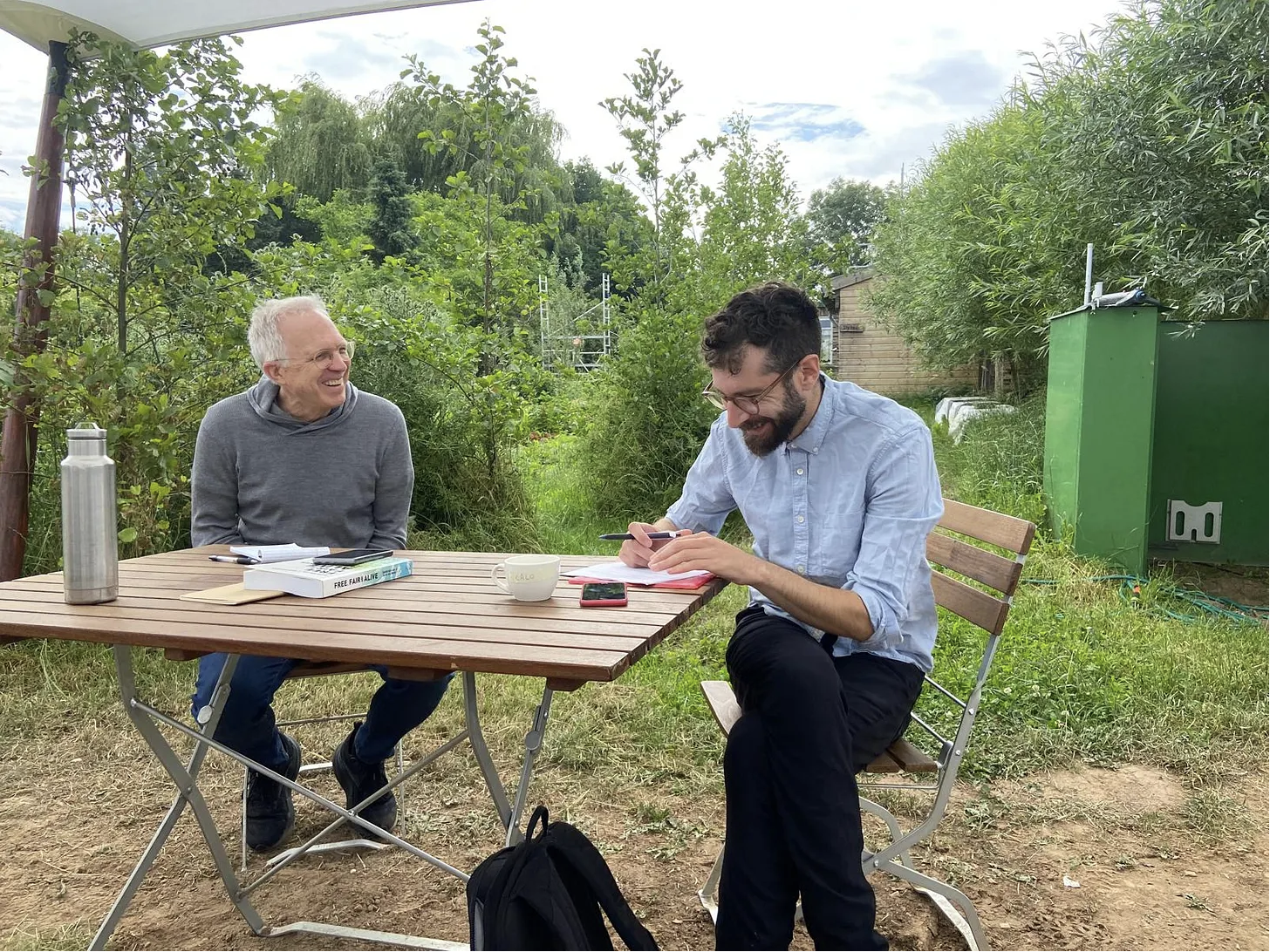
Adam Calo’s interview with David Bollier
Property vs. the Commons (https://davidbollier.substack.com)
Having said that, these legal workarounds allow you to amass a cohort of people around a different set of values. The way a lot of people said, you know, Creative Commons is still relying on property rights, and it’s therefore impure by my Marxist standards. But of course, it created an entire global universe of people who share and understand this, which arguably is as important as the intellectual purity of finding some other basis for the licenses. So, you know, purity is not going to win the day. And yet, we don’t want the incremental stuff to be co-opted either.
Can AI be a commoner?
Olivier Schulbaum: So, I won’t go into extraction and all these minerals feeding the AI industry and so on. But my question is, if AI potentially and dramatically reduces the cost of coordination, does it, or could it, somehow strengthen commoning or common movements, or could it quietly replace, or become a clear threat to the social relationships that make commons possible?
David Bollier: So, it’s definitely a risk. I think right now, we really don’t know because AI has not been released into the field sufficiently with sufficient autonomy for its participants. I think it’s conceivable that it could serve that function. But I think that there are so many pitfalls. The AI privileges cognitive knowledge and backward-looking knowledge as opposed to forward-looking creativity and human judgment and context. You know, it’s like a very arcane type of knowledge that we’re privileging versus something more humanistic, relational, meaningful.
And so that’s just the first threshold. We don’t even get into the operational dimensions of it. So I’m a little more skeptical that AI is going to have this valuable role, particularly since we already know it’s based on these ecologically unsustainable data-center models. So, you know, it is astonishing what the technology is capable of. Who’s going to control it under what logic? Its money-making potential is so huge.
Could we just slow down and have a little more deliberate, thoughtful reflection on how we might want to deploy this technology and who it's going to serve as opposed to some marketing-push service that warps our humanity in ways we haven't begun to fathom?
And indeed, it’s an imperative if all that huge investment is ever going to be recovered and not just have a super economic crash. So, I just am reluctant to invest myself personally or economically, certainly, in something that seems so problematic as the titans of AI themselves imagine. You know, half of them are saying it could destroy humanity. So, I was like, whoa. Could we just slow down and have a little more deliberate, thoughtful reflection on how we might want to deploy this technology and who it’s going to serve as opposed to some marketing-push service that warps our humanity in ways we haven’t begun to fathom? So, big topic. Big topic, with no answers, but nevertheless…
Olivier Schulbaum: I think AI right now could be good at taking over some of the less exciting moments: deciding the rules, or adapting or personalizing the governance rules for a commons. It could very quickly propose something that we could agree with without long discussions. It’s an example.
David Bollier: I think the principles of commoning are very much needed to try to start a different kind of conversation about AI as opposed to just getting into the grooves of existing institutions and businesses. But, you know, it’s the vastness of it and the fast-changing character of it that makes that almost impossible, it seems, especially at a popular level. Perhaps a handful of, you know, 50 or 100 people could have sufficient expertise to have these discussions, but whoa.
Olivier Schulbaum: Yeah, smaller experiments can be useful. Anyway, next time I’ll share with you some of the experience we’re having creating, you know, multiple agents. We’re thinking about the collective views of an AI agent that could also help us deliver it a bit better. But there are lots of reports on failures and adapting Habermas to a Habermas machine that really oblige us to think only about consensus and don’t allow us to, you know, basically activate our query, really, because we dissent or we don’t really fully agree on some decision that should be made. So we’re working on a small experiment that we’ll share that with you later.
David Bollier: Well, any little beachheads of understanding on an experimental basis are valuable, especially coming from a different perspective. So I’m eager to learn more about yours.
Olivier Schulbaum: Basically, we’re also doing a kind of study. So we use the official kind of AI from industry and we’re building our own AI agents, which is basically set up on my TV set. And the biggest difference is that if you ask both of them, “What is democracy?”, the one on my TV set takes something like five minutes to answer, anyway. But we basically started from scratch with the whole curation of the, you know, knowledge feeding and we started with a philosopher agent.
So we have a legislative theater agent and we have a deliberative agent representing something more like, you know, a classical institutional deliberation agent, but we also have the philosopher, and we’re basically using a set from my colleague Christian, which consists only of non-digitized books and, you know, handwritten manuscripts by philosophers that he has been collecting for the last 25 years. And this is basically the first body of knowledge we’re providing to the small AI engine.
So it’s just an experiment, but it’s a, you know, small: small is beautiful.