Interviews
Petra Guasti Can Youth Deliberation Inoculate Democracy? Youth deliberation, democratic learning, and the fragility of equal voice


Petra Guasti is Associate Professor of Democratic Theory at Charles University in Prague and a researcher at the Institute of Sociology of the Czech Academy of Sciences. Her research focuses on democratic resilience, populism, and citizen participation, with particular attention to democratic backsliding in Central and Eastern Europe.
In November 2025, the Liberec Scientific Library hosted the deliberative youth forum Region for the Youth, bringing together 54 participants aged 15–26 from across the Liberec region as part of the AUTHLIB (Neo-Authoritarianisms in Europe and the Liberal Democratic Response) project. Organized by researchers from Charles University together with local partners, and facilitated by Participatory Factory, the two-day forum was designed as an experiment in democratic practice. Participants received structured information about governance, deliberated in facilitated groups, and presented proposals directly to municipal, regional, and national politicians.
The process also included questionnaires administered before and after the forum to observe how attitudes toward politics, democracy, and participation might change through deliberation. The results complicate simplified narratives about youth radicalization and democratic decline. While participants were often willing to revise policy positions during the process, their basic democratic commitments remained surprisingly stable. At the same time, the experiment revealed how fragile an equal voice can be inside deliberative spaces and how much careful design is required to support meaningful participation.
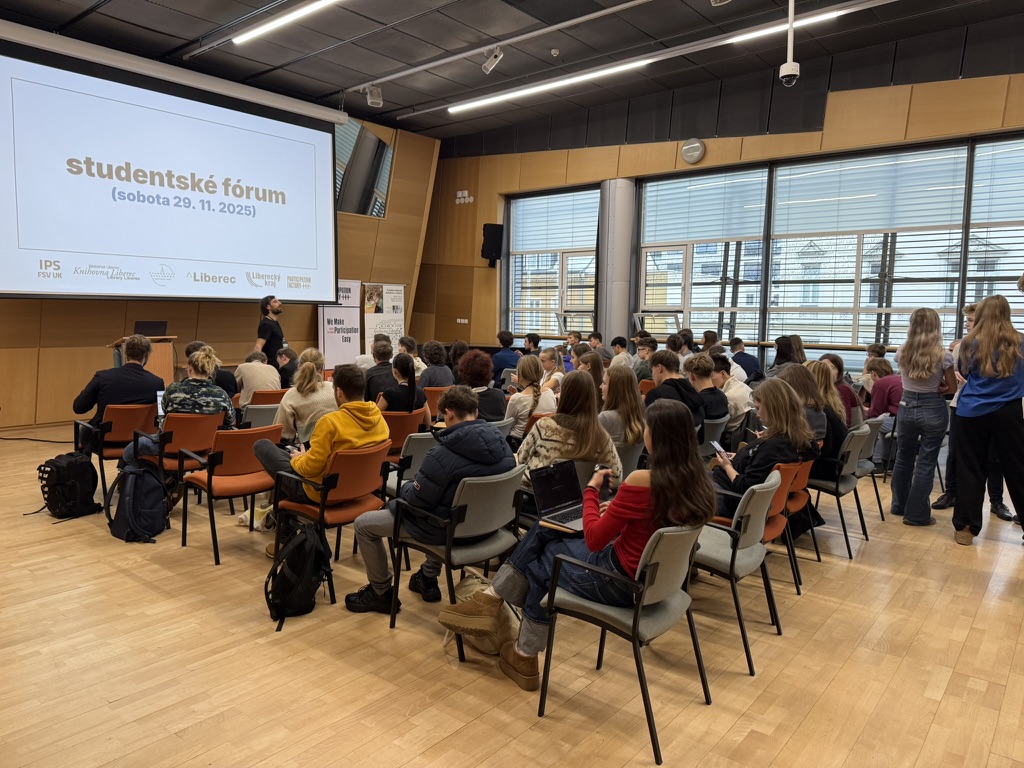
First Youth Forum entitled “A Region for the Young”
AUTHLIB’S 2025
Agenda-setting and what young people actually discussed
Can you basically contextualize what the topics of the youth forum were?
One of the most important design choices we made was to allow participants themselves to define the agenda. In our earlier deliberative forum (of ideological opponents) we selected deliberately polarizing topics. But with the young people we wanted to see what happens when the agenda is set from the bottom up.
The first day of our youth forum was largely devoted to agenda-setting. Participants were randomly assigned to mixed groups balanced by gender, age, and information levels. During the morning and afternoon sessions, they worked through exercises and discussed to identify the most pressing problems facing young people in the region.
Several themes emerged repeatedly. Transportation was one of the biggest concerns, particularly for young people living outside the regional capital Liberec, who struggle with limited night and weekend connectivity. Cultural opportunities were another issue. Many participants felt there were too few spaces where young people could organise activities themselves. Environmental concerns also appeared, particularly around neglected public spaces such as parks.
Interestingly, civic education itself appeared as a topic. Some participants argued that schools do not provide enough opportunities to learn about democratic participation.
This emphasis on agenda-setting resonates strongly with experiments we have conducted in the INSPIRE project, where deliberative pilots often begin not with policy questions but with collective mapping of lived problems. In one migrant community pilot, participants similarly shifted the conversation from predefined policy themes to everyday issues such as access to housing and bureaucratic barriers.
Do you see arts-based or performative methods such as legislative theatre, storytelling circles, or participatory cultural practices as potentially expanding democratic expression where formal discourse becomes constrained?
Yes, I think they can be very helpful, particularly at the beginning of a deliberative process. Many fora rely heavily on verbal argument. That immediately privileges participants who are already comfortable speaking in public or who have experience with political debate.
Arts-based methods create additional channels of participation.
Arts-based methods create additional channels of participation. Drawing, visual mapping, or storytelling can help participants express experiences that they might not yet be able to translate into policy language.
With young people, this is particularly important. They often have very concrete experiences but lack the vocabulary to express them politically. Artistic methods allow these experiences to surface before the discussion becomes structured.
In several Platoniq experiments, including legislative theatre processes, we observed something similar. Participants often articulate problems through scenes, images, or stories before translating them into proposals. The artistic phase does not replace deliberation. It prepares the ground for it.
Do arts-based deliberative formats create different kinds of democratic safety, for example by allowing metaphor, narrative, or embodied experience to surface grievances without immediate polarization?
Yes, they can create a different type of safety by lowering the pressure to speak in a highly formal way. When participants feel they must sound knowledgeable or sophisticated, some withdraw.
Expressive formats allow people to communicate concerns without immediately entering an argumentative mode. This is particularly useful in heterogeneous groups where participants have different levels of confidence or experience. Which, from my experience, is every time. At a different level, and to a different degree, but always.
But these methods must connect to the broader process. If they remain isolated, policymakers might see them as symbolic rather than substantive.
In some INSPIRE pilots we observed that visual or performative tools helped participants articulate complex experiences of exclusion. However, their legitimacy depended on linking those expressions to concrete deliberative steps and institutional dialogue.
Volatility and recruitment
In your forum, the youngest participants were most willing to revise their views during deliberation, compared with young adults. How should we interpret this volatility?
One important explanation lies in our recruitment. We cooperated with local partners – among others, the Technical University of Liberec and the Association of High School Parliaments. Around ninety young people aged 15 to 26 initially signed up. From those we invited, 60 participants were selected, ensuring variation across gender, age, and levels of political information. Participation was still voluntary, so 52 ultimately attended.
Due to this recruitment strategy, many of the youngest participants (15–17) came through high school parliaments. These are student representation bodies that operate in many Czech secondary schools as part of civic education programmes encouraging democratic participation. Students debate issues affecting their school community, organise activities, and represent their peers in discussions with teachers and school leadership.
This means that neither the youngest participants nor the forum as a whole was a representative sample of young people. They were young people who attended schools with student parliaments, had already chosen to engage with civic structures, and wanted to come. They were used to discussion formats, negotiation, and the expression of their views publicly. In that sense, they resembled active citizens more than a representative youth sample.
A small vignette illustrates this. One participant arrived wearing a suit and was accompanied by a school adviser. The attire signalled that the event was unusual and important for him, and the presence of the adviser signalled that it mattered for the school as well. This illustrates that participants did not arrive randomly but were often already embedded in civic structures.
Recruitment inevitably introduces self-selection bias. This is a common feature of mini-publics, including those using sortition.
Recruitment inevitably introduces self-selection bias. This is a common feature of mini-publics, including those using sortition. With a five to ten per cent acceptance rate, deliberative democracy research should probably devote more attention to this issue.
Another lesson concerns how we think about youth cohorts. Our forum included participants aged 15 to 26. On paper, this looks like a single generation, but in lived experience, these are very different life worlds. High school students, university students, and young adults entering the labour market face very different responsibilities and experiences. Age differences in this cohort matter much more than in older groups. In future forums, we will likely separate cohorts and also try harder to involve vocational training students.
Similar generational differences appeared in Platoniq’s youth facilitation programmes, where participants aged 18–25 often approached participation very differently from high school students. The institutional experiences available to them shape how they engage.
Internal efficacy and communicative confidence
Were you surprised that deliberation sometimes reduced participants’ sense of communicative confidence?
Yes, that was one of the most interesting paradox of the experiment. In theory deliberation should increase people’s sense that they can express themselves politically. But what we observed is that the process can also make communication inequalities more visible.
When participants enter a deliberative space, they encounter others who may be more articulate, more confident, or simply more experienced in discussing political issues. Gender differences exist; in the Czech Republic, different behavior is still expected in many families of boys and girls. Even if facilitation is carefully designed to create equal opportunities to speak, these differences still appear in the interaction. Some participants naturally feel more comfortable speaking in front of others, while others hesitate or withdraw.
What becomes visible is the difference between having a voice and feeling able to use that voice. Facilitation can help by preventing domination and inviting quieter participants into the conversation, but facilitators cannot fully control how confident people feel expressing their views or how articulate they are.
This is why I think we need to experiment more with multiple synchronous and asynchronous channels and communication modes. Not everything needs to be verbal. Some participants may feel more comfortable expressing their positions through written inputs, digital tools, or other forms of interaction that do not require speaking in front of a group.
We also observed something interesting in the earlier experiments we conducted. Participants sometimes expressed stronger or more controversial opinions in written form than in open discussion. In any group setting, there is a social filter. People moderate what they say in front of others. When responding anonymously, they sometimes articulate positions that they would not express aloud – more radical.
the challenge for deliberative design is to recognise that equal voice cannot be achieved alone through allocating speaking time equally.
So the challenge for deliberative design is to recognise that equal voice cannot be achieved alone through allocating speaking time equally. It requires creating multiple channels for participants to contribute to the discussion and influence the collective outcome. Digital tools can allow participants to express views anonymously or register preferences without speaking aloud.
Deliberative mini-publics, therefore, reveal something fundamental about democracy more broadly: formal equality of voice does not automatically translate into equal influence. In that sense, deliberative spaces often make visible the same inequalities of confidence, articulation, and experience that structure political participation more generally.
Experiments combining digital participation tools with deliberation, such as those using Decidim-based platforms, have shown that hybrid formats sometimes allow quieter participants to contribute more actively.
Informal hierarchies and facilitation
Facilitators observed informal dominance patterns during deliberation. Some participants were more articulate or politically experienced and tended to shape the discussion. What role does active facilitation play in guaranteeing equal voice?
Facilitation can limit domination, but it cannot eliminate inequalities in communication styles. Some participants are simply more extroverted or more confident speakers. That does not mean their views should carry more weight, but it does mean they will often try to speak more.
What we asked from facilitators was to create equal opportunity for voice. Their role was to prevent a single participant from dominating the discussion and to actively invite quieter participants into the conversation. But facilitation has limits. Even when you invite someone to speak, you cannot control how comfortable they feel using their voice. Sometimes participants with less confidence will simply repeat, almost verbatim, an argument articulated earlier by someone they perceive as dominant or particularly knowledgeable.
This is another aspect of deliberation we still need to understand better. One direction I would like to explore is expanding the number of participation channels. Not everything needs to happen through speaking in front of the group. Digital tools can enable participants to register their positions anonymously or respond via mobile devices. Some participants may feel more comfortable expressing their views in this way rather than speaking in front of ten strangers.
If students learn facilitation skills early, we can build a cohort of facilitators closer in age to the participants and less shaped by other types of facilitation.
I am also curious whether AI-supported tools could help participants access information more easily during deliberation or structure their arguments more clearly. The goal would not be to replace discussion but to support participants who might otherwise feel less confident in articulating their views.
Another lesson concerns facilitators themselves. Many professional facilitators are accustomed to processes with a desired outcome, for example, resolving local conflicts or negotiating compromises. In our case, we wanted something different: a democratic procedure with a clear process but uncertain outcomes. That requires considerable discipline from facilitators, because people inevitably bring their own perspectives.
One longer-term idea for youth fora is to train facilitators internally rather than relying entirely on commercial providers. If students learn facilitation skills early, we can build a cohort of facilitators closer in age to the participants and less shaped by other types of facilitation.
This echoes discussions within the INSPIRE project about the “micro-politics of facilitation,” where facilitators must balance guiding the process without steering the results.
What role does informational equalisation play in deliberation?
We cannot completely equalize information, but we can try to establish a shared minimum level of knowledge so that participants begin the process from a comparable starting point. The goal is not to eliminate differences completely, which would be impossible, but to ensure that discussions are not dominated by those who already possess more information about how democratic processes work.
In the youth forum, we therefore focused on providing a basic understanding of how governance actually works. Participants needed to know which decisions belong to the municipality, which are in the purview of the regional government, and which are at the national level. Without that knowledge, bottom-up agenda-setting discussions can quickly become unrealistic. Someone might ask a national politician to solve a problem that is actually the responsibility of the city administration or propose a solution that lies outside the competence of the institutions present in the room.
We also paid attention to how information was delivered. I did not want it to feel like a lecture by a professor. Instead, a PhD student who was closer in age to the participants presented the material in a more conversational way. The idea was to create an informational foundation without reproducing the hierarchical dynamics of a classroom.
Participants also had access to the materials during deliberation, so they could refer to them when preparing their proposals. In this way, informational equalisation functions as a democratic infrastructure. It allows participants to focus on preparing their argument for the political representatives rather than struggling to understand the institutional landscape.
Several participatory experiments using civic platforms have shown that participants often struggle not with opinions but with institutional navigation. Providing this informational infrastructure is essential for meaningful deliberation.
Deliberation as bundled democratic practice
Why is it misleading to isolate deliberation as a single causal mechanism?
Because deliberation almost never happens in isolation. In our forum the process combined several elements: information provision, peer interaction, facilitation, and encounters with politicians. Each of these components may influence how participants think about issues.
For that reason, I prefer to describe the forum as a bundled democratic experience rather than as a single intervention or a black-boxed deliberation. We know that participants were exposed to various inputs during the process, but we cannot easily say which one produced a particular change in attitudes.
I do not think this is unusual. We are simply being more transparent about the ‘behind the curtains’ than some of the literature. If you look at well-known deliberative processes, such as citizens’ assemblies in Ireland, they also combine expert presentations, participant discussion, and interactions with political actors. These are all part of the experience. And we do not know which element contributed more (or less) significantly to the outcome – persuasion of individual participants.
If we wanted to identify causal effects more precisely, we would need more detailed measurements during the process. For example, digital tools could allow participants to answer short questions at different stages: before the information session, after it, after a coffee break or lunch, before meeting politicians, and again after those encounters. That kind of design could help us understand which moments in the process actually influence participants and the outcome of deliberation.
Our most substantive finding exemplifies this. We found a difference between values and policy preferences. Participants were often willing to revise their views on specific policy issues. But their basic views about democracy itself were much more stable, even among the youngest participants. That suggests that deliberation may be more effective in shaping policy reasoning than in changing fundamental democratic commitments.
In several participatory experiments using digital civic platforms, similar dynamics appear: exposure to new information and perspectives often shifts policy preferences, while core democratic values tend to remain relatively stable.
Did deliberation produce any movement toward illiberal attitudes among participants?
No, we did not observe systematic radicalization during the process. Participants entered the forum with a diversity of views, which is normal, but there was no consistent movement toward more extreme or illiberal positions.
At the same time, I did not want to assume in advance that deliberation would necessarily move people in a more liberal direction. If persuasion happens in a deliberative process, it could theoretically go either way. For that reason, we designed the study to allow us to observe shifts without presuming their direction.
One issue I was particularly attentive to concerns the growing gap that surveys are identifying between young men and young women. Some studies suggest that young men are increasingly exposed to far-right narratives, often through online platforms and algorithmic recommendations, for example, on YouTube. So it was important for us to examine whether deliberation could amplify those dynamics.
What we observed instead was that while participants held different positions on issues such as LGBTQ rights or migration, the process did not push them toward more extreme views. If anything, participants holding less liberal views were somewhat more open to revising their positions in a moderate direction than moving toward more radical ones.
Authoritarian appeal and democratic inoculation
Where should democratic interventions focus their energy in response to authoritarian narratives?
I often describe the goal as democratic inoculation. In the same way that vaccines teach the body to resist disease, democratic inoculation can help citizens develop the capacity to resist manipulation, misinformation, and overly simplistic political narratives.
One thing we know from research is that the appeal of authoritarian solutions tends to increase in periods of uncertainty. When people feel insecure or when the future becomes unpredictable, there is often a temptation to look for strong leaders who promise order and certainty. In that sense, authoritarian appeal is frequently linked to uncertainty.
At the same time, research suggests that authoritarian preferences exist in varying degrees across societies and can become more visible under particular conditions. They interact with ideology, political culture, and media environments.
Algorithms favour engagement, and people tend to engage most with content that provokes strong reactions or clashes with their views.
Today these dynamics are amplified by digital ecosystems. Algorithms favour engagement, and people tend to engage most with content that provokes strong reactions or clashes with their views. This dynamic can contribute to polarization and to the visibility of more extreme narratives. I am very concerned that in the absence of effective regulation, young people in particular are exposed to increasingly radicalizing content.
For this reason democratic education cannot rely only on messaging or symbolic appeals to democratic values. What democratic interventions should aim to do instead is strengthen citizens’ capacity to navigate the political system. Democratic participation requires a basic level of institutional literacy: understanding how decisions are made, where authority lies, and how citizens themselves can intervene in these processes.
Protest and activism are important, but they are only one part of democratic participation. If citizens do not understand where, when, and how decisions are actually taken, their political energy can easily be diverted or manipulated.
Several deliberative experiments working with young participants have shown that institutional literacy and direct interaction with policymakers can strengthen democratic resilience more effectively than purely informational campaigns.
Personal reflection
Listening to Petra describe the Liberec experiment, I was struck by how many of the lessons emerging from this small youth forum echo insights from other participatory experiments across Europe. The fragility of equal voice, the importance of information, the subtle but crucial role of facilitation, and the need to create spaces where disagreement can unfold without collapsing into polarization all appear again and again.
Yet the most intriguing lesson may be the idea of democratic inoculation. In an era where political debate often focuses on combating misinformation or countering extremist narratives, Petra’s reflections suggest something deeper. Democracy may not be defended primarily through arguments, but through practice. Through the lived experience of participating in processes where disagreement is structured, where institutions become legible, and where one’s voice is both challenged and recognised.
This raises a broader question for readers and practitioners alike. If democratic resilience emerges from experience rather than persuasion, then perhaps the challenge is not simply to convince citizens that democracy works. It is to create more opportunities for them to practice it.