Interviews
Eva Navarro “Algorithms will change as society changes.” Humanistic AI for the LaNuestra community

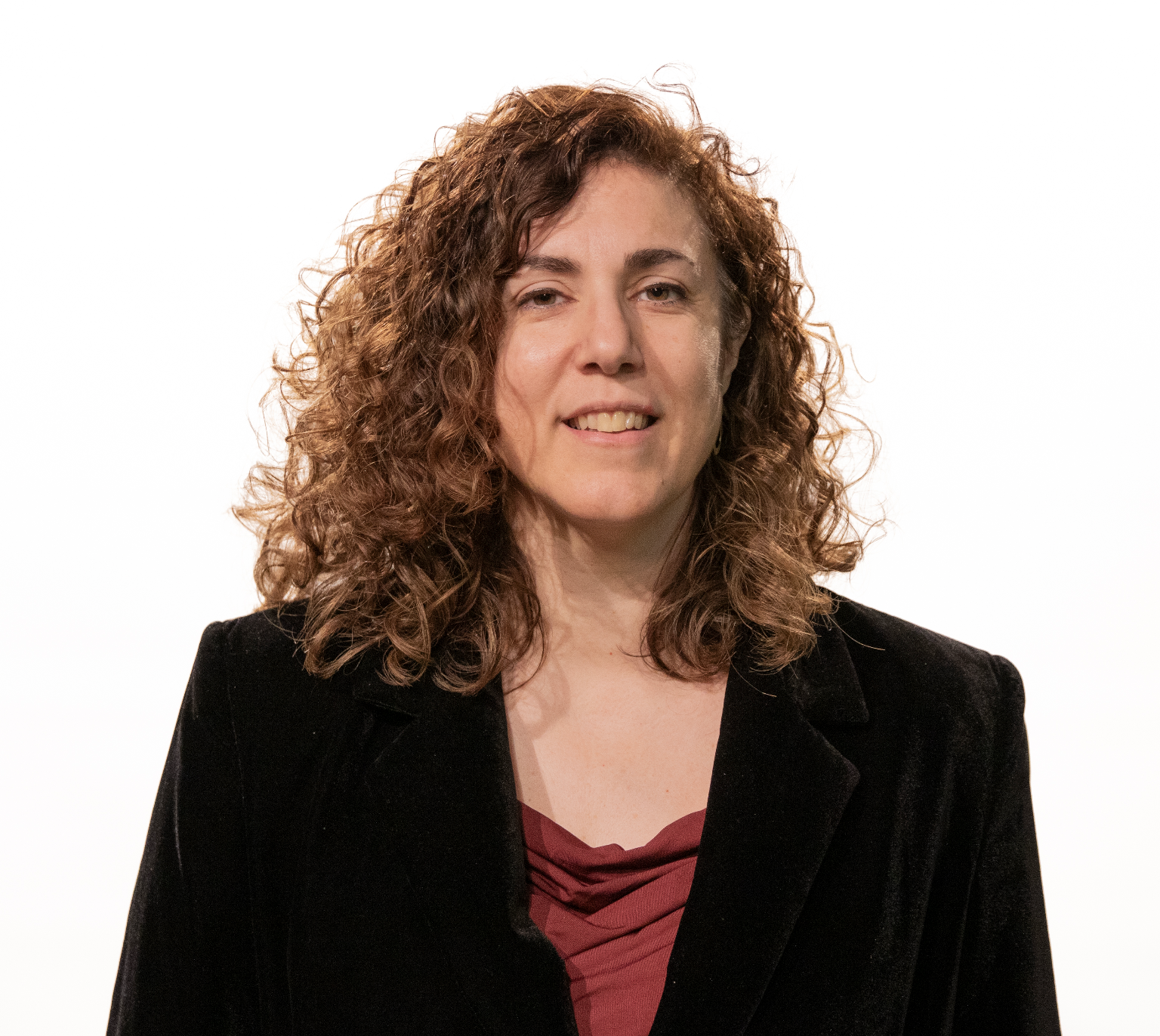
We spoke with Eva Navarro, who is responsible for designing the artificial intelligence architecture behind LaNuestra, the feminist infrastructure that transforms testimonies of gender-based violence into collective memory by combining ethical technology, human oversight, and community to restore power, dignity, and decision-making capacity to those who have historically been silenced.
Drawing on her experience, Navarro explains how the project not only aims to anonymize, categorize, and analyze millions of testimonies of gender-based violence with ethical rigor and human oversight, but also to build a community capable of restoring power, dignity, and agency to those who have historically been silenced. Within this vision lies one of its most powerful initiatives: the creation of a LaNuestra Academy, a space where technology is neither an extractive tool nor reserved for specialists, but rather a pathway to learning, autonomy, and healing for women who, drawing from their experiences of pain, can take ownership of technical knowledge and transform their own lives as well.
Eva is a scientist, professor, and researcher specializing in artificial intelligence, computing, robotics, cybernetics, and control systems. She has served as a professor of Artificial Intelligence and Computing at the Rochester Institute of Technology, where she also directed the School of Information. Her work combines technological research, critical thinking, and social engagement. She is a member of the senior team at the International Panel on the Information Environment, a global organization founded in 2023 that works to promote information integrity and combat disinformation, algorithmic biases, and the negative impacts of artificial intelligence on democracy. In addition, she is a researcher at the NOVARS Innovation and Media Lab at the University of Manchester and collaborates with the Civic A.I. Lab at Northeastern University in Boston, which focuses on civic artificial intelligence, human-computer interaction, and new forms of digital work.
Eva is also part of Technolatinas, a horizontal support community for Latin American women in technology and their allies, created during the pandemic to address the loss of job opportunities that particularly affected women. For her, Tecnolatinas represents a fresh, feminist, intergenerational, and community-based space, founded on collaboration, mutual learning, and collective action.
Starting point: complex systems
Hi, Eva, let’s start at the beginning. What do you mean by artificial intelligence?
Well, as a computer scientist, I’ve been obsessed with modeling the brain since I was a child, and I’ve done just that. That’s one way to understand artificial intelligence: I model the human brain—not just with artificial neural networks, though I use those too—but with dynamic mathematical models, complex dynamic networks where you know the equations. The goal of artificial intelligence is to model and reproduce certain aspects of intelligence found in humans and in nature. But imitating or reproducing something doesn’t mean you have intelligence. This is a fundamental point. Something more is needed.
There are many artificial intelligence techniques based on models and the observation of nature, for example, multi-agent models of collective intelligence in which you observe ants, birds, and fish: that is collective intelligence. We can also talk about genetic algorithms that have generated many artificial intelligence models, and we can also talk about automatic reasoning, for example.
And then there are those who believe they have developed intelligent models, when in reality they are serving other interests. I’m talking about that so-called “generative” artificial intelligence, which, in fact, isn’t even intelligent. It’s more of a business model than artificial intelligence. I’m talking about those who believe that if I can model a brain, then I can replace humans: a hyper-capitalist vision of artificial intelligence. And I find that abhorrent. That’s where artificial intelligence stands in opposition to human rights, based on fear and control.
we need a humanistic artificial intelligence based on Terence’s “nothing human is alien to me.”
Right now, what we have is a society completely riddled with discriminatory biases, unequal, and exploitative. We have undone everything we had achieved over 200 years through social struggles, and behind the most popular technologies lie armies of humans—working-class underclasses with no rights—what are called “ghost workers” or, as I call them, Buñuel’s “the forgotten”.
You’ll agree with me that his view of artificial intelligence is gaining ground—is there any alternative to this way of understanding it?
Algorithms will change as society changes. We need more diversity of ideas and people in algorithms. If I were to propose an alternative, I would say that we need a humanistic artificial intelligence based on Terence’s “nothing human is alien to me.” I’m talking about feminist artificial intelligence, understanding feminism as an inclusive movement that fights for equality, inclusion, and diversity for everyone.
An artificial intelligence for everyone, everywhere in the world, that does not promote the concentration of privilege. I would like us to stop talking so much about human-centered AI and start talking about environment-based artificial intelligence, which also includes humans. We need multidisciplinary technology that integrates the humanistic and the ethical into a diverse technological world.
I understand that an initiative like La Nuestra seems to be the kind of alternative you’re describing. You work with artificial intelligence, complex systems, formal methods, data science, robotics, education, art, and technology ethics. What does a project like La Nuestra require that couldn’t be addressed by a single discipline?
La Nuestra is a challenge in which I feel I have to apply everything I’ve learned throughout my life. I believe that the La Nuestra space is not merely a technological, scientific, sociological, legal, or political issue, but rather a complex system; and as such, if we look at it from the perspective of control theory and dynamical systems, I see nonlinear dynamics that change over time, delays in institutional responses, invisible patterns at the individual level that we detect as a collective, and structural silences that we can then model—which means there is feedback…
Control engineers work with complex systems. How? We want to make a better world, and to do so we have an ideal, a desired behavior, and from there we observe the world, model it, measure it, and if we don’t like it, we act and correct it. In our society, there is a social contagion of fear; there is a collective memory of pain, and it is possible to view this collective memory as self-organized behavior, as a complex system.
Therefore, we need different perspectives to approach this system: artificial intelligence, computing, engineering. We must protect complexity. That is why we need a sociologist, a psychologist, a human rights specialist, a legal expert… who complement each other like pieces of a puzzle.
Multidisciplinarity at La Nuestra is essential, and it is no coincidence; rather, it is an ethical imperative because if computational, mathematical, and technological design is not done with care, we risk oversimplifying human experiences—and that, at La Nuestra, is not an option.

\
You have worked with symbolic AI, automated reasoning, verification, and formal methods. What do these fields contribute to an AI that cannot afford to hallucinate, oversimplify, or invent anything regarding the testimonies?
First, let’s be clear. ChatGPT and similar generative tools don’t “hallucinate”—they make mistakes, on average 60% of the time. This shift in language obscures the truth about these tools. At La Nuestra, we will use a variety of technologies, including mathematical computational models and artificial intelligence models—not just generative ones.
In our case, there can be no errors. The basic principles we were taught in algorithm design classes are: robustness—the output of an algorithm must be correct—and completeness—the algorithm will find a solution if one exists. This is what I teach my students, and we cannot forget it, especially in this case. When handling sensitive data and files of this type, there can be no errors, so we cannot use these kinds of tools at LaNuestra.
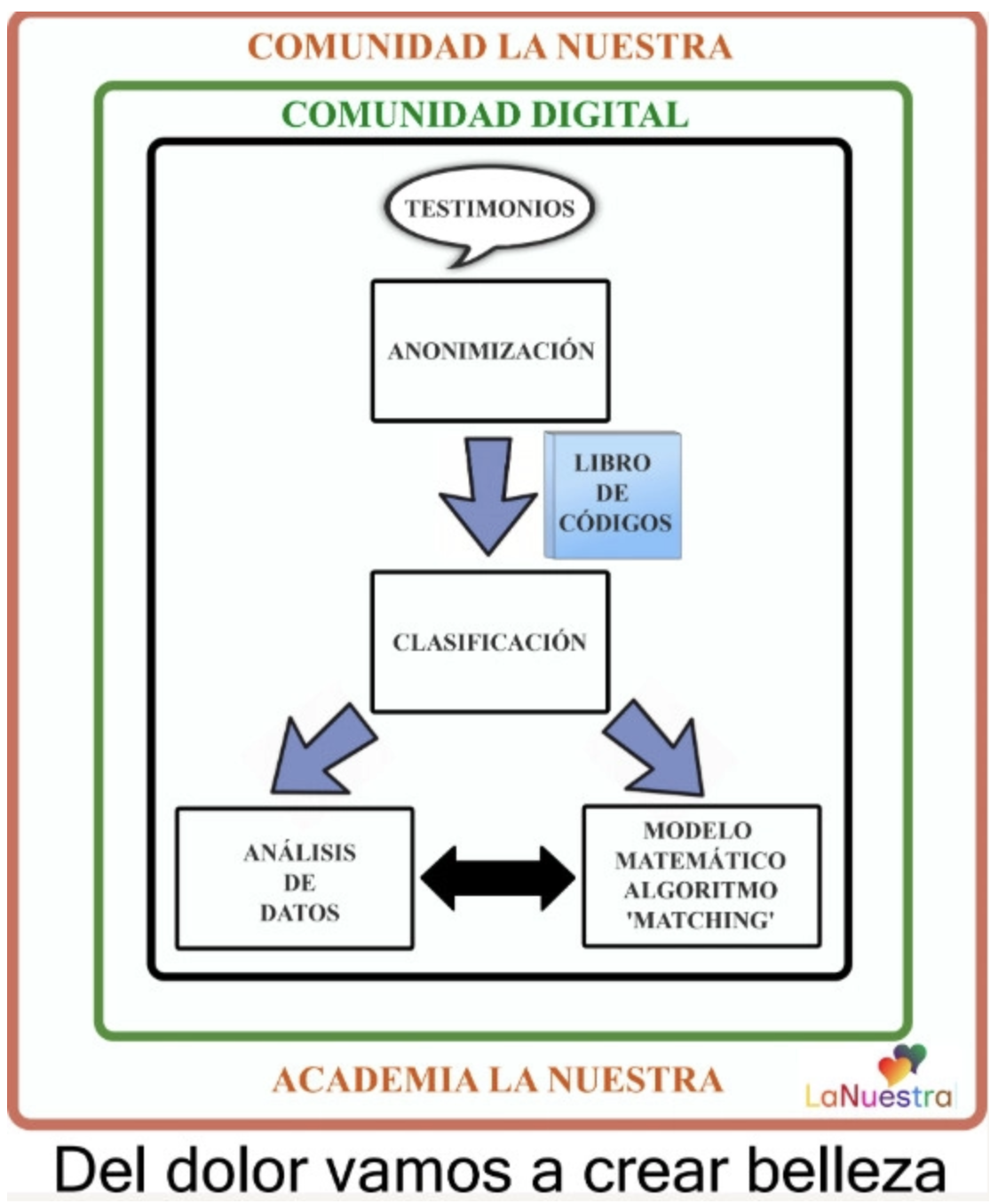
So, the first AI module in La Nuestra will be used to semi-automatically anonymize the more than three million testimonies. On the one hand, it will build on all the work done with the first 5,000 manually anonymized testimonies. Here, Data Género’s AymurAI project will serve as our reference.
We will use different techniques: natural language processing techniques and techniques on which large language models (LLMs) are based, although I like to think that ours will be a “small language” because it will be very closed, local, and won’t be done online.
Once we have anonymized the testimonies, the second phase will involve categorizing them, and for this, we can use different techniques: machine learning or statistical classification techniques in combination with other artificial intelligence techniques. Here, we must highlight all the work done by Juliana de Souza, who has created a codebook with great care and rigor, and that will be our starting point for categorizing the testimonies.
Once we have categorized the testimonies, we will still have two more steps: the third step involves data analysis using data science techniques and statistical data visualization methods, which should help us provide reliable data. Keep in mind that this database is very comprehensive. Imagine being able to provide reports and data to governments and organizations like the United Nations.
Currently, the data used by the Spanish government consists of reports of incidents and represents only a small percentage of the women who have experienced violence. The LaNuestra archive, the Cuéntalo archive, and the one that will be continuously generated—because, unfortunately, there will always be new testimonies of gender-based violence—is far richer than the data held by governments.
And then we have the last box, which for me is the most beautiful and the one that drew me in: network modeling—modeling a complex network not as an artificial neural network, but as a mathematical and computational model, always keeping in mind that it is a multilayered network that adapts and changes over time. There, we’ll be able to create LaNuestra’s algorithm to match women, skills, needs, and so on…
In short, boxes one, two, three, and four make up LaNuestra’s artificial intelligence, and with all of this, I want to create a LaNuestra academy. Imagine that woman who seems broken by grief and who doesn’t come from the tech world suddenly learning about technology—and from there, changing her life and landing a job in the tech industry.
That’s how technology can transform people, too.
First box: anonymization
How can we address accounts of sexual assault, institutional violence, fear, or silence?
When Cristina Fallarás invited me to join LaNuestra, I remember I couldn’t sleep that night. Suddenly, I was going to be leading the entire artificial intelligence component, the complex network model, and the feminist matching algorithm, so the first thing that came to mind was the beauty of complex networks.
From the very beginning, my motto has been: we’re going to create beauty out of pain, using mathematics and artificial intelligence. I see it as a form of healing. LaNuestra is healing: building a supportive community and breaking the silence is the beginning of healing. As feminism says, what isn’t named doesn’t exist.
But I’m not an expert archivist; I don’t have experience with the entire testimonial movement, but I fully understand that a feminist archive doesn’t collect pain and fear, but rather creates conditions so that the experience is no longer isolated.
What is fundamental to me is that LaNuestra creates a community of mutual support and collective action, because reparation does not consist of preserving memory but of restoring dignity and narrative power to people; otherwise, it is something dead.
What changes when we work with personal stories?
Well, it changes everything—absolutely everything—and here we must return to the concept of multidisciplinarity, the multiple perspectives offered by diverse viewpoints, because a mistake in this context is not merely technical; it puts a person or a group of people at risk. A poorly executed classification can completely distort an experience, and an inappropriate data visualization can expose sensitive patterns.
Furthermore, in these contexts of trauma, we must consider ambiguity—something that cannot be treated as noise for us, but rather as part of the experience. Considering the silences might lead us to assume that the data is incomplete; however, they must be understood as a form of protection, as a process of mourning, as an inability to narrate—and, of course, this is completely new to me.
How can we be transparent when the material we’re working with is a testimony that may not want to reveal itself fully?
Speaking of data, opacity is a legitimate form of democratic protection. In my opinion, “all open” doesn’t necessarily mean “more democratic.” The open technology movement began in Silicon Valley and is rooted in a techno-libertarian ideology. Look where that has led us. In an ideal world, “all open” would be wonderful, but the reality is that it masks a narrative of privilege within an utterly unequal system.
For example, “open access” in scientific journals is neither “open” nor “access.” Who can afford the $3,000 it costs to publish on those platforms? If we’re talking about engineering and computer science: white men and women, at universities outside the Global Majority… It must be said: “open” can amplify discrimination and privilege. So, returning to LaNuestra, not everything needs to be visible to be verifiable. We’re talking about a very sensitive, very complicated application that involves very serious human experiences. Therefore, for something to be verifiable, not everything has to be visible.
LaNuestra, it is something completely different because, in our case, building community means creating value for the community; it means restoring capabilities, providing support, and weaving networks—which is what women’s communities always do: generate useful knowledge.
We will need to manage access permissions, abstractions, protected metadata, and cryptographic verifications with granular consent; all of this will ensure that the mathematical and computational models designed on LaNuestra are explainable, accountable, and semi-automated, and, of course, highly rigorous thanks to the human oversight that will always accompany them.
Traceability lies in the model itself and in the ethical way you design your models, regardless of whether they are open or not.
Box 2: Categorization
LaNuestra doesn’t want to extract data from pain, but rather to build a feminist infrastructure. From an AI design perspective, what exactly does it mean to be non-extractive?
We need to distinguish between data extractivism and the care platform that is LaNuestra, but then, what is an extractive system? It is a system that takes information, resources, and knowledge from one community and creates value in another. In extractive systems, the key question is not what data is obtained, but who gains power through it. It is a matter of power.
In the case of LaNuestra, it is something completely different because, in our case, building community means creating value for the community; it means restoring capabilities, providing support, and weaving networks—which is what women’s communities always do: generate useful knowledge.
We’re still at the stage of categorization. Categorizing testimonies can help identify patterns, but it can also oversimplify or distort experiences. How do we design a categorization framework that is useful, open to review, and does not re-victimize?
Well, look, the only thing we can do is, with great care and scientific rigor, be very aware of what we’re dealing with. And that’s exactly what Juliana de Souza has done to produce the codebook on which our categorization will be based—a project I believe she’s been working on for over a year. It is a work of impressive scientific rigor, in which she has used statistical techniques to verify more than 110 categories.
Now what we’re going to do is start with the first 20. Divide and conquer is the motto of computing, but the goal isn’t to reduce human experience to fit into our categories; rather, we must design mathematical and computational models that incorporate human complexity. Complexities that have to do with the fact that human experiences do not always belong to a single category and, furthermore, that category will change over time. Therefore, we will have to consider flexible and dynamic taxonomies and categories, capable of evolving over time.
Which brings us back to the core of complex systems: variation over time and evolution over time. Unfortunately, violence against a woman can fit multiple categories, and the narratives surrounding it must remain open to contradictory testimonies given their complexity. This is something very new to me. It’s going to be a huge challenge, but we’re going to approach it with great rigor to account for all levels of complexity.
Box 3: Data Visualization
Could you explain in a couple of paragraphs what this visualization will entail and its intended uses?
Once the testimonies have been categorized and information has been extracted from them in a guided manner using our codebook, it will be time to transform the information into knowledge. This will be done through data science, statistical analysis, and various data visualization techniques, using both qualitative and quantitative methods. We will divide the analysis of the information into three levels: 1) the micro-level of individual experiences, 2) the meso-level of communities with similar experiences, and 3) the macro-level of systemic patterns of violence. Here we see once again LaNuestra’s network of complex networks.
We will analyze the narratives of the testimonies, the sociodemographic contexts, the types of violence, and the consequences of violence over time. We would like to share this knowledge with governments around the world, starting with Spain, as well as with UN-affiliated international organizations and other bodies, such as Amnesty International, among others. We plan to do so through synthesis reports, technical papers, and summaries for policymakers.
Box 4: The Feminist Match
One of the features envisioned for LaNuestra is matching testimonials, mentors, or women with related experiences. How do you design a feminist matching system that doesn’t replicate the commercial logic of these platforms?
I don’t think the feminist struggle—that act of piecing together fragments of pain and silence—should be focused on seeking justice, but rather on healing.
Traditional platforms focus on retention, interaction, monetization, and dependency; in contrast, a feminist matchmaking service should aim to reduce isolation and loneliness. The goal is not to connect compatible profiles but to break the fragmentation of pain and loneliness. What the match aims to do is break that fragmentation and bring women together so they can heal. So it’s about fostering collective action, companionship, mutual recognition, seeing one another, and supporting each other based on consent—which must be a safe space. All of that is what healing must take into account.
Consent as both the starting point
In this box-based architecture you have in mind, what role should informed consent play—that is, allowing a woman to decide whether her testimony should be included in the archive or if she wishes to withdraw it? How will you balance the power of the individual against that of the platform itself?
What you call “situated consent” is what I meant by “granular consent,” and it is essential.
The power must lie with the person giving their testimony, and in this sense, consent cannot be merely a checkbox that is checked and then becomes permanent. Every woman must be able to decide what she shares, with whom, when, for what purposes, for how long, and whether she can revoke that consent at any time and for future uses.
Therefore, consent must be dynamic, reversible, granular, and situated, and we will surely come up with more considerations to take into account.
In the case of LaNuestra, testimonies will never be rated; there will be no competition to determine which is the best testimony; victims will never be identifiable; and, of course, the data will never be commercialized. And we will never challenge the credibility of any testimony.
Nothing about LaNuestra will be automated. We’ll always be guided by mathematical models, computational models, and some based on artificial intelligence techniques, but there will always be human oversight of all areas. It will be the technologists, survivors, feminist collectives, mediators, lawyers, archivists, researchers, and local communities who are responsible for auditing the platform, and how we distribute that power goes a bit beyond engineering—it’s a political question.
I would say that there is no distribution of power here, because there are no hierarchies or competition here. I mean, what we women usually do is cooperate, not compete, so we’re not going to fight over any power. It has to be distributed governance, a fully pluralistic oversight that draws on the multidisciplinary and diverse richness we have at LaNuestra, and, furthermore, with all the co-founders, there must be pluralistic oversight and binding participation. Those affected individuals who share their testimonies—the co-founders—cannot be merely a source of data; they must be decision-makers.
La Nuestra currently has testimonials from 64 countries. Hopefully, we’ll have many more in the future. Hopefully, we’ll be able to adapt La Nuestra for different countries: La Nuestra in English, La Nuestra in German, La Nuestra in French, La Nuestra in Quechua, La Nuestra in Nahuatl. Hopefully, we’ll be able to include everyone.