Interviews
Cristina Fallarás Against the macho silence: "La Nuestra", the power of the voice of the women


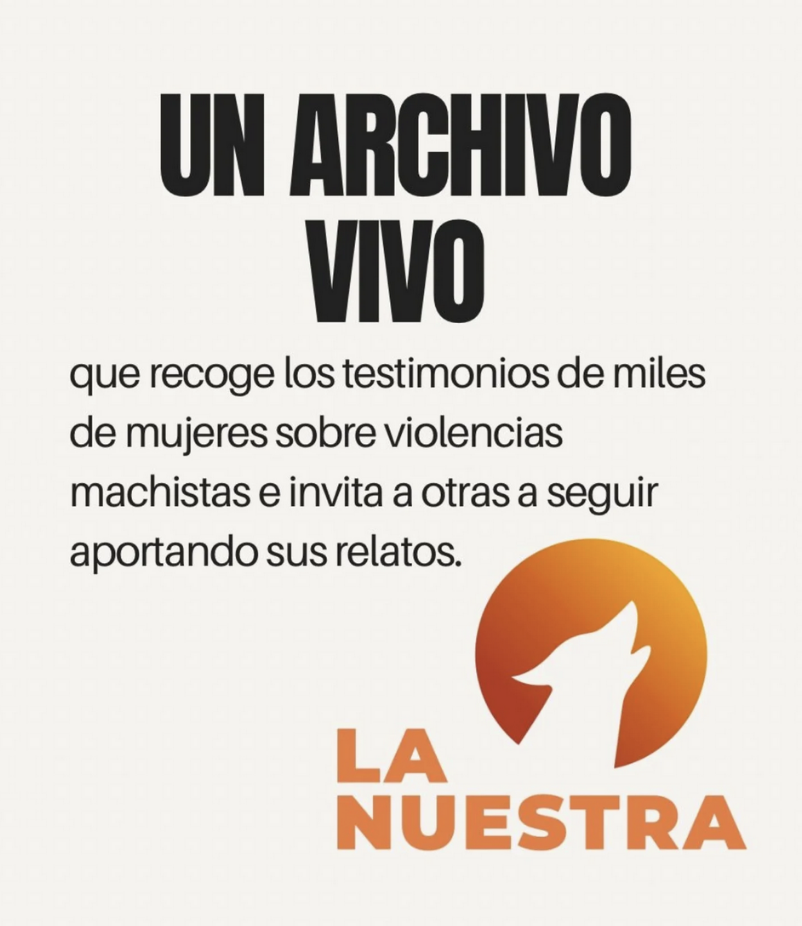
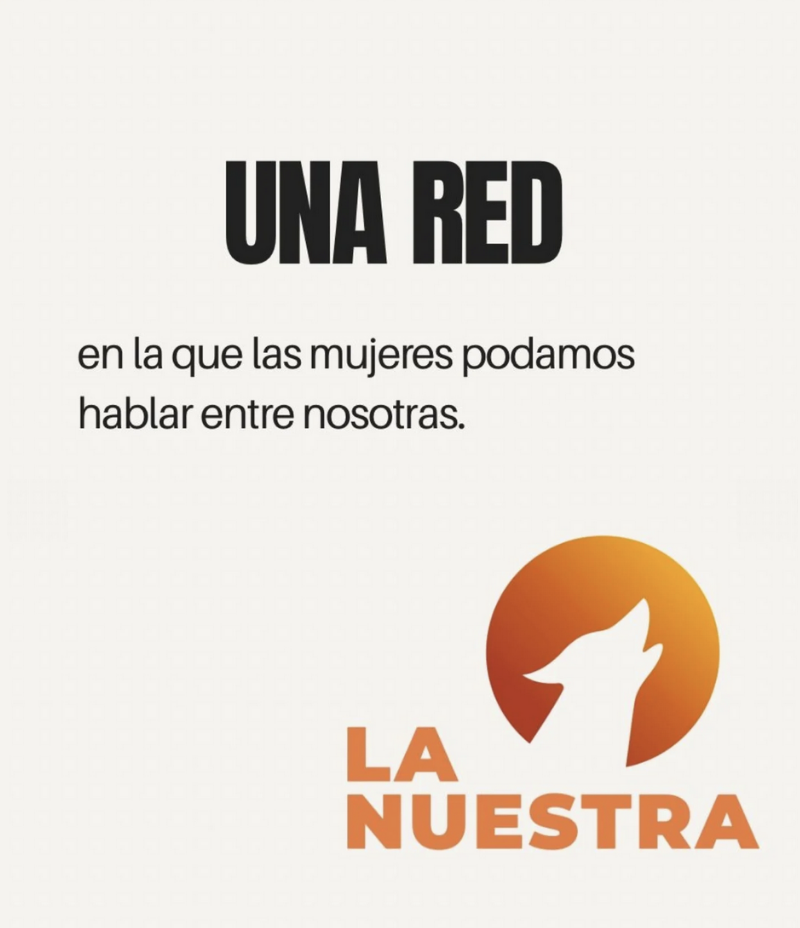
We spoke with Cristina Fallarás, journalist and writer, about ‘La Nuestra’, the future collective and testimonial network against gender-based violence promoted by Acción Comadres, in connection with the launch of the campaign on Goteo that aims to make it possible. The space will collect and highlight the testimonies that Cristina has gathered since August 2023 and aims to provide a living archive where it is possible to reconstruct the truth about sexual violence and offer help to women in need.
The meaning of feminist digital sovereignty
You describe ‘La Nuestra’ not only as a website, but as an exercise in feminist digital sovereignty. At a time when we are so dependent on algorithms and ‘techno-pharaohs’ like Elon Musk and Zuckerberg, why is it urgent for women to have our own technological infrastructure?
It is urgent that we have our own technological infrastructure because data should not be owned by the great pharaohs of technology, and yet it is. We are creating a large archive of testimonies that changes the narrative about ourselves and about violence in general. This is the first time in history that this has been done.
It began in 2017, with MeToo. We are changing what we consider violence and what our position is in the world. It is no coincidence that the first time we all spoke together, the central theme was not fashion or aesthetics, which was ‘our field’ in theory, but sexual violence.
We decide what the focus is, but we are doing so within platforms to which we cede ownership of this narrative. Therefore, it is essential to extract ownership of the narrative from there, to extract our narrative in order to preserve it.
These male-dominated platforms function like all extractivist male-dominated systems: they take but do not give. You post whatever you want, they profit from your story, whatever it may be, whether it’s your holiday in Rome or the #Cuéntalo movement, and they don’t really offer you anything in return.
We believe it is essential to create other types of platforms that offer free services in exchange for your participation in them. In other words, they should not function as extractivists of the stories of women or any other social group, but rather be a give and take: there should be a dialogue between technology and users so that they can benefit from what they contribute. And this is fundamental: we are using networks in an ultra-capitalist way, with ultra-capitalist rules. We want to break that.
The School of Creativity and Democracy works with young people to help them understand technology as a political space and not just as a tool. In ‘La Nuestra’, this intuition appears in a radical way: you don’t just want to tell stories, you want to decide how they are stored, who sees them and under what rules. How do you imagine a feminist digital sovereignty that is also educational, that trains new generations so that they do not depend on extractive platforms? Can ‘La Nuestra’ become an example of technological democracy built from the bottom up?
I definitely think it will be. Wherever La Nuestra goes, as a pioneer, it marks the possibility of change. We don’t know how far it will go or how much we will achieve, but that doesn’t matter.
I remember once talking to some American activists. We were in New York and went to a demonstration. I thought and said, ‘Wow, there are so few of us.’ There were only about a hundred of us. And they said to me, ‘You Spanish women, and European women in general, are wrong. It’s never important how many people go to a demonstration, but the fact that it exists.’
‘La Nuestra’ is relevant insofar as it will exist and insofar as it will exist with, say, three thousand founders, which is not a small number. Three thousand women have come together to do something that breaks the rules of social media as we know it. This break is a milestone, a pioneering milestone. And let’s say that our ambition is not like theirs: to end up becoming a macro-structure, whether economic, financial or of any other kind, but to take another step forward in the march of feminism and the fight against violence.
When the steps are very big, the attack is usually immediate and short-lived. We believe, and we believe firmly, that any small step is simply another milestone, a contribution, a small brick in the pavement.
One of the most innovative features of ‘La Nuestra’ is the concept of “matching” and the creation of support groups. We know that current networks are designed for entertainment or confrontation. How have you designed the architecture of ‘La Nuestra’ so that the goal is mutual support and not the consumption of other people’s misfortunes or the pornography of pain?
I have been working since 2018 to raise awareness of testimonies, and I believe that, apart from the men who admit to visiting the website to masturbate, which is appalling, there has been no pornography whatsoever.
In other words, if there had been any revictimisation of women or morbid consumption of the content, we would not have taken the step to ‘La Nuestra’. We took the step to ‘La Nuestra’ when it became very clear that women do not find reparation solely through the publication of their testimonies, but also through the comments of others.
And this perception is constant. When others comment on a witness’s testimony, the witness enters into dialogue with them. In this way, what I have been creating and trying to make the judges who hear my cases understand is that, with each testimony, an area of autonomy is created, a dialogue: a small room where, around that specific testimony, there are dozens or hundreds of women who participate, support, and intervene in each other’s stories.
When women are given autonomy, you have to offer them a safe place, an encrypted place, a place where they will not be the ones going to court.
The fact that this is constant, habitual, and not only that, but that it has led to the creation of groups outside Instagram: there are groups that accompany women to court, groups that accompany women when they hand over their children to the aggressor or the accused, groups of women who have come together to create reading clubs, all of this has emerged from the comments.
We saw how that worked, and all we have done in the architecture of the tool is to try to transport that as closely as possible to a tool that already provides you with places. In other words, you will be able to comment within the testimony, but you will also have places where you can create groups, forums, and support sections.
Yesterday I was talking to some women in Barcelona who have already created these networks: they create networks of women who offer to accompany others in streets, neighbourhoods or localities, and they have hundreds of women. I spoke to them so that they could add it to ‘La Nuestra’.
‘La Nuestra’ is not based solely on the architecture of the initial promoter group, but we have been talking to groups of women throughout the territory who have already taken some very interesting steps. For example, the issue of accompaniment. And then there is the issue of encrypted rooms: being able to meet with others to talk in a way that is not visible is essential, in my view, given how offended men or men who feel that their honour has been violated are responding and taking us to court.
When you give women autonomy, you have to offer them a safe place, an encrypted place, a place where they won’t be the ones going to court.
So what we have done is to gather together the things that are already happening.
Can a project like ‘La Nuestra’ also become a laboratory where women exercise their agency, deliberate together, and experiment with new forms of digital and analogue sovereignty?
It certainly is. ‘La Nuestra’ is a tool that is made available not only to women, but also to associations, organisations, collectives, etc. We wanted to create a tool, not a movement, not a collective, but a tool. And when we talk to what will be the partner organisations, which will number in the hundreds, what we offer them is to ‘act’ on the tool. The tool has a lot of details that we are going to offer you, but also a lot of possibilities, future details that have not yet been thought of. As these women take ownership of the tool, it will evolve, and as it evolves, it is an experiment.
And it is an experiment because we have nowhere to draw inspiration from. We are clear about the model we do not want to follow, but the model we want to follow will have to be built collectively. We are very convinced of the collective construction of new tools. This is fundamental.
The possibilities are enormous, and I have no idea where it will go. And I do not believe in any way that it will go in a bad direction, so to speak. It is a tool that women need.
The main objective of the campaign is to migrate, anonymise and process all these testimonies to turn them into a living, searchable archive. Why is it so important to transfer these ephemeral Instagram testimonies to this archive?
This is an exercise in memory: almost the first exercise in historical memory about sexual violence in the whole of Spain and the entire Spanish-speaking world. There is an archive that was created in the United States with #MeToo, containing millions of entries; there is the one created by archivists Aniol María and Vicenç Ruiz around #Cuéntalo, and now there is this one.
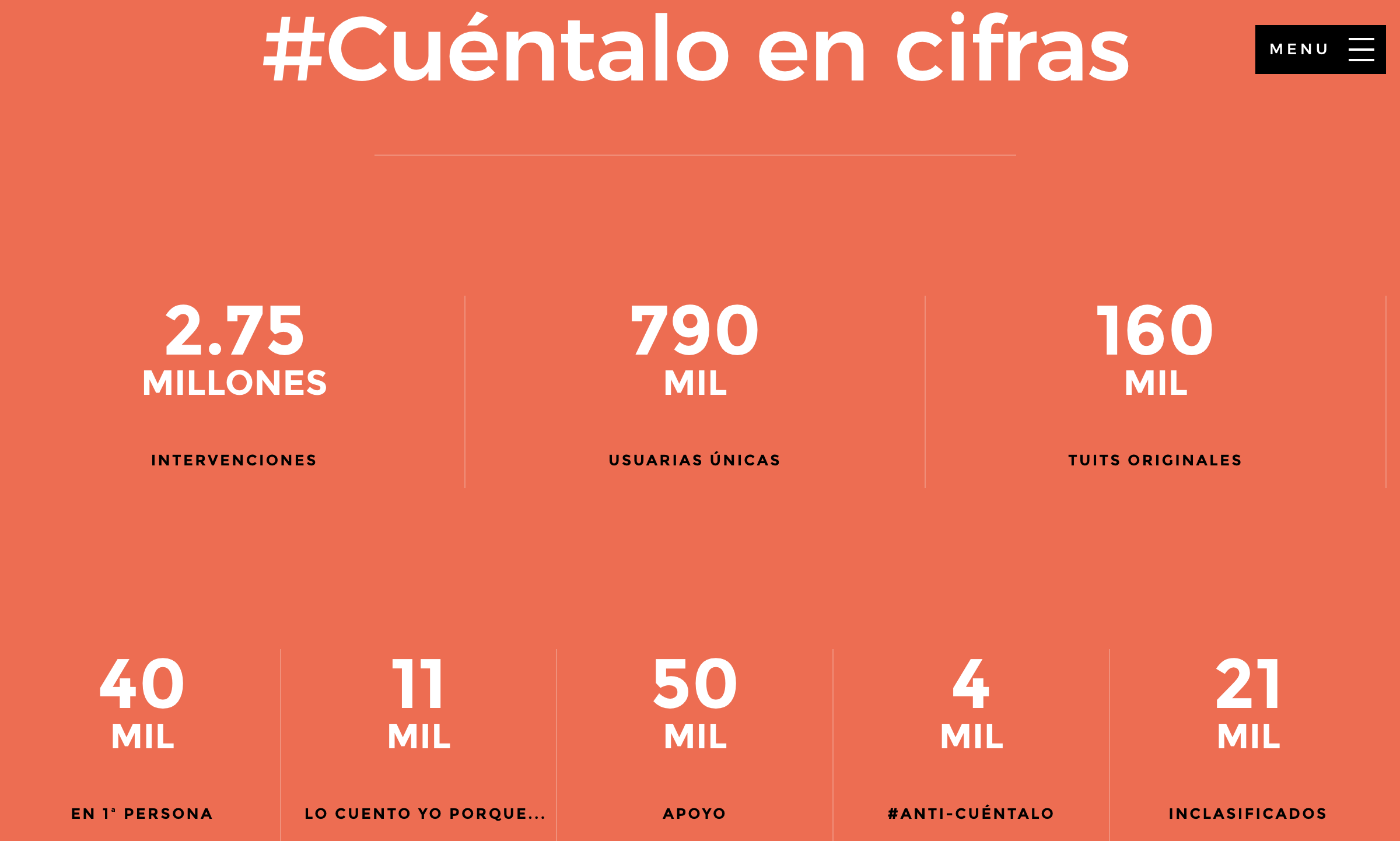
The first point is to preserve the archive. Preserving the archive is essential. Not only preserving it, but also handing it over to the public administration so that, through a contract we have signed, we are guaranteed that they will study the data and make it available to academia or to researchers who want to work with it.
Secondly, it must be categorised. Extracting the archive helps us to categorise it, to generate a database where you can browse the data and search for what you need to tell your story.
And thirdly, for the match. In other words, if we want to set up a tool that uses match technology, we need to categorise the testimonies very carefully. We need to extract the archive and anonymise it, clean it up, ground it. We need to strip it down to its bare bones and then start working from there.
This first batch of testimonies is missing a lot of data: the witnesses do not say where they are, there is no geolocation, many say their age, but not the exact age at which they suffered the assault; others say the age at the time of the assault, but not their current age. However, we have a basis, and we will generate the match on that basis.
So, if I say that I was raped by a journalist in Madrid in 2015, I will see the stories of all the women who were raped by a journalist in Madrid in 2015, but also those women who were raped by a journalist in another year, and those women who were raped in the workplace in 2015…
All of that and the entire categorisation ‘book’ is already done. Two people have been working on it for a year. So, on the one hand, we have the categories and, on the other, the files. Now that this first phase of Goteo is over, we are ready to bring these two parts together.
We have opened a Telegram channel where we talk to the founders every day. And we will open other channels of communication. We need to keep you informed of how it is progressing. But that ‘how it is progressing’ could not be: ‘Come on, now we are going to spend a year cleaning up testimonies’. No. This is a job that we are offering you done. We are asking for a loan to be able to get this work done and, when the crowdfunding starts, to be able to say: ‘Come on, we already have something worked out, let’s move forward’.
“La Nuestra” is not just an archive, it is a living process where women participate, decide, correct and rewrite the memory of sexual violence together. Do you think this participatory model could inspire other ways of managing democratic memory, such as Civil War archives or decolonised memory projects, so that they are not just static repositories, but spaces for collective deliberation on what to remember, how to narrate it and with what voice?
On 25 November, I published an opinion in which I said: ‘Our narrative is a political act to blow up the institutions that have imposed silence on the majority of the population: women, the republican movement, migrants, victims of the Catholic Church, the LGTBIQ+ community, those tortured in democracy…’
We must be clear about one thing: when women need to use social media so desperately that we generate millions of pieces of data in three or four days, it is because our narrative has been banned. The narrative about sexual violence has been banned implicitly and, in some cases, explicitly in the courts.
There are many groups, such as memory groups, migrant groups, and impoverished groups, whose stories have been banned, whose stories have not been allowed by the mainstream. This tool not only serves all of them, but we will also provide it free of charge to anyone who needs it. Housing groups, migrant groups… there are many groups.
At this moment, we can all create an irrefutable collective narrative.
I always remember the moment when Carmen Calvo, then Deputy Prime Minister, appeared before the media and said that the Transition was the most peaceful and wonderful period in Spain’s history. I thought: how can this woman say such an outrageous thing when thousands of men and women were tortured in official places, in police stations, in barracks, in the streets; when there were men and women who were murdered and imprisoned?
She can afford to say it because that story has not been told.
However, at this moment in time, we can all create an irrefutable collective narrative. The basis is irrefutability. It is not enough for five women or five men or five people to tell a story. What is considered academically sufficient is a large volume. And, at this moment in time, we have the tools to do so.
Let the movement against male violence and sexual violence in particular, let this women’s movement from #Cuéntalo, #SeAcabó, etc., serve as an example of how to build an irrefutable archive with which we can say to Mrs. Carmen Calvo: ‘Look at what the Transition was, mate.’
The truth of testimony
You have been collecting testimonies on Instagram for years. What is the power of first-person testimony?
Direct first-person testimony, without intermediaries, is the taking possession of your body and your story.
When you post your own testimony autonomously, spontaneously, as an act of will, it mediates a political decision to participate in collective memory. That political decision is healing, it is historical justice, and it is part of the reparation that does not require going through the justice system, which is something that matters a lot to me.
There are cases that need to be tried, of course. But there are many cases where a trial is not required. And we are also talking about many forms of violence that are not punishable in Spain. What we are doing is broadening the spectrum of violence, especially sexual violence, to the point where we consider sexual violence to be something that the law does not consider punishable.
You have spoken in other contexts about the idea of “truth”. Legal truth is often demanded, but you advocate a kind of narrative truth. Why is the judicial system not enough to heal or understand sexual violence? What does this narrative contribute? Why is it necessary to go further?
In the triad of truth, justice and reparation, truth was something that was forbidden to us. Channels such as ‘La Nuestra’ allow women to take charge of their truth autonomously, without the need for a lawyer to tell them anything.
The mechanisms of justice are not offering us reparation, but rather the opposite: revictimisation. Probably because my reparation involves seeing my truth published and engaging in conversation with others who have published their truth or who see themselves reflected in mine. Women’s truth is sovereign. The truth of every human being is sovereign. The only thing missing is that we do not have the right to the truth.
The judicial system, on the other hand, is an oppressive system. The judicial system was never created to give women freedom or truth; the judicial system was created to control us, to control our narrative and our bodies, just like the police system. We cannot trust the judicial system. Whether we use it is another matter.
There is a cultural construct that leads us to interpret the judiciary as a power that is there to protect us. That is not true. If it were true, they would have protected us. In the same way that the media are not there to communicate our reality. If it were true, they would have communicated our reality and we would not have had to do it ourselves. In the same way that political parties, courts, etc. are not there to give us autonomy.
And then, suddenly, social media appeared. It showed that the republican movement, the movement against the Catholic Church for sexual abuse, the memory movement, all the relatives of victims of Franco’s repression who still have their relatives in mass graves that have not yet been exhumed, those opposed to the Bourbon monarchy, and women, the poor, junkies, women in general, are not represented in a society that decided to leave us out of the narrative.
We are not represented and we have not had the right to tell the truth, not because we couldn’t say it, but because we didn’t have the places to do so.
If the channels are closed to you, that truth ceases to exist. And they don’t need to lie. I always say: the opposite of truth is not lies, it is silence. The worst thing is that this construction of silence around the violence perpetrated by the State or allowed by the State means that it is not even necessary to lie about us or any other group punished by the media.
As a communicator who is an expert in analysing public and political discourse, what types of narratives or testimonies have you found to spark the most social debate? Are there taboo topics within sexual violence that, when brought to light, break the silence more than others?
Yes. And note that these are not the most serious issues. They are much smaller issues that, because they are common and silenced, generate very large movements. An example would be something like when the father, who is supposed to have the child at home, returns them naked, completely naked in the street, or with their clothes torn, absolutely torn with scissors, after a week or a weekend with him. This is common. And when the first stories appeared, it was a boom, because suddenly thousands of women finally felt recognised. There is something that silence achieves: you don’t report what you believe you are the only victim of.
These stories, which in principle are not so brutal and I doubt were punishable, generate tremendous movements. These women take a weight off their shoulders that you cannot imagine. Suddenly, they realise that it’s not their fault and that their partner or ex-partner isn’t the only bastard who does that kind of thing, but that it’s actually quite common. In a way, you rid yourself of that shame you feel from being alone, from feeling alone.
I suffered serious sexual abuse as a child, within my own family. And until I read the stories on #Cuéntalo, I couldn’t stop thinking that I was an abominable being, the only person in the world to whom this had happened, and that I deserved to be punished. I believed that I deserved all the violence I was receiving as I built my life because I was an abominable being, the only woman in this world to whom this had happened.
The moment we break the silence – I cried like a beast – we realise that we are not exceptional cases. We stop torturing ourselves at night and become part of a community that not only can talk to us, but also relieves us of guilt, shame, and that lump in our throats that prevents us from telling those around us what we have been through.
And there is another layer to this: if a solicitor is going to report this and has two hundred other similar cases to justify to the judge that it is a strategy of violence by the father against the mother, etc., it is no longer the same as if the judge finds it isolated and thinks, ‘Well, you married a Martian, deal with it.’ It becomes violence, a type of violence. That’s why these kinds of movements are important.
In the face of polarisation and the rise of the far right, safe spaces
We are living in times of extreme polarisation, the rise of the far right and a machinery of disinformation and hoaxes that often attacks feminism. How does ‘La Nuestra’ shield itself from these attacks? How do you build a real ‘digital safe space’ when the outside environment is so hostile?
Could there be attacks? There could be. So the tool is built with a very strict security architecture, with various nodes in different locations, so that if one goes down, another takes over, and if not, another one takes over, and so on. It is a disaggregated tool. But I’ll tell you one thing, and I hope I’m not wrong: women’s testimonies matter so little to men that they don’t even attack us.
I have not received any attacks on my account. I have had my Instagram account suspended three times, as they considered that by recounting what a woman’s father or grandfather did to her, I was spreading child pornography. But I have not had any direct attacks on the testimonies.
On Instagram, I can get up to 50 million views. Normally, there would be a high percentage of attacks. But I don’t get them, and neither do the testimonies. I get one or two a month. That’s not very many. They’re not interested. I think men are not interested, I insist, in looking at our stories, not even to attack us.
They can’t hold their gaze. Of course, violent men can’t hold their gaze in the face of the proliferation of testimonies. These men can refute the testimony of one woman, ten women, a hundred women, twenty-five thousand women… But the testimony of several million women at once is very difficult. It’s impossible. It’s irrefutable. That’s why they don’t look at the testimonies.
Social media revictimises and censors keywords related to sexual violence, as has happened to you with Instagram, but at the same time allows hate speech. Do you think this type of algorithmic censorship is a new form of violence against women? How does La Nuestra combat this dynamic?
Of course it’s violence. Mr Twitter, Mr Instagram and Mr Meta didn’t create social media so that women could talk about ourselves and, more specifically, talk about the sexual violence we have experienced. At first, they didn’t give it the importance it deserved. They were so stunned that it took them three years to react. But they did react.
This archive we are building needs your peace, it needs your tranquillity.
Given this, when you generate your own algorithms, let’s call them that, or trends, or uses of the machine, of the tool, yours are the ones that rule, not Elon Musk’s. Although social media networks are designed for violence against women and to promote hatred and violence, ‘La Nuestra’ has its own algorithms, and its algorithms are about matching, dialogue between women, and connecting women with similar experiences.
The testimonial movement is important and growing because it has been ignored by men. And because the only response it has received from the mainstream media has been ostracism or fierce criticism. If it remains ‘that space where girls tell their stories’, that’s great, because this archive we are building needs its peace, it needs its tranquillity.
At INSPIRE, we work on democratic capacities that emerge when communities participate in decision-making processes: agency to speak in the first person, the ability to influence rules and changes, the practice of co-governance, radical listening, and shared responsibility. In ‘La Nuestra’, women not only share memories: they are deciding on protocols, designing a safe space and defining how a living archive is protected and used. What democratic capacities would you say are activated when a community builds the governance of its own archive?
I believe that the first thing to do is to refute the idea that any democracy must be capitalist and hierarchical. And, for me, that would be enough, although there is more.
We have been sold the idea that all democracies are inevitably capitalist, hierarchical and vertical. In other words, a strictly patriarchal, male construct. And the opposite is China, Russia and chaos. And that is not true.
It is possible to create collective mechanisms for participation. These collective mechanisms for participation simply have to be clear and decisions have to be made by the collective. We need to establish some basic fundamental rules that have nothing to do with the construction of parties or the construction of different nuclei, which, in some cases, some feminist movements have wanted to repeat. We can participate without having to unite in blocs. With direct participation technologies, it is possible to build a democracy that is not hierarchical.
In this sense, the idea of capitalism is refuted. Not just today’s savage capitalism, ultra-rich capitalism, but capitalism as a construct opposed to communism or the idea of applied communism. We are proposing another way of functioning through the collective, which attempts to offer a glimpse of other possible, non-utopian forms.
The project is in the final stages of the first phase of the crowdfunding campaign. For those who read or listen to this interview and think, ‘This isn’t for me, there are already too many social networks, it doesn’t resonate with me’… what would you say to them to help them understand the importance of ‘La Nuestra’ as a tool for feminist self-defence?
‘La Nuestra’ is not just a social network, it is also a social network, but at the same time it confronts the idea that a social network is something built by a white, rich, heterosexual man, outwardly, who imposes a hierarchy of control and extractivism.
‘La Nuestra’ is the possibility of organising ourselves from a different place and using technology for good, for the collective, and generating voices that, until now, had no possibility or public reflection.
‘La Nuestra’ may not even work, and yet the work of ‘La Nuestra’ is already done. The work of ‘La Nuestra’ is to collect and give voice to women. If it does not happen now, it will happen at another time, because it is inevitable. Because there are groups of people who need to break out of the silence imposed by printing technology.
Printing society imposed silence on the majority and created small hierarchies of voice, which were male, and which gave rise to economic structures of brutal repression and structures of repression against women’s bodies and against our sovereignty.
Right now, there is a chance to break that. If anyone, at any time, figures out how to break any tyranny, it is an ethical obligation to do so.
- Do you want to be a comother of "La Nuestra"
La Nuestra needs hands, voices, and commitment to exist outside of extractive platforms: to maintain a living archive that is secure and governed by those who build it.