Interviews
Luísa Franco Machado “Feminist AI is a democratic project.” On unlearning in order to advocate for a different way of experiencing and relating to technology

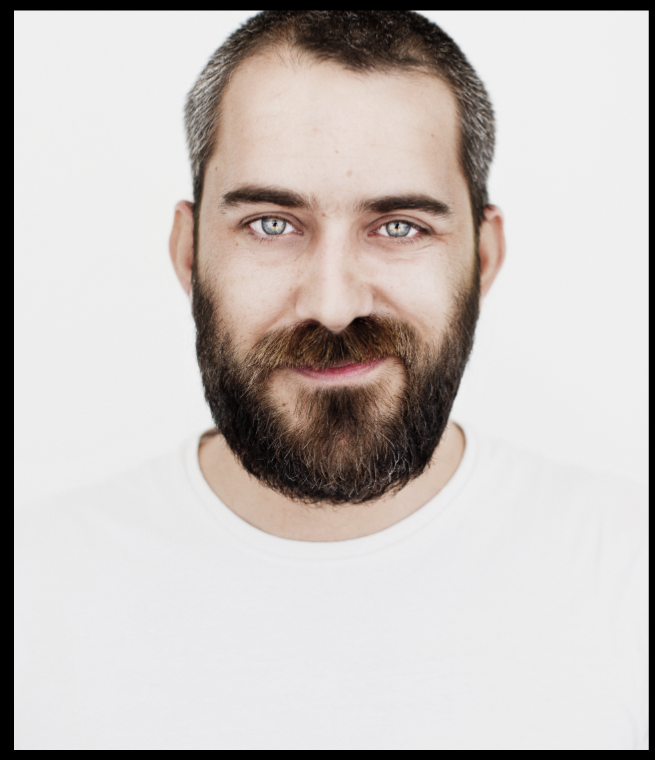
Luísa Franco Machado is a Brazilian digital rights activist, data justice researcher and founder of EquiLabs, a global youth-led laboratory that works to imagine and build fairer digital futures. Through her social media content, Luísa has brought debates on feminism, internet governance and digital rights closer to an international community of more than 60,000 young people. The first openly queer person to preside over the Brazilian Youth Parliament, Luísa understands activism as a work of translation between worlds: between institutions and youth, between lived experience and public policy, between queer theory, intersectional feminism and technological design.
In this interview, Luísa invites us to unlearn the idea that the digital world is already given and cannot be transformed. From her experience as a queer activist, data justice researcher and founder of EquiLabs, she proposes looking at technology as a field of political dispute where youth, feminisms, queer communities and situated knowledge must not only be heard, but recognized as forces capable of imagining and building other futures. The conversation goes through the power of community, the urgency of abandoning extractive logics and the need to open institutions to new forms of experience, leadership and democracy.
The power of unlearning
Throughout your trajectory, the idea of unlearning seems to be a constant, from your queer activism to your work on data justice. What does unlearning mean to you in the context of technology and social movements?
Luísa: Unlearning has been really important for me because I think that all of us, in some way, have assumed the idea that the digital systems in which we live are already given; that this is reality, that this is what is established, that this is the status quo. And we feel so powerless that we do not even imagine that a different future could be possible, or that we could have a voice in the decisions and policies that will later be implemented and that will impact our lives.
For me, unlearning is born from that curiosity to imagine what worlds are possible and what digital worlds are possible. But it is also born from the honesty of recognizing that, in order to build those different, alternative and better worlds that we want, we have to change the way we do things. We have to change who has the power to influence public policies, corporate decisions or any other type of decision; also how resources are allocated.
unlearning comes from the curiosity of knowing that things can be different, but also from the courage to say: this is what has to change.
So, for me, unlearning comes from the curiosity of knowing that things can be different, but also from the courage to say: this is what has to change. Sometimes, we need to let go of some of our privileges and think about how we can use them to build a different world. In that sense, unlearning is changing how we do things and what our role is in them.
In this sense, what do you think are the main narratives or assumptions that we need to unlearn in order to build a better relationship with the digital world?
Luísa: One of the things we need to unlearn is what we consider expert experience and what types of knowledge deserve to be heard. I think that, as a society, we value academic experience very highly. We invite experts to speak about certain topics, and that is an important part, but I do not think we should stop there.
On the other hand, as I lead EquiLabs, a youth-led organization, I would like to say that welcoming and valuing youth experience is something that I think everyone would benefit from learning, or rather from unlearning. Youth experience does not only consist of us bringing energy or of it being fun to be around young people. Many times, the knowledge we bring as young people is very valuable for public policies. However, many times those who design policies are not prepared to listen to what we have to say or to the types of knowledge we bring to the table: knowledge about intersectional feminism, about queer rights, about how we use social media, about the harms we experience on them and about how we organize collectively to combat them.
I think that is how successful policies are built, whether public policies or even changes within platforms, if that is possible. It is really a loss when we are not willing to unlearn the way in which we understand and value expert experience.
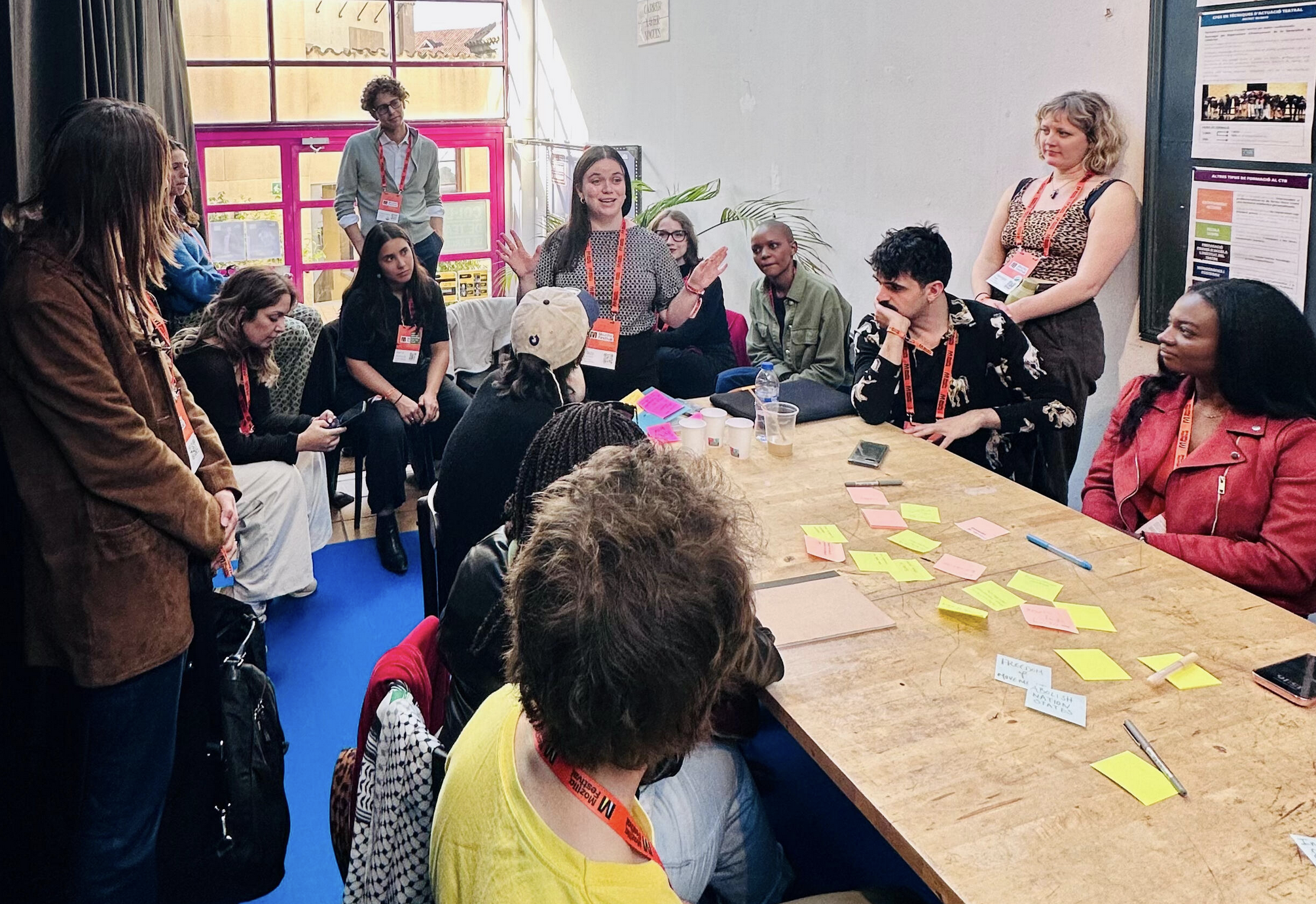
Equilabs workshop at MozzFest 2025
Equilabs
In fact, many young people feel disenchanted or disconnected from institutions. How can unlearning help them connect?
Luísa: I think it works in both directions. Young people are disenchanted with institutions because, historically, institutions have not given them a real space to talk about their needs; and not only to talk about their needs from an extractivist position. As a young activist, this is something I also struggle with a lot. We are entering a moment in which more and more institutions realize that we have things to say and, then, they create a youth platform so that we can give our opinion. But many times that feels a bit like the children’s table, you know? It is like saying: “we have created the children’s table,” where we invite young people to speak, but the real decisions are made somewhere else. We see that, we feel it, we feel used as a quota, and it ends up seeming useless.
We need institutions to see us as equal partners, in the same way they would see any other person, so that we can trust that our experience will be valued, our time will be respected and our knowledge will be taken seriously. So yes, it goes in both directions.
I understand that all this you are explaining to me is closely related to EquiLabs. Can you explain its objectives, its purpose, how it began or whatever you feel is important to share?
Luísa: EquiLabs was born from a mixture of burning rage and the courage to imagine that digital futures can be better.
It all began with my own trajectory in international activism. A couple of years ago I was appointed by the United Nations as a young leader for the Sustainable Development Goals. The UN recognized me because I started posting on TikTok about feminism, digital rights and internet governance. I, as a Brazilian and the only Brazilian in my class at an elite university in France, felt that this knowledge was being kept under lock and key, and I wanted to spread it. So I started talking about it in Portuguese on TikTok and translating that academic language into a language that more people could understand. I did that for a couple of years to, in some way, open a path. Then I was nominated by the UN and I started doing almost the opposite: translating youth demands into high-level decision-making spaces, such as the UN General Assembly and all those elegant United Nations conferences.
But then I realized, once again, that I was the only person in those spaces who looked like me. I was the only young person, often the only person from the global majority, the only queer person, whatever you want. So I founded EquiLabs because I wanted to build a youth-led digital rights movement, and I knew perfectly well that I could not do it alone and I also did not want to do it alone. I needed more people on board, but many young people do not see themselves as digital rights activists, but rather, for example, as climate activists. We could say that EquiLabs was born with the will to bring more young people closer to digital rights activism.
We are a digital rights laboratory. The name plays with the idea of imagination, of imagining different digital futures. We call ourselves a laboratory because we are experimenting with different ways of actually influencing policies. We train, empower and provide resources to young people so that they realize that, in reality, they already are digital rights activists, and so that they use that knowledge to impact public policies at the international level, perhaps in the future also at the national level. And we do this globally.
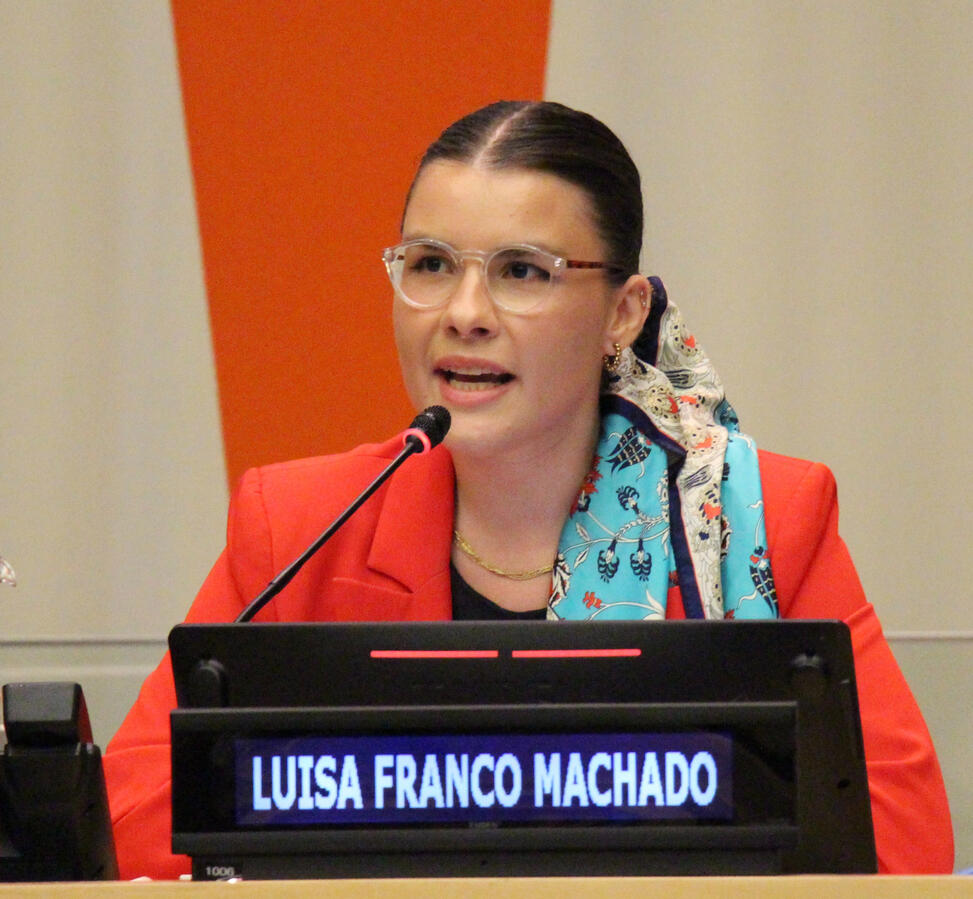
Luisa Franco Machado at Sustainable Development Goal (SDG) 16 Conference 2025
Equilabs
Data justice
How do you bring situated or community perspectives into those spaces without them being absorbed by bureaucracy? How do you deal with that?
Luísa: I would say that it is a constant work of translation: translating between different worlds and building a bit of a bridge. If I go to the UN and speak in the same way I speak with my friends, nobody is going to take me seriously there, because there are certain codes that you need to follow and that you only know once you are inside. But, at the same time, if I speak with my friends in the same way that I, or the people responsible for policies, speak at the UN, they will say: “this does not speak to me, I cannot connect with this at all.” That is why I think this work of translation between worlds is so important. Sometimes you hear people responsible for policies say: “every time we open youth consultations, nobody ever participates.” Of course, because nobody speaks your language, people do not have access to those resources or to the time needed to participate. There is a real disconnection. That is what we try to do: build bridges between those different worlds.
Could you mention a project, a technology, a resource or whatever you can explain from a feminist perspective to a bureaucratic audience?
Luísa: Last year, I gave a speech in which I was asked to talk about democracy and artificial intelligence, and about the connection between the two. My main statement in that speech was that feminist AI is a democratic project. When we bring intersectional feminism into the way AI is developed, but also into how it is governed and designed, we turn that tool into a more democratic tool. More people can feel represented by what the tool can do and, at the same time, harms are reduced, because most mainstream AI systems today are very biased, sexist, used to generate deepfakes of naked women and also to oppress queer people. So I repeat it again: feminist AI is a democratic project and it is possible. But, for that, we have to listen to feminists. We have to listen to queer people who have long been using intersectional feminism and queer theory to analyze these systems and propose better frameworks.
Youth, democracy and resistance
You have gathered a global community of more than 60,000 young people around digital rights. What have the new generations taught you about resistance and hope? Is there any initiative that you especially like, or anything you want to highlight?
Luísa: Young people have taught me that, in order to resist, you need to be in community. Community is a really important part of my work and something that I think more people would benefit from. To generate change, you have to do it in community; you cannot do it alone. First, because when you do it alone it becomes very lonely. We are living through a huge mental health crisis, in which many people of my generation feel completely anxious, depressed and disempowered, and the answer to that is community. Through community you build movements, defend changes and create different things. So community is always the answer.
To expand our imagination we need, first of all, provocation: to be provoked by different realities. But we also need examples of what has already been done and of the possibilities that exist.
From the queer aspect, as the first openly queer person to preside over the Brazilian Youth Parliament, what barriers did you have to break? What lessons do you draw from that experience for other young queer or dissident leaders?
Luísa: I love this question because lately I have been thinking a lot about what it means to enter these spaces as a queer person. Many times I feel that it is quite evident. Of course, it depends on each person and their experience, but I feel that queer people dress in a certain way, behave in a certain way, and that often it is very visible that you are queer. It happens to me: when I go to certain places I feel that I am different from the rest. I have different clothes, different hair, piercings, tattoos. I think it is very important to carry elements that allow me to feel that I am being myself; to feel that I can enter those spaces, talk about what I want to talk about and bring my lived experience, which is very valuable as a young queer person living in Berlin. But I have also learned to do it in a way that can be taken seriously by institutions that, in the end, are simply people: millennials, boomers, people with life experiences different from mine.
I feel that older generations are usually afraid to talk to us because, when they see us, they project how they relate to their daughters, to their families, to their granddaughters, and I, personally, when I enter these spaces, try to do it with an open mind. I think it is fine for people to make mistakes as long as they are willing to learn and improve. But, from the other side, you also need people who are open to confronting something different, something they may never have seen before, and not judging it or immediately rejecting it as something without value. I think there is a lot of value in intergenerational learning, but also in learning from one another and from our experiences. That has given me many wonderful things.
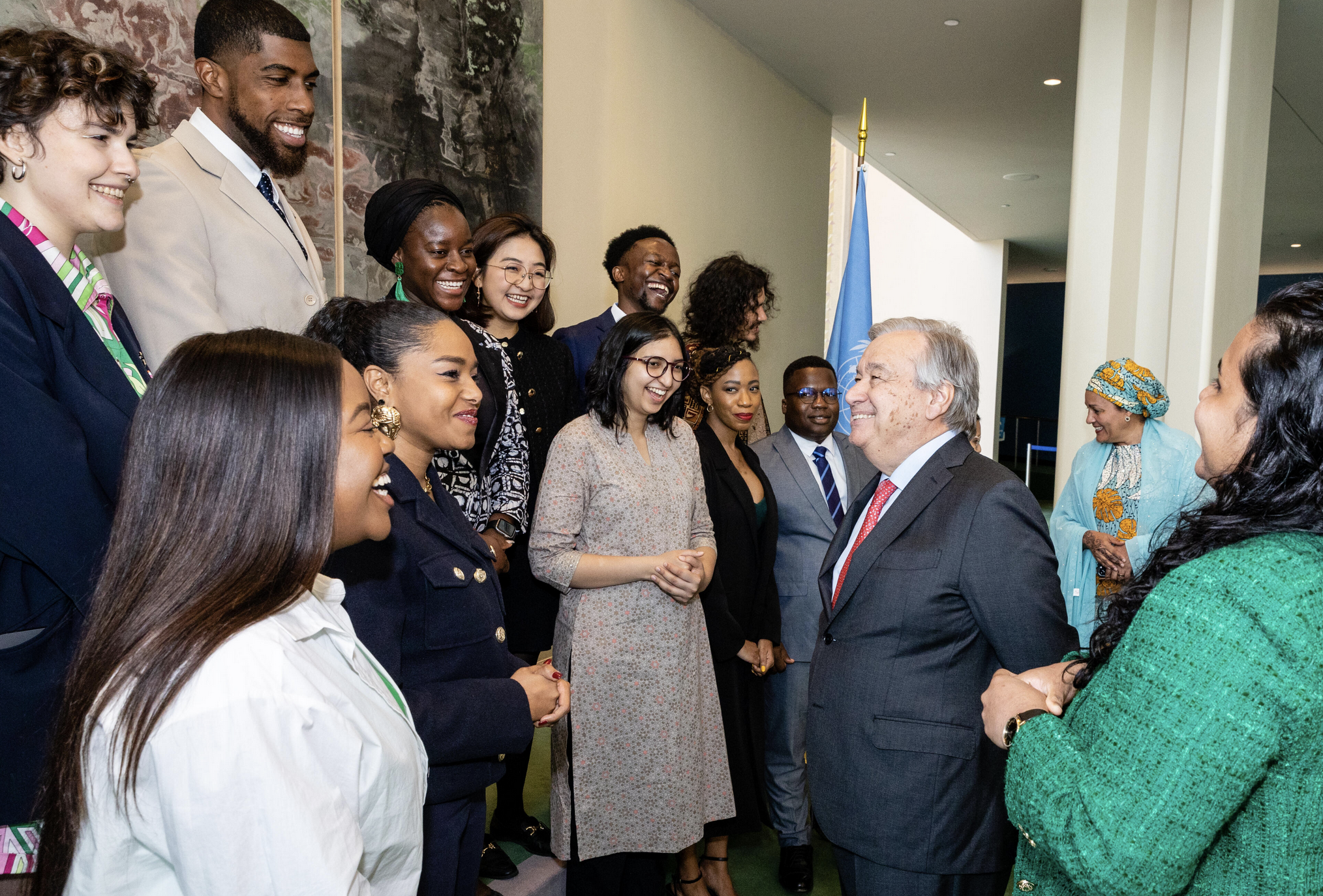
Meeting UN General Secretary Antonio Guterrez
Equilabs
Regarding methods that can drive or facilitate the encounter between different people, what role does imagination play in building a more inclusive digital future?
Luísa: For me, imagination begins with believing that other possibilities exist, but for that you have to be able to see them. There are many initiatives in Brazil and in Latin America on feminist AI, on AI applications led by queer people, on localized AI, on different ways of doing things. For me, imagination has to do with that. To expand our imagination we need, first of all, provocation: to be provoked by different realities. But we also need examples of what has already been done and of the possibilities that exist. That would be, for me, a small recipe for imagination: confrontation with ourselves and with other people, examples, the pioneers who can inspire us. For me, expanding our imagination also means expanding who is respected and recognized as a leader.
A slightly more technical question: how can public policy incorporate this new energy, this new creativity and this new sense of urgency of youth without diluting its transformative power?
Luísa: Young people have always contributed to public policy. Most of my friends who were interns at some point were the ones writing policy reports, the ones drafting speeches for ministers. Interns have always been the backbone of public policy. So, how can we stop seeing young people as interns, from an extractive mindset of “what can I extract from them while I am recognized as the one who does it,” and start really giving them a platform? As I said at the beginning, it is about seeing them as equals.
From my experience, young people tend to learn more with other young people, in the same way that women tend to be more inspired by other women, and so on. We need this type of experience to build better policies for everyone. I have seen it in my work: I worked in government for three years before founding EquiLabs, also in international organizations, and I have seen that, when you incorporate these new perspectives, when you bring intersectional feminism or queer theory, you actually build better public policies for all people. When you start seeing this as an opportunity for people responsible for policies to better represent society, I think that alone should be incentive enough to incorporate these voices and see them as equals. But, for that, we have to let go of this extractive mindset.
If you could share a message with those who are responsible for this extractive mindset, what would be the first unlearning you would propose today?
Luísa: I think I would insist on extractivism. When we talk about extractivism, we need to unlearn the extent to which we believe we can extract from people, from things and from the environment. When we talk about feeding artificial intelligence, many times we are extracting from the environment, because we need data centers to feed AI systems. So we are extracting from the environment. When we extract data from people, we are also reproducing that extractivist mindset. I think we need to unlearn extractivism, really. Things are not there to be taken. People’s data is not there to be taken. People’s emotions are not there to be taken. And when we unlearn that extractivism, space opens up for co-creation, for collaboration, for giving instead of taking.