Interviews
Liliana Arroyo Sychofancy, loneliness, and parasocial attachment: How can we work with young people to envision a socially responsible AI?


She entered college saying, “I want to understand social reality in order to transform it, because what I want is to improve the lives of my neighbors.” Years later, and following her tenure as Director General of the Department of the Digital Society at the Government of Catalonia, Liliana Arroyo now heads the ESADE and Exea Chair for Socially Responsible Digital Innovation (SoReDI), where she fosters a Community of Practice for young people aged 16 to 25, with the goal of proposing new ways to experience technology, particularly as it relates to youth loneliness and AI.
We have nearly two years ahead of us, and it is from this vantage point—straddling academia and philanthropy—that we aim to open new avenues for technology, because the industry alone has not succeeded in doing so.
Your background is in sociology, and today you work in social innovation and responsible technology. When we talk about digital social innovation, what criteria must a technology meet to be truly socially responsible?
When we talk about social innovation and technology, we’re talking about solutions that help us collectively: they help us connect better, understand one another better, live together more harmoniously, and manage disagreement more effectively.
For me, digital social innovation does not include platforms that fragment us, isolate us, and trap us in echo chambers. Far from nurturing our connections—even though that was the original promise—these platforms trap us in a very homogeneous landscape where we cannot grow.
For me, responsible digital innovation is socially responsible not only when it complies with the charter of human rights, but also when it responds to that very human need to be and to belong, and thus creates spaces for belonging, for encounter, for creation, and for social fabric. In short, it would be a technology that helps us nurture our connections or, at the very least, does not damage them.
What does it mean to you to be a techno-optimist today, at a time marked by both enthusiasm for technology and mistrust of big tech platforms?
This is a very powerful tension that I’m always mindful of. I’ve sometimes been described as a critical techno-optimist, but if there’s one thing I’m certain of, it’s that digital tools, digital environments, and digital threats don’t just appear out of nowhere; there’s an entire process of innovation behind them that we’ve chosen to embrace and that we need to study closely.
These technological tools are welcome, as long as we’re able to manage them. We must be able to tame them a bit so that they serve us and not the other way around
It’s true that radical optimism is becoming difficult to sustain, but at the same time I believe it’s more necessary than ever. I try to find the signs that help me envision the future—those that bring us closer to livable digital environments on a human scale where we feel like growing, developing, connecting, and interacting…
And what signs do you see right now?
If we look at the dominant platforms and their business models, hope quickly fades. They couldn’t care less about their impacts. Given this, I believe we must accept that what is understood in economics as negative externalities are not externalities at all, but rather impacts resulting from business activity.
We’ve come from a period where large corporations have shirked responsibility for what happens online, but that’s becoming less and less common. Meta and Google, for example, have had to accept that what happens on their platforms is their concern and their responsibility. It’s no longer enough to say that they merely provide the platform and that its content is irrelevant.
The time has come when we know that tech monopolies are a risk and an anomaly that must be confronted. There is a lot of talk, for example, about banning social media for those under 16. Regardless of what I think about that specific issue, to me it is an example of how we are finally daring to stand our ground and tell the digital sector that we cannot continue this way. Governments seem to have realized that we must stand up to the tech giants.
Where would you draw the line between critical techno-optimism and technological solutionism? In other words, how do we reconcile the idea that technology can solve everything with the need to maintain a certain degree of controlled criticism?
Technological solutionism only works if you’re part of that privileged minority who will have access to this technology that’s supposed to solve everything. And here, I think we need to raise a lot of questions: “everything” is a very broad, very ambitious absolute. And, by the way, I think it’s a good thing that there are spheres of our lives and our existence that are free from technology.
In this sense, believing that technology is something that magically falls upon me, or that it is governed by natural laws I do not understand, perpetuates inequality and undermines our capacity for agency to govern it. Forgetting that there is a design conceived by people and that, therefore, there can be a process of negotiation and social correction—that is what I advocate from a position of critical techno-optimism.
We must have the final say on what technology should be like and how we want to use it, and preferably in a collective manner. Because if we approach this individually, those with the ability to govern technology are those with money and power—which is what is happening now. On the other hand, if we do so collaboratively, collectively, oversight of these products and services is much greater and, therefore, fairer and more inclusive.
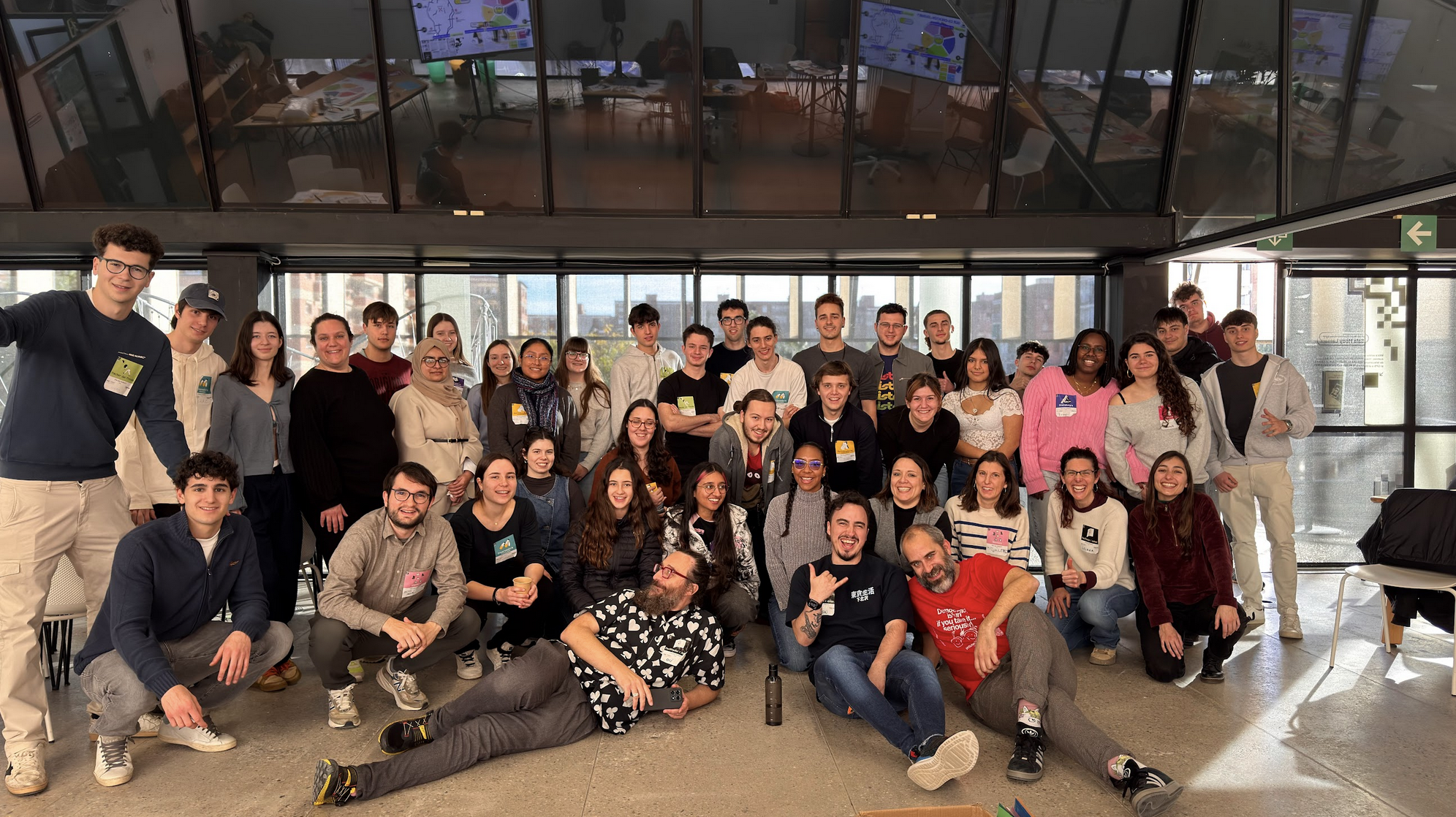
1r Bootcamp - COP SoReDI
Platoniq, 2026
What role do you see young people playing? Could they play some kind of role in the current digital transformation? They are the most vulnerable users, but at the same time producers of digital culture…
Absolutely. I am 100% convinced that they need to be key players. Maybe not the only ones, but they definitely need to be firmly part of this conversation. And not necessarily young adults. The participation of children and youth is very important. There are organizations dedicated to this that establish mechanisms so that children and adolescents can participate in a way that is safe, protected, but also empowering. In fact, we’re already seeing it: many youth-led movements demanding to be heard and to be part of processes they understand are being developed without them—and, in some ways, against them.
There is a segment of youth who, just as with climate change, have realized that they have grown up in toxic environments and that things didn’t have to be this way. To highlight a couple of very interesting initiatives in this regard.
One is Design It For Us—the name says it all. It’s a community that started in the United States but now spans 24 countries, made up of young people who dare to show up at these companies’ headquarters, knock on the door, and say, “Hello, I’m here to explain how we want our digital environments to be.” And they do this not just out of anger or frustration, but by researching regulatory issues and how to establish frameworks, standards, and best practices.
Then there’s another one that I find very interesting at the European level called Control Alt Delete, which operates in a similar way: they’ve produced a report identifying young people who are creating specific tools against cyberbullying and are developing their own devices where you can have a smartphone, but without all the layers of the attention economy. Even here in Barcelona, there are some young entrepreneurs who have designed a phone where you can’t download social media, streaming platforms, gambling apps, or sites for consuming pornographic content.
When you talk to them and ask, “How did you come up with this idea?” they tell you that they didn’t like what they were seeing, so they designed a small piece of software. And in the end, what happened? Now they consume whatever they choose. And that has an audience.
We recently spoke with a young woman who uses artificial intelligence to address cyberbullying in digital environments. Address in the sense that if you’re experiencing it—whether as a victim or a perpetrator—it invites you to rethink your words before posting them. Or even, once posted, it helps you review them and see if you can channel that discomfort, that anger, that confrontation in a different way. And I think these are very inspiring examples. Very inspiring, because they also bring together very diverse voices, from a wide range of backgrounds. They make me believe there is hope.
We were in a situation where we had sad young people, but not angry young people. And to some extent, anger and discomfort are a condition of nonconformity. Without meaning to imply rage, nonconformity is a necessary and healthy condition in youth. Therefore, I think it’s fantastic that they themselves want to take the lead as protagonists and creators.
At the same time, young people are described as being heavily influenced by everything they encounter in this new wave of technology. How do you think algorithms and platforms are changing the way young people think?
It completely changes it. If only because of the sheer volume of exposure and the diverse, mixed information we’re exposed to. We’re constantly placed in a reactive format where you see an ad mixed in with a post from a friend, your favorite website, or a go-to digital influencer, and then you see another ad, a news story, and a firsthand account of a conflict from some place in the world… It’s very difficult to develop discernment in the face of so much diverse information.
Daniel Innerarity talks about a concept I find very interesting: the collapse of contexts. The fact that everything happens within the same environment makes you lose sight of the contexts of where this information comes from, who is putting it out there, and what the purpose is. There is such a quantity, volume, speed, and abundance—in the negative sense—that the whole experience ends up creating an emotional blackmail we don’t know how to handle.
We know it. These are tools that play on FOMO, on that feeling of missing out, and on the whole issue of validation. Growing up in such an environment fosters a very fragile emotional state, because there are moments when you live outwardly—putting on a show, proving yourself—and there’s no room for inner reflection. There is little room for reflection, for not reacting, and that drastically changes the way we think, interact, and relate to others. That’s why we talk about the individuation of experience. All these experiences—whether fleeting, pleasant, or unpleasant—are lived in isolation.
We need spaces to collectively process how we feel in digital environments. People are just starting to talk about this now
But until now, it’s as if these spaces didn’t exist. In fact, the person who feels freer, more connected, and better equipped in the digital realm is also the person who faces the most harassment. On one hand, young people can organize and have a voice, but they’re exposed to this double-edged sword. There’s a very interesting study by Hopelab and Common Sense Media that explains this and provides data on how important the collective is to a person, and the risks it entails in the digital realm. We’ve assumed that having a digital identity comes with a price, and these are the kinds of things I think it’s important for us to bring to light.
Through the SoReDI Chair at ESADE-URL, you’re working to promote socially responsible digital innovation, driven by conversations with these young people… What topics are you focusing on?
Well, first of all, I’d say there’s a lot of talk about digital well-being, but not much about corporate responsibility. This isn’t a project aimed at creating yet another digital detox app; rather, we want to create a space for dialogue and co-creation, so that we can achieve results for the industry and in collaboration with the digital sector. We already know the demand is there; we already know what we need. For example, there are people working on media literacy, and they’re doing a great job. Or those working on regulation, which we also need.
But I also believe we need spaces that build bridges between these young voices and users and the companies that build their models by assuming toxic roles—each with variations depending on the specific platform—but which, in general, are solely focused on fulfilling their business models. In the case of social media, for example, they are directly geared toward the attention economy: the goal is for you to spend as much time as possible on the platform so they can serve you content that keeps you hooked to your screen.
Second, when we talk about artificial intelligence, we’re already entering the realm where we form bonds and develop parasocial relationships. This concept—parasocial attachment—originated in the 1960s and refers to the somewhat emotional bond you might form with a celebrity. For example, with your favorite actor or actress, or with a singer, or when people line up at the stadium before a concert because they have this passion. Until very recently, parasocial relationships were with strangers, but still people. Imagined relationships that evoked emotions and feelings in us. Other cultures, having a more animistic foundation, also formed such bonds with objects. For example, think of the Tamagotchi from the ’90s and how we formed bonds with it.
This, which might seem ridiculous from a distance, isn’t. It has to do with the ability to form an emotional bond with something or someone, who doesn’t necessarily have to reciprocate. We are now entering a new phase: the shift from the attention economy to the attachment economy. And it is in this phase that we begin to build parasocial bonds with a computer program, which could be our go-to chatbot or our AI agent. We already know there are generative artificial intelligences, GPT, and similar models, and then there are specific programs and companies where you can design companions for yourself.
Now, having an imaginary friend is a reality. It’s no longer imaginary; it’s software you can design using Character AI, Chai, or Replika—to name just three of the most prominent ones. The point here is that the bonds you form with these entities are crucial, in the sense that they can have a real impact on your life, on your way of thinking, and—I’d say this is the most important part—on how you make decisions. That is the point, the element that affects your freedom: what decisions you make and from where you make them. There is a flaw in the decision-making framework you establish and in the path you choose to take. And in this, artificial intelligence is very good. It is very good at serving, because the models are very skilled.
And the problem with this is that we have no one to audit the sustainability of the business models, nor how they are making money. And in the meantime, things are falling apart. We have a segment of the market that is in this state, so a basic idea of the project is also this: we need bridges between young people and industry, and we need them for this reason.
And finally, thirdly, we believe we need to agree on a framework that clearly defines what responsible digital innovation actually is. And to that end, we’re asking ourselves about the influence of artificial intelligence on youth loneliness.
What if we were able, with a group of highly committed and determined people, all working together within a very specific and short timeframe, to come up with projects and solutions that are compatible with artificial intelligence but aren’t anthropomorphized? That they don’t make you believe it’s a person; that they can serve as a synthetic assistant, but that you’re always clear that you’re talking to a program—which, at the end of the day, is just lines of code—that also takes human fragility and vulnerability into account. In other words, that they have emotional responsibility, like when they provide therapeutic support.
These are parameters that must be present. What if we didn’t just focus on ethics and responsibility, but also considered that what is right is also what is responsible toward your emotional well-being? There’s a whole field that’s growing rapidly right now—affective computing—which might seem far-fetched to us, but ChatGPT and its counterparts are good examples of it. And we see how people start by asking it things like “convert this table” and end up asking how to raise their child or how to handle a conflict they’ve had with a friend.
We are increasingly seeing that one of the three most common uses across all age groups is precisely that of a personal assistant—like a personal coach—which benefits us all, because we all need a bit of guidance and direction when we feel lost. In other periods of history, people have turned to religion; now we have this new space, this emerging third force, which consists of these digital interaction platforms.
Therefore, the project aims to do just that: to instill emotional responsibility in the models we interact with, to do so in collaboration with the industry, and to do so through the voices of young people; and not just because they are invited to participate, but because the prototypes can, as much as possible, be based on projects that are already led by young people.
Before we dive a little deeper into the risks we see in these new ways of using digital intelligence, there’s something I’m very interested in and don’t want to forget to ask. Why do you place so much emphasis on the fact that this tool is clearly non-human? Why do you mention it so often? Why do you place so much emphasis on this “non-human” aspect?
Yes, absolutely. I emphasize this a lot because this anthropomorphic design and these human qualities are being studied: AI thinks, AI reasons, AI feels, AI believes. This feeds into it in a very exaggerated way and has to do with these parasocial relationships. And it’s one of the elements of its design. Three have been identified: one is the anthropomorphic design; the other is constant validation, because that creates a false sense of emotional security. You know you’re never exposing yourself to judgment or criticism—it will always applaud you. The silliest question you want to ask it, the simplest, most mundane, and most prosaic question you want to ask it, will seem like a wonderful idea to it. And then there’s the whole issue of sycophancy, which is that we’re already crossing these boundaries of reliance where we trust artificial intelligence more than what I say, without verifying it. It upsets me as a person. These three design elements, as they stand now, foster emotional dependence on these models. But if we design them differently, perhaps these models can be empowering.
As Alison Lee says, it’s important to use AI “before human contact” and never in place of human contact. I think this is a key point. It’s fine to prepare ourselves for a difficult conversation, but we must be clear that human contact will ultimately define reality—not the other way around. We must be clear that this is a tool, and that it is not a person. It is not accompanying us; it does not think about us, it does not think about the context, it does not think about the collective. It has no existence. It is not a living being, nor a sentient being.
Because there is one fundamental thing that separates us, that distinguishes us: it has no senses, it has no body. And the body is the gateway to experience—to the experience of context and to other things. That is why I emphasize this so much. And in this regard, because I believe it is the most fundamental link we must address in order to turn it into an ally, rather than becoming slaves to these false oracles.
Earlier, we discussed a very delicate issue: how to envision a synthetic assistant that can accompany or care for us without taking on a role that does not belong to it. This involves many nuances: responsibility, connection, boundaries, design, and language. I’d now like to shift the question from the more individual or emotional plane to a more collective and democratic dimension. What responsibility do these technological infrastructures bear in the reproduction or transformation of social, generational, gender, racial, or cultural inequalities? As Eva Navarro told me recently: “The way some artificial intelligences speak makes it seem as though we’re erasing 200 years of social struggle.” How do you see it? Can artificial intelligence help acknowledge those struggles and expand rights, or do we run the risk of it once again normalizing inequalities that we had already learned to name?
I see three levels to this. One is the challenge of representation: if you fall outside the norm, if you aren’t in the databases used to train the models, you won’t even appear in the results they produce. There’s an issue of sampling and representation. And this is where the danger of homogenization and the loss of diversity comes in.
This makes me think about the importance of social mobilization; we can disagree, starting with the creation of spaces for dissent. In fact, we could be talking about a space for deliberation, and it would be fantastic if that could help us.
Now that we’re reading literature on these issues, we see that there are two things that work very well. One is that it generates more questions than answers, that it makes you elaborate further on what you’re asking. That also means that it doesn’t just ask follow-up questions, but invites you to think about how firmly you hold an idea and even to question it. And the other is the third person. The model shouldn’t tell you “what a great idea you’ve had,” but rather “the user has had an interesting idea.” Asking questions and speaking in the third person is a way of disembodying it. And that is precisely what we should be aiming for.
What democratic skills do we need in the face of new realities, such as those you describe? What democratic skills do you think we should cultivate in order to live in societies shaped by artificial intelligence?
Well, I’ll mention one individual aspect and two collective ones. First, the ability to have moments of solitude and silence—spaces where we also build our identity. Those moments when we rethink ourselves, when we view ourselves from the outside, when we reflect on ourselves, when we ponder… In short, moments of solitude and self-reflection.
Then, on a collective level, the ability to sustain dissent. That is, that we can continue a conversation even if we don’t agree. That we can agree to disagree. And even so, seek common ground or consider whether we share a common vision. If we don’t, that shouldn’t be a problem, nor a seed of confrontation. Working from a place of sustaining dissent is important.
And then I would say that there is nothing more democratic than empathy. Empathy is that ability to see the other person, and it connects to this second element I was talking about. And that is the seed of democracy.
And perhaps I would add a fourth: the ability and potential to feel like we are part of the solution. In other words, I will participate in an improvement if I feel that it is a space where I am useful and that my concerns, at the very least, are heard. I can understand that they can’t always be met, because there are other people who also have other needs. But that’s what democracy is all about—the ability to make us feel that participation isn’t just a formality, but that it has meaning, as a bond. The sense of belonging is deeply democratic. A democratic need, I would say, of the highest order.
Join SoReDI COP
ESADE