Learnings
Investigating to dismantle: creativity and knowledge in the service of democracy [ECD1_M4]

In this module, the School of Creativity and Democracy ventures into a field as fascinating as it is complex: the relationship between research, creativity and political participation. Under the conceptual direction of Platoniq, we embark on a journey where data becomes narrative, and information is translated into tools for institutional imagination.
This is not a module about techniques, but about creative acts that transform how we understand, feel and construct the public sphere. A space where research was not about accumulating truths, but about dismantling dominant fictions in order to imagine other possibilities.
From data to the heart, from graphics to action
The first session begins with an image that seems distant: a Mesopotamian clay tablet from 3100 BC, used to record economic transactions. Olivier Schulbaum’s provocation is clear: since its origins, data has been a way of governing and narrating the world. It is neither neutral nor aseptic. It is language, and like language, it has the power to name, render invisible or transform.
From there, an exciting field of exploration opens up: data visualisation as an aesthetic, emotional and political tool. Quoting Mona Chalabi, we understood that “there is no such thing as data visualisation without emotion”. Every graph, every map, every font is a choice with narrative implications.
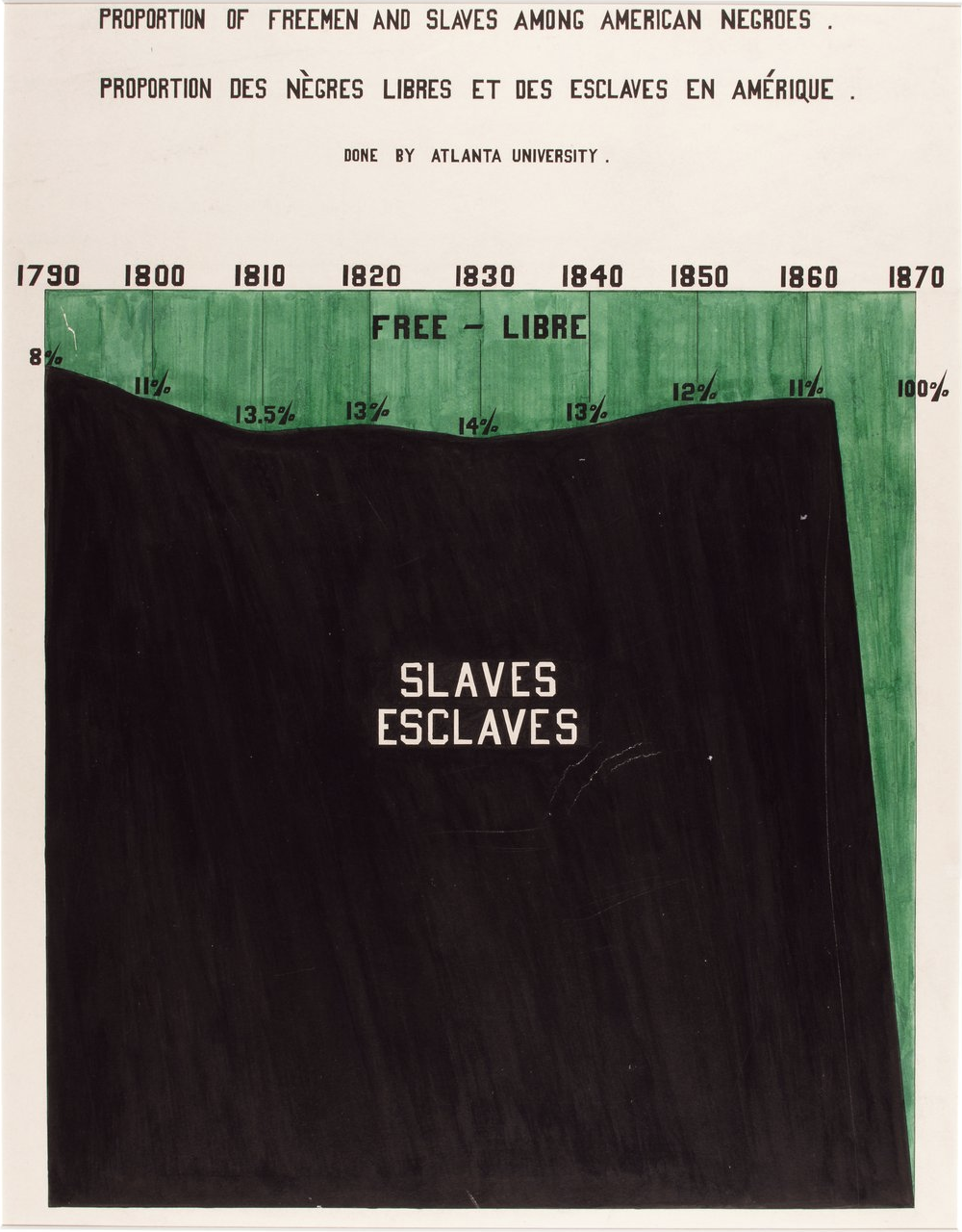
WEB Du Bois
Library of Congress
Examples such as the exhibition Data Displays (which recovers W.E.B. Du Bois’ statistical graphs to represent the African American reality in 1900) or Valentina D’Efilippo’s visualisation of the #MeToo movement show us how data can be forms of resistance, denunciation and empowerment.
Civio: uncovering patterns, narrating injustices
Eva Belmonte, director of research at Civio, shares how data journalism can also be a form of citizen activism. According to her, “people don’t consume data, they consume stories”. That’s why at Civio, every investigation is transformed into an accessible narrative that is emotionally powerful, capable of shaking consciences and demanding institutional accountability.
Among the examples she presents are:
- El Indultómetro: a visual database that shows all the pardons granted in Spain since 1996. The visualisation revealed that the most pardoned crimes were not those that appeared to be (robbery, theft), but crimes committed by civil servants such as prevarication or embezzlement. The investigation not only denounced this, it led to an effective reduction in the use of pardons.
- Medicamentalia: a project that shows global inequality in access to medicines.
- Video game on nationality: which puts the user in the shoes of a person trying to obtain European nationality, to experience the administrative maze in an immersive way.
All of this can be summed up in a phrase that defines Civio’s spirit: “We want the administration to feel observed”. Because well-presented data not only informs, it also makes people uncomfortable, challenges them and transforms them.
- Who creates institutions?
- Who narrates the data?
- How can we represent reality?
Creative processing: institutions as collective fictions
It is no longer enough to research or visualise. It is now a question of understanding that political ideas themselves are the result of creative acts. Democracy, the nation, rights: all these structures that seem so solid were invented by someone, at some point.
Once upon a time, in a noisy and forgetful city, a group of young people found a broken sculpture in the square. It was not made of stone but of stories, struggles and invisible threads
That sculpture was nothing other than democracy, built collectively, in constant tension, always incomplete.
History of political creativity: art, identity and resistance
Together with Paola Pierri, we embark on an exciting journey through historical examples of aesthetic research and political production:
In classical Athens, the theatre was a space for deliberation. During the Enlightenment, Goya used art to denounce tyranny. In Mexican muralism, artists such as Aurora Reyes painted rights, classes and collective memories. In the 20th century, Boal, Beuys, Jenny Holzer and the Guerrilla Girls occupied public space with uncomfortable, ironic and powerful art.
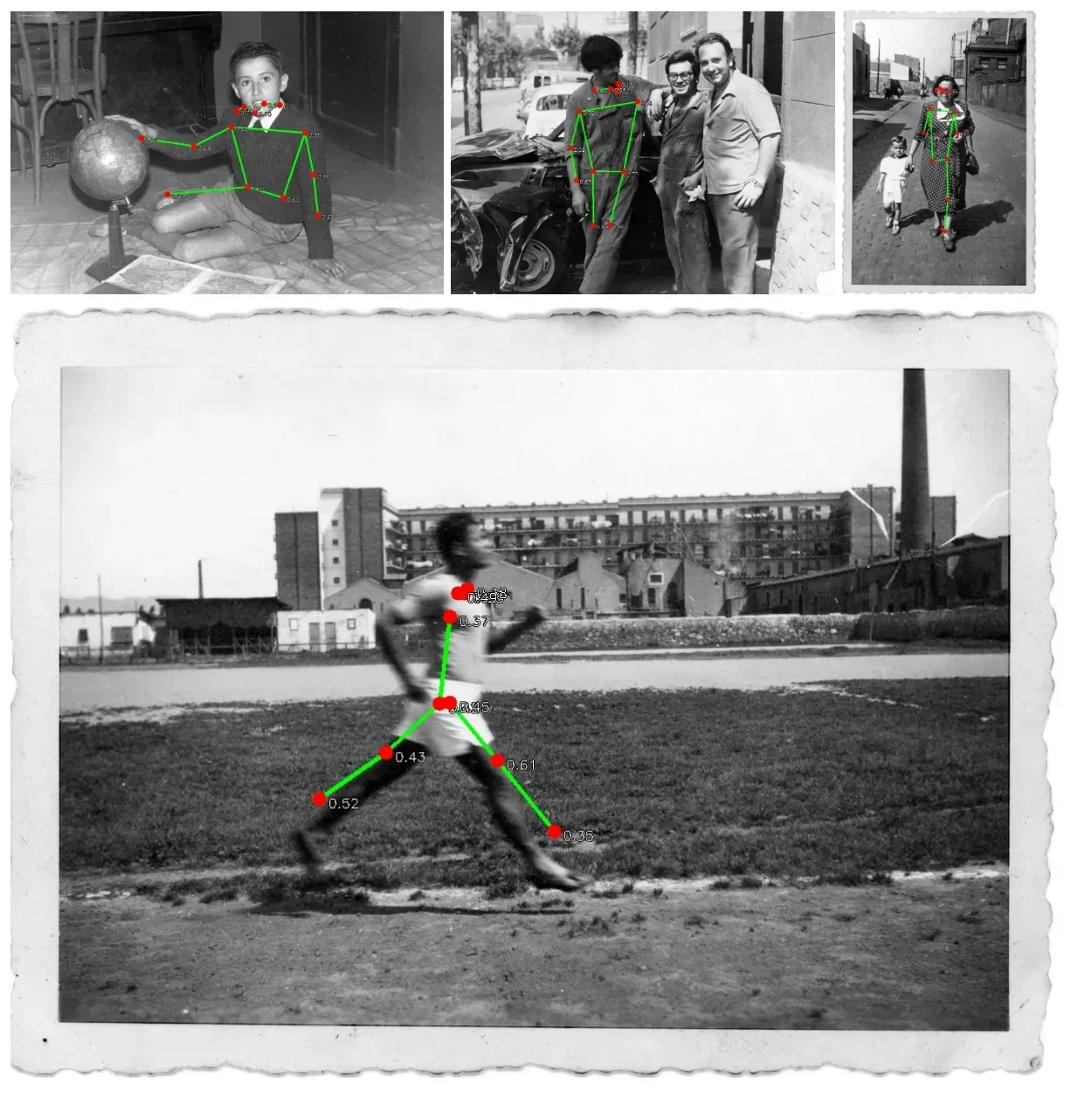
Domestc Data Streamers
Images from Poblenou public archive analyzed through pose detection AI models — April 2025
As the image shows, in recent decades, groups such as Domestic Data Streamers have turned abstract information into sensory experiences for citizen participation. These examples demonstrated that creativity is not a luxury. It is a political necessity.
The theory of political creativity
Paola Pierri asserts that unlike artistic creativity (which can be personal, expressive, individual), political creativity:
Is collective in intention and effect. Produces institutions, processes, shared ideas. Is based on collective fictions, as defined by Benedict Anderson or Ezrahi. Only works if it achieves representation, rituals and audiences.
Political creativity can be progressive or conservative. It can be used to expand rights (as the suffragettes did), or to sustain the status quo with new fictions that legitimise it.
“Democracy, he says, cannot survive without creativity. Because all its ideas, rules and structures are ultimately products of the collective imagination.”
Developing a citizen participation process. Step 4: Visualise your data
Platoniq proposes a creative and provocative exercise: turning a data visualisation into a legislative theatre scene. The goal: to move from data to emotion, and from there to deliberation.
Each group chooses a set of data on a public injustice, reads it critically (what does it show? what does it hide? who does it leave out?) and then creates a short scene—in the form of a dialogue, monologue, choral narration or fictional interview—that ends with an open question to the audience. A radical way of reminding us that democracy is not only debated: it is also represented, felt, acted upon. Because sometimes, a theatre scene can do more for public understanding than ten graphs.
Researching is not about recounting what exists, but asking what could be different. That creating is not about embellishing politics, but establishing it. And that democratic participation can only be real if it is also represented, dramatised, imagined and felt.