There are stories that are missing, not because they did not exist, but because they were silenced, fragmented or archived without words to name them. This conversation with Núria Ferran Ferrer takes place on that threshold: the place where memory ceases to be a repository of the past and becomes a living practice of justice, care and democratic responsibility. We ask ourselves what it means today to narrate with advanced technologies (such as artificial intelligence) without renouncing a feminist, situated and deeply political perspective. It is not just a matter of recovering data, but of accompanying memories, of reconstructing links between lives, silences and power structures that still affect us today.
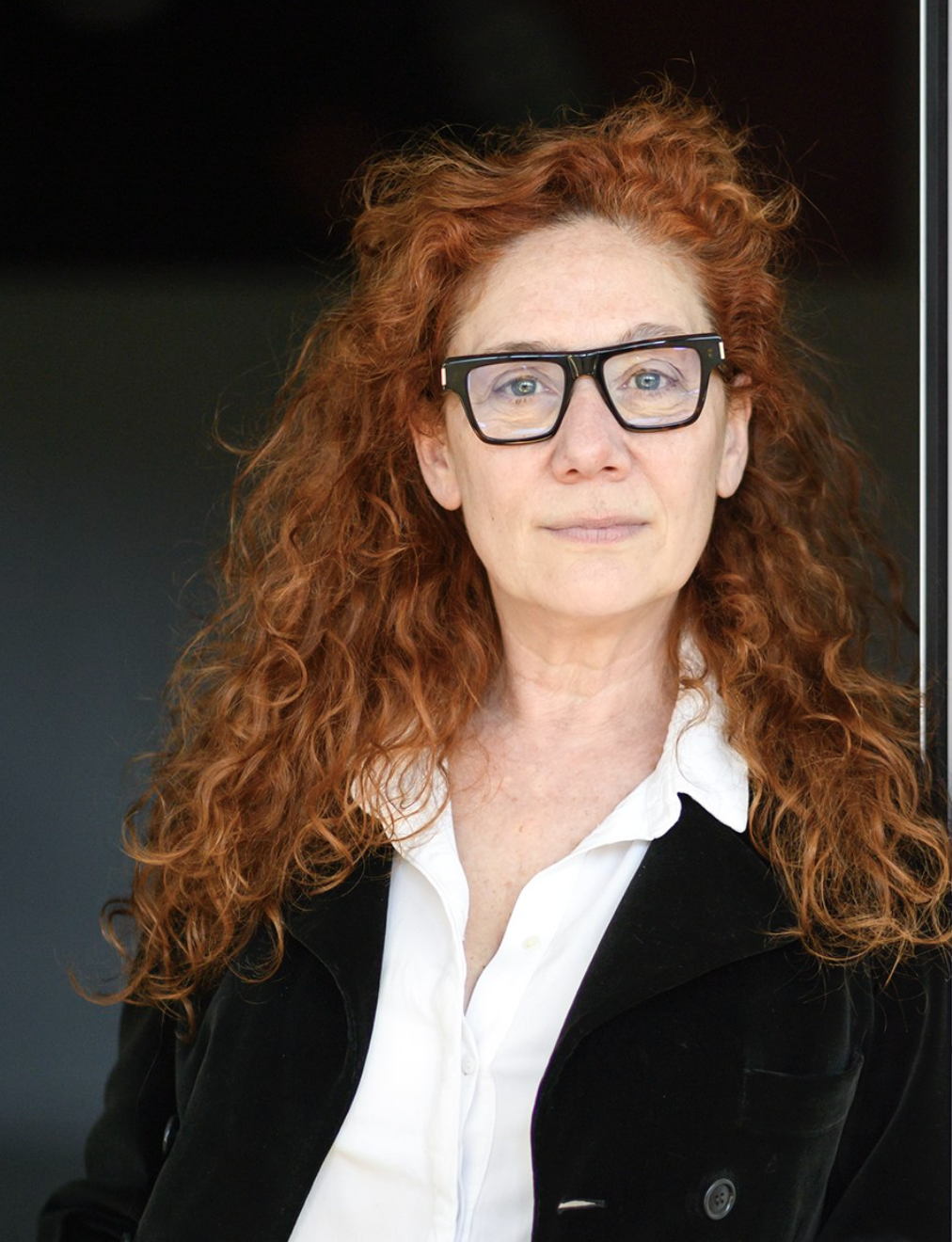
Núria Ferran Ferrer is a researcher and lecturer at the Faculty of Information and Audiovisual Media at the University of Barcelona. She leads the Women & Wikipedia research group, which studies gender bias in the co-production of open knowledge and in Wikimedia projects such as Wikipedia and Wikidata. Núria is the principal investigator of the HerStory project, which applies information architecture methods and artificial intelligence systems to enrich historical narratives about women and marginalised gender identities in contexts of historical memory such as Franco’s repression and censorship.
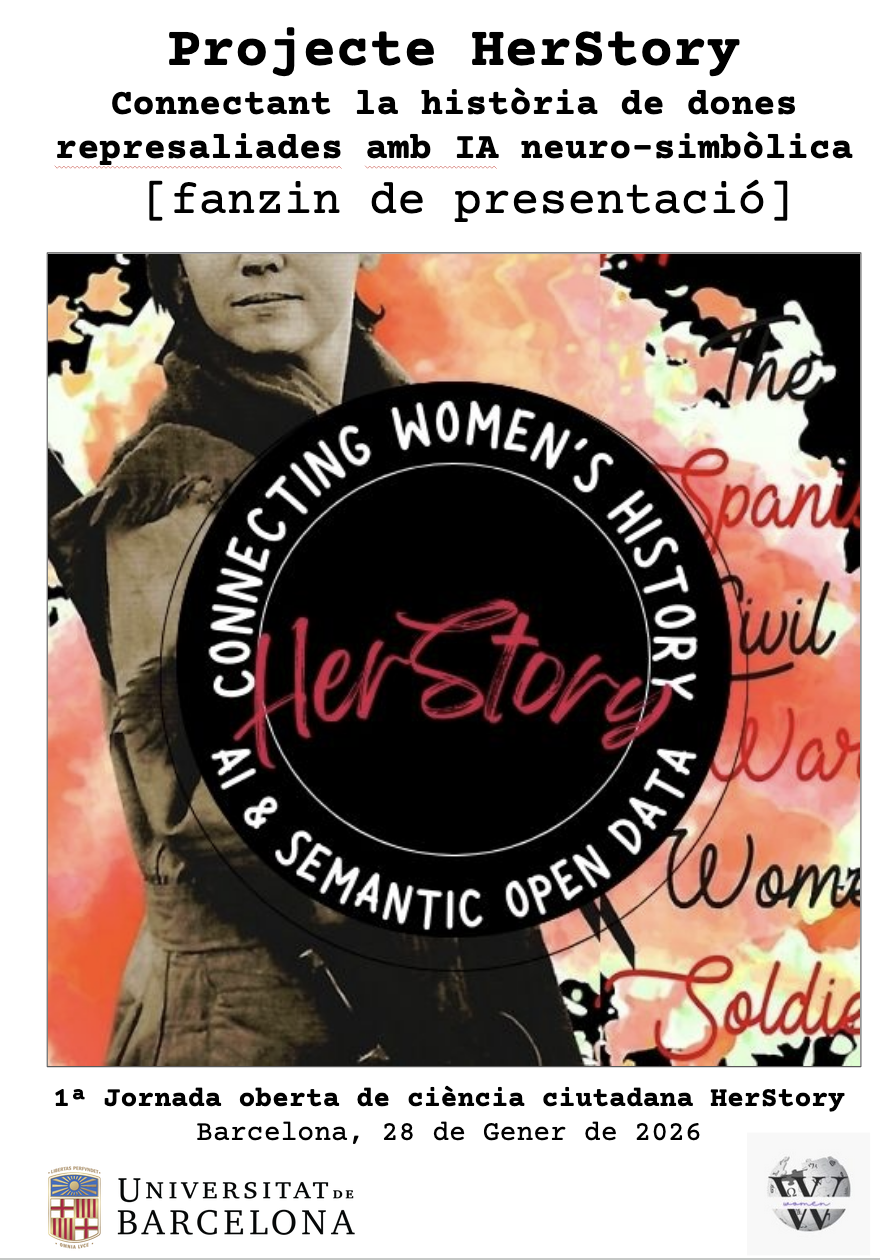
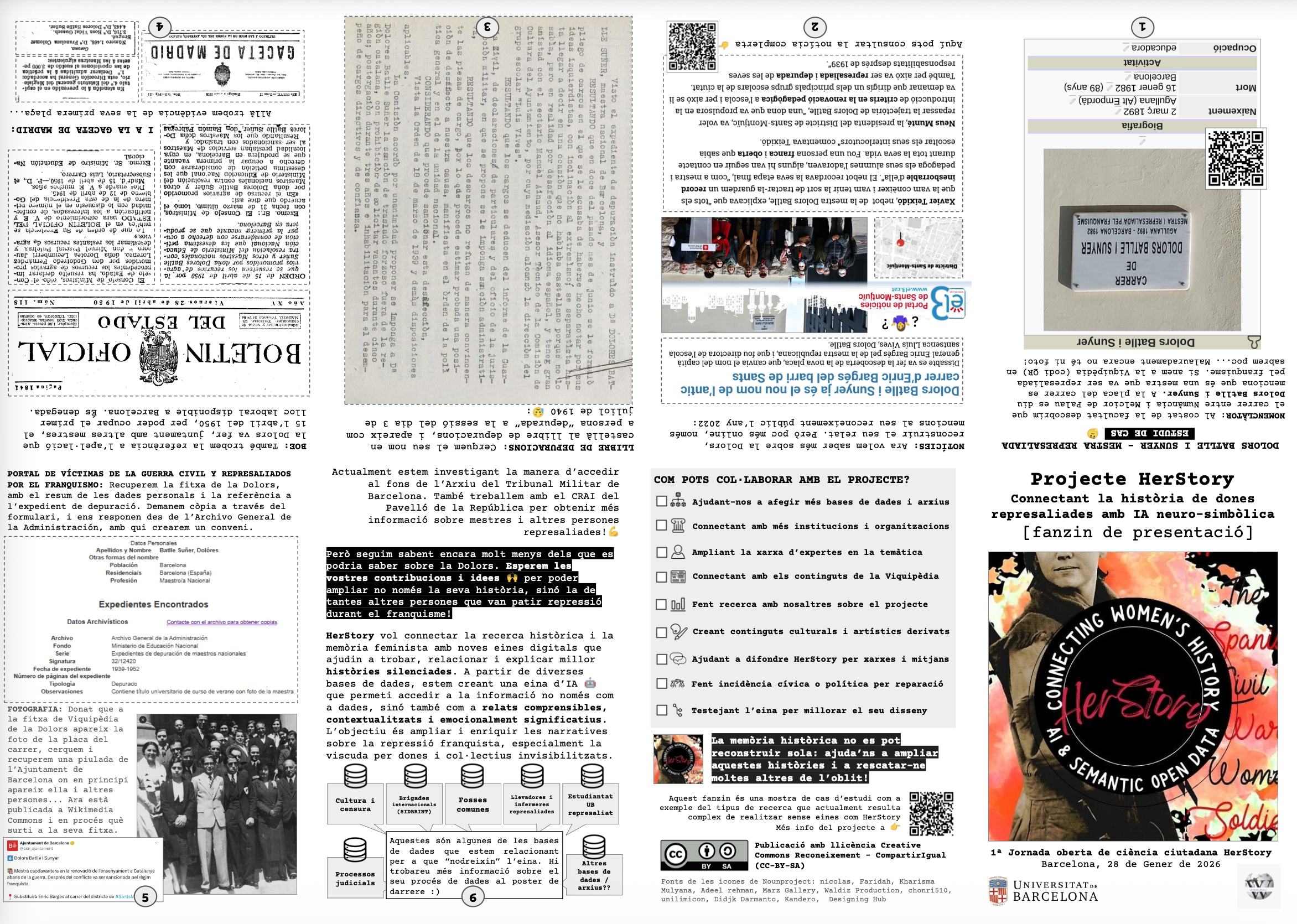
Presentation Fanzine
CC (2025)
Herstory emerged as an opportunity to investigate Francoist repression by accessing a wide range of data sources that had previously been scattered: censorship records, documentation on repressive practices and torture, and to do so from an explicit gender perspective. What idea or political urgency gave rise to the project, what erasures or what violence does it seek to confront?
I wouldn’t frame it as a ‘political urgency’ in the most immediate sense, but rather as a research opportunity that becomes a position: we start with a call for proposals, followed by what motivates us and where we want to take our work.
The project is activated within the framework of a call for proposals from the Ministry of Science, Innovation and Universities, which is probably the most competitive space for state research and which, in practice, shapes lines of work that function as a framework for public policy. In that edition, a specific line on artificial intelligence was opened for the first time, and we decided to position ourselves there.
We were interested in taking advantage of working with AI technologies from a critical perspective: focusing on their blind spots, on what algorithms tend to hide or distort as black boxes, hallucinations, biases, and bringing that analysis into a framework capable of producing the social impact we seek. And that framework was, specifically, the recovery and valorisation of the lives and memories of women in a historically silenced period.
So we took a seemingly neutral line and repositioned it: we talk about artificial intelligence, yes, but we place it in a non-neutral terrain, which is that of an intersectional gender perspective applied to a historical period that demands precisely that view. And that view is, indeed, deeply political.
The forgotten subject of the feminist archive
History is not neutral, nor is the act of narrating. What does it mean, on an ethical level, to be able to reconstruct these personal stories from a feminist perspective? What does it mean to work with these voices, and what kind of reparation do you think is necessary with regard to these forgotten or silenced stories?
We are talking about recovering the voices of people who have disappeared, but also of many who are still alive. So, inevitably, the project is not just documentary research: it is also a way of highlighting the work that has been done by institutions and collectives, of recognising these trajectories and, above all, of making them accessible to younger generations.
Sharing the experiences of people who could be our grandmothers, our neighbours, our families, has a deeply restorative meaning. And here something very significant emerges: many of us have grown up in contexts where our grandmothers did not want to or could not explain what they had experienced, precisely because of fear. Fear of speaking out, of reprisals, of reopening wounds in an environment where silence functioned as a survival mechanism.
What we are looking for is to generate tools that allow us to recover those stories, not from a morbid curiosity or for the sake of exposure, but from the possibility of understanding who we are
So part of what we are seeking is to generate tools that allow us to recover these stories, not out of morbid curiosity or for the sake of exposure, but from the possibility of understanding who we are, what memories we carry with us and what silences have also shaped our collective identities.
There is always the risk that a voice that has already suffered a form of violence at a particular moment in history may be exposed or exploited again in the present. How are you working with these voices to prevent these stories from being co-opted or exposed in a way that could cause further harm?
There is an important difference here: many of the cases we work with refer to structural repression, systemic violence, not necessarily intimate violence. The way in which a person can experience reparation or exposure varies depending on the type of violence.
Speaking publicly about structural violence can, in certain cases, contribute to a form of collective recognition and reparation. But in situations such as sexual assault, for example, the framework is completely different: it requires a context of protection, care, support networks, and above all, situated consent. It cannot be approached in the same way. This distinction is fundamental to our approach.
From this starting point, it is also important to note that, at this stage of the project, we are working with five databases that are the result of various previous research projects. This data has been generated with public funding and should therefore be accessible to all citizens, as established by law. Another issue is that, in practice, real accessibility is not always guaranteed.
What Herstory aims to do is precisely to facilitate access to these sources and, at the same time, to connect them with each other. We are talking about databases on international brigadistas, on teachers and midwives who were victims of reprisals, on the effects of the Vagrancy Act on LGTBI groups or sex workers. These are existing sets of information, but until now they have remained fragmented. Our aim is to extract, link and generate interconnections that allow for new interpretations.
At the same time, we are collaborating with groups such as Rosa Sensat to create teaching units and educational materials, and with Viquidones to produce encyclopaedic articles on teachers and midwives who were victims of reprisals. The results of the project must respond to current needs: education is one of them, but so is having a database that allows different questions to be asked.
At the same time, dissident women have also claimed the right not to be categorised. Is there room for silence, anonymity or withdrawal as valid forms of participation in HerStory? What protocols or data protection measures do these decisions require?
Well, there we would have to see precisely how we describe a person without forcing them into closed categories. In terms of gender identity, for example, we do not work with binaries. And in other dimensions, such as political orientation or forms of self-definition, the person themselves can choose how they want to be named. In Wikidata, in that sense, nothing is completely closed: ontologies are expandable, nuances can be added, new properties, new forms of representation.
It should be remembered that this is an information science project. And our discipline, in a way, spends its life putting labels on things in order to find meaning, establish relationships, and build intersections. But that is precisely why we opted for a data model such as Wikidata, which is much more open and flexible than a traditional library catalogue. It allows for an ontological structure that is not limited to classification, but can incorporate complexity, ambiguity and plurality.
In addition, Wikidata has a specific power: it connects multiple sources and diverse records. Dissenting voices can also have a space there, because their information can be articulated from different documentary sources. It can be a way to emerge without being locked into a single label. Even if someone wants their voice to be heard without being categorised in a reductive way, they can at least appear with references, with values in the metadata that the person themselves determines. That is precisely the advantage of not being a black box. If the tool is transparent, we can open it, intervene, modify it. It is a philosophy of democratic software, linked to civic tech practices: the first requirement is that the code is accessible, that anyone can understand and transform it.
Recategorising (in the age of AI)
Herstory is also a reinterpretation of the function of the archive and how cataloguing and categorisation have served to construct a narrative that may not correspond to historical reality as it actually happened. How much learning is there in the project about the archivist’s own ideological conditioning?
The archivist thinks about preservation; the librarian is concerned with facilitating consultation. That has been the starting point.
We try to mix both worlds: we care about preservation, but we work with databases that already guarantee a certain degree of documentary stability. The real challenge is access, but complex access, capable of activating multiple entries and allowing semantic relationships that enrich the narratives of this period. And especially, that give more prominence to dissident and silenced voices, which until now have remained fragmented or marginal.
This also reveals a structural deficiency in our discipline: we do not have sufficient critical training on the ethical and political implications of archiving. In many curricula, there is no subject that explicitly raises these questions. And yet they are fundamental, because what we do constructs a worldview: it determines who can access information, which stories become visible, which memories are left out.
What we want to introduce into our discipline, in the field of censorship, documentation and information science, is a fundamental idea: that the cataloguing and description of digital objects, of a book or an archive, are never neutral operations.
Technically, what the project aims to do is generate knowledge linked to both artificial intelligence and information architecture. But above all, what we want to introduce into our discipline, in the field of censorship, documentation and information sciences, is a fundamental idea: that the cataloguing and description of digital objects, whether a book or an archive, are never neutral operations. They always start from a political position.
It is not the same to call what was in reality political repression a ‘crime’. It was not a crime: it was structural violence exercised by the state. And saying this in no uncertain terms is also part of the work of memory. In making this shift, we recognise something essential: that our profession is not neutral. Information sciences have historically been linked to supposedly aseptic techniques, but in reality every decision—how you classify, what labels you use, what categories you prioritise, what silences you produce—is permeated by politics. At HerStory, we want to highlight this and also generate consequences in training, teaching, and future practices in the field.
AI technologies are currently entering many archiving and storytelling processes. What role does artificial intelligence play and how has its use been considered at HerStory? To what extent is a different model of artificial intelligence being explored, one that incorporates emotional, community, and even empathetic dimensions beyond the usual behaviour of current systems?
We do not work with generative artificial intelligence in the sense that everyone understands: based on probabilistic calculations that produce responses even though there is no real semantic understanding and even though they can generate hallucinations or errors. Instead, we work with neurosymbolic artificial intelligence, that is, with systems that depend on the context of the data.
This means that the system does not respond if it cannot contextualise the information using a knowledge graph. And that graph is designed specifically for the field of digital humanities, history, and in particular Franco’s repression.
By not working with generative artificial intelligence, the focus of the responses is not to produce an automatic result, but to provide information in a narrative form, contextualised and open to different formats. The tool can suggest paths: from an explanatory narrative to an audio file, a teaching unit or a more elaborate article. But there is also a second fundamental axis: traceability.
For us, it is essential that every word, every statement that appears in a narrative is linked to its source. There will never be a piece of data within the system that does not explicitly refer to a reference. This is a crucial difference from many current AI tools, which operate like black boxes.
AI can amplify biases or reinforce invisible forms of violence. Is there any critical reflection on the risks of delegating curatorial, interpretative or selection decisions to this type of automated tool? Are there limits that HerStory contemplates in advance or is unwilling to cross in this regard?
Absolutely. We are working on Franco’s repression, that is, on a deeply patriarchal and authoritarian regime. But precisely for this reason, the semantic relationships and principles that govern our knowledge structures are defined by the project’s objectives: to reduce gender bias and avoid hallucinations or automatic associations that reproduce stereotypes. For example, simplistic correspondences such as ‘doctor/man’ and ‘nurse/woman’.
We know that these relationships have been naturalised historically, and what we are trying to do is break them down through design. When we establish connections between a person and a profession, for example, we do so in a direct and contextual way. Gender is metadata in itself, and we do not understand it as binary: we work with a structure that contemplates multiple values. It is at this level that politics is introduced into the algorithm, because it defines which principles and values guide relationships.
But correction does not consist of inventing arbitrary categories, but rather of intervening critically based on historical knowledge and rigorous information management. In that sense, yes, there is an inevitable political stance: we are putting the spotlight on a fascist and patriarchal period, and that always implies conflict. But it is also a scientific stance, based on historical studies, academic methodologies and a public responsibility with regard to memory.
Regaining control: an exercise in democratic dignity
Cristina Fallarás, in her experience with La Nuestra, stated: ‘When women are given autonomy, they must be offered a safe, secure place, a place where they are not the ones who end up in court.’ How does this statement resonate with the work you do at HerStory? How is security defined in this type of action research involving such sensitive archives?
This is a central issue. On the one hand, we are analysing and looking for references to determine which personal data can be published and which cannot. Some information is particularly sensitive.
In this project, for example, gender is handled very carefully, but in other contexts we have seen the extent to which certain data can put a person’s life at risk: there are countries where gender identity can be punishable by death. Publishing such data can cost someone their job, their social network or even their very existence. That is why it is essential to be extremely vigilant.
We are still in the process of defining this framework. Until now, we have mainly worked with research databases that, in principle, are public: they have been financed with public money and should be accessible as such. But the project is also opening up another dimension, because we are calling on information sources that may even be personal, voluntarily contributed accounts, which can then be semantically linked to our knowledge graph and form part of a tool that articulates biographical data with other historical and documentary records.
Which carries more weight? The right to know who carried out repressive functions or the right of a family not to be stigmatised by this.
And that’s where complex dilemmas arise. What happens, for example, with data linked to repressive individuals? If my father was a censor, I might not want that to be known. But at the same time, it was a public office, paid for with state resources. So we are in that debate: what weighs more? The right to know who exercised repressive functions or the right of a family not to be stigmatised by it.
Our position tends to be that the more public, the better, in the sense that a father’s job does not imply sharing his ideology or his decisions, and we are also talking about events that happened decades ago. But we are designing a document that governs the legal and ethical dimensions of personal data protection, trying to be as open as possible without causing further harm.
Is HerStory a space for rehearsing forms of democratic dignity? In addition to allowing stories about victims of reprisals and repressive organisations or actors, what kind of political agency can the act of collectively narrating a feminist history, recovering cross-referenced data from historical memory, awaken?
For me, it’s obvious. When they explained the Civil War to me, they talked about the military, battles, who won. But I had almost never heard of teachers who were persecuted, women who were unable to practise their profession throughout the Franco regime because they spoke Catalan, because they defended a mixed school, because they used banned books. There was no mention of midwives who had to go into exile just for doing their job, or how many people died in concentration camps, or how many children were stolen.
It all seemed distant, like an abstract story. And here we are talking about everyday life, about specific life stories, family members, neighbours, people who are deeply close to us. Stories that speak to you because it could have been you. I am a teacher, and I think of all those teachers who had to remain silent, adapt or leave. That is why these gaps exist.
Furthermore, in feminism in particular, it is a historical period in which not enough figures have yet been recognised. We have the women of 1936, yes, but now other stories are beginning to emerge: there is talk of the Patronato de Protección a la Mujer (Women’s Protection Board), of specific prisons, of repressive measures that particularly affected women. Just this week, a book by Carme Guillén has been published [ “Redimir y adoctrinar. El Patronato de Protección a la Mujer (1941-1985)” ]. It’s all very recent. I was born in a democracy, and yet fifty years have passed and many of these stories had not reached me.
And what we are discovering is brutal: just for being a woman, you were punished; for being a lesbian, even more so. Women could not open bank accounts, they could not stay in a hotel without their husband’s permission… All of this is only now becoming visible. It is, as you said, bringing historical facts to the everyday level of life.
That is why the focus of the project is on feminism and dissident voices: because they were the ones who were most oppressed and also the ones who later managed to bring their stories to light. Recovering them is a form of epistemic and political justice.
At Platoniq, we are working to define the democratic capacities necessary for good deliberation: narrative agency, temporal justice, relational security, capacity for imagination, situated voice. How do you think Herstory could contribute to cultivating any of these democratic capacities?
Yes, of course. I believe that Herstory can contribute very directly to cultivating several of the democratic capacities you mention, precisely because it works at a very particular intersection between memory, technology and participation.
To begin with, the project activates a very powerful form of narrative agency. Not only because it recovers silenced stories, but also because it allows those stories to be articulated on multiple scales: from institutional archives to family memory, from academic research to citizen narratives. Giving access to these trajectories and allowing them to connect is to restore the capacity for storytelling to those who have historically been relegated to the margins. And that is profoundly democratic: to be able to name, to be able to appear, to be able to inscribe oneself in a common narrative.
There is also a clear dimension of temporal justice. We are working with a historical period whose effects have not disappeared, but whose memories have been suspended, interrupted, silenced for decades. Recovering those lives is not just about looking at the past: it is about reordering the present, recognising that there are continuities of violence, inequality and repression that still structure our societies. Temporal justice implies precisely that: that time does not close falsely, that wounds are not covered by silence.
As for relational security, I believe it is one of the most delicate aspects of the project. We are not talking about security in technical terms alone, but about creating a framework where people can access this data without being exposed, without being exploited, without being trapped in rigid categories.
Relational security has to do with care, with context, with the possibility of building trust in the tool, in the sources, in the collective process. And that is where traceability, transparency and shared governance are fundamental.
There is also a dimension linked to the capacity for democratic imagination. Because when you connect scattered data, when you make visible relationships that were not previously evident, new possibilities emerge for understanding the past and, therefore, for imagining different futures. Imagination here is not abstract: it is the possibility of saying ‘this happened, these lives existed, these women sustained worlds,’ and from there to think about what other forms of society could have been built and can still be built.
And finally, the idea of the situated voice runs through the entire project. Citizen science is not a complement, it is an epistemological principle: it implies recognising that knowledge does not belong only to academia, but is also produced from experience, from family memory, from the bodies that lived through repression, from the communities that inherited those silences. Incorporating these voices is not just about adding testimonies, it is about transforming the very framework from which knowledge is organised.
Herstory is not just a technological tool or a digital humanities project. It is also a proposal on how to build the common good.
Herstory is not just a technological tool or a digital humanities project. It is also a proposal on how to build the common good. That is why I believe that Herstory is not just a technological tool or a digital humanities project. It is also a proposal on how the common good is constructed, on what memories we consider legitimate, on what kind of democracy is possible when access to information becomes a space for justice, care and collective agency.
In that sense, perhaps the most important thing is that the project attempts to demonstrate that artificial intelligence, far from being a neutral technology, can become a political and democratic device if it is designed based on explicit principles: transparency, traceability, participation, and epistemic justice. That, at least, is the direction in which we want to move.
Narrating history as a form of accompaniment
Two final questions, moving into a more human dimension of the project. Beyond data processing, you have talked about meeting spaces, events, and communities that are being generated around the archive. How can the project sustain or accompany these spaces of listening, accompaniment, and struggle? What political impact can this environment have?
For us, social impact is at the heart of the research. If there is no social impact, it makes no sense. That is why we are so concerned with teaching and training, but also with the community fabric that is activated around the project.
We do not yet know if this community will have the vocation to endure over time. For now, we are working hand in hand with those who participate to design the tools, improve the processes, and build a shared methodology. But what we want is for the community, if it so desires, to be able to take ownership of these tools, empower itself, and find opportunities within the project.
A clear example is the work with Viquidones. They have seen the possibility of recovering information about women who suffered reprisals and midwives, which until now was literally stored away, invisible, like a document in a closed archive. By digitising it, structuring it and connecting it semantically, the possibility of generating narratives, responses and articles is opened up. Therefore, the project also has consequences in terms of who produces knowledge and who has a voice in digital spaces.
It is true that we have not yet articulated how this community will be sustained in the long term. The project will last for two more years. During that time, there will be monthly meetings, and Viquidones will also maintain its weekly dynamic linked to the project. That community will be alive, at least during this period. And if it grows, we are already in talks with the Generalitat, with the Directorate-General for Democratic Memory, to explore how it could continue within the public system and how administrative data could also be integrated into this common architecture.
What happens when a project enters the institutional system? How does the relationship with the community change? What tensions arise between sustainability and autonomy?
The next big question is what happens when a project of this nature begins to enter the institutional system. Because it is one thing for it to exist as a community space, experimental, with open governance, sustained by a logic of collaboration and citizen appropriation. It is quite another when it is integrated into broader administrative structures, with their own rhythms, their own regulations, their own hierarchies.Inevitable tensions arise. On the one hand, institutionalisation can bring sustainability: resources, continuity, public legitimacy, long-term maintenance capacity. If we manage to integrate part of the administration’s public data into this architecture, the project can be greatly expanded and become a structural device for democratic memory.
But, on the other hand, there is also the risk that, upon entering the system, the community will drift away. That what was a living space for participation will become a more closed, more bureaucratised tool, less permeable to citizen intervention. These are issues that we cannot yet fully resolve because we are breaking new ground. We are in a period of exploration, and many decisions will be made based on how the collective process itself evolves.
What we do know is that we do not want to lose the citizen science dimension as the epistemological and political core of the project. It is not just a question of producing a technical infrastructure, but of sustaining a space where knowledge is constructed with people, where the archive is not only preservation, but also access, narration, and reparation.
We are, in a way, on that frontier: between citizen experimentation and the possibility of becoming public policy. And what happens will depend both on the institutions and on the community’s ability to continue to claim this space as its own.Because in the end, what is at stake is who has the right to narrate history, who has the right to access the archive, and who decides which memories are part of the common good.These are questions that we cannot yet fully answer.
These are dynamics that must be observed, because the same thing does not always happen: sometimes institutionalisation provides continuity and resources, but other times it can dilute community participation. We are paving the way, and we will see where things take us.
And finally, there is one issue that runs through all of this: the dignity of the testimonies. How can we protect that democratic dignity in the face of discourses that may exploit or attack the project?
The dignity of testimonies is protected by the seriousness of the work, by rigour, by the awareness that we are building memory on the ‘shoulders of giants’. And yet, many ‘giants’ were not there. They were not there because they died, because they were silenced, because fear erased them.
And those epistemic, vital, historical silences have done damage. They have impaired our ability to be a society, because we have not known these lives, these experiences, these losses. How many times were we told at home: ‘Don’t talk about politics.’ All of this has left deep scars. That is why we must give voice to those silences.
When we talk about epistemic justice, I connect it directly with feminism, but in reality it is a broader responsibility: any phenomenon that falls outside the academic gaze, any culture that no one studies, any ignored disease, any relegated social experience, is also a silence that must be questioned.
And when you choose a research project, it is not enough to produce technical knowledge. If that knowledge is funded with public money, it must have an impact on society. It must serve to look where no one has looked before, to repair what has been erased, to make absences visible.That is why we seek epistemic justice, we seek out the silences, we seek out where we place our gaze. I believe this is a fundamental responsibility of intellectual and democratic practice.