Learnings
Facilitate the co-creation of agendas and public policies with those affected [ECD1_M2]

The second module of the School of Creativity and Democracy is focused on understanding and facilitating the co-creation of agendas and public policies with those affected. It enters a territory where emotions are not a hindrance to politics, but its most powerful fuel. Here we learn that political participation is not limited to rational acts or institutional mechanisms, but is also written on the body, felt on the skin and contagious with the eyes.
Affection, dignity and conflict
Affection, dignity and conflict, traditionally relegated to the private sphere, are in fact public forces, intensely political and generators of change.
From the outset, a radical shift is proposed: facilitation as a practice of democratic care. Facilitating is not moderating from a technical distance, but involving oneself in the collective bond, listening to the unspoken, sustaining discomfort without neutralizing it, and opening safe spaces where all voices -especially the silenced ones- can emerge with force.
Together with Olivier Schulbaum, Platoniq’s strategic director, we explore how affections, far from being an irrational residue, are the living matter of democracy. Olivier reminds us how Amber Huff states that “the very notion of movement has to do with emotion”, and that all political transformation is born of a collective vibration, of a shared rage, of a desire that circulates. And also that Brian Massumi took this idea further: we feel before we think, and power acts not so much with arguments as with modulations of mood. Hence, creativity and movement are political tools of the first order.
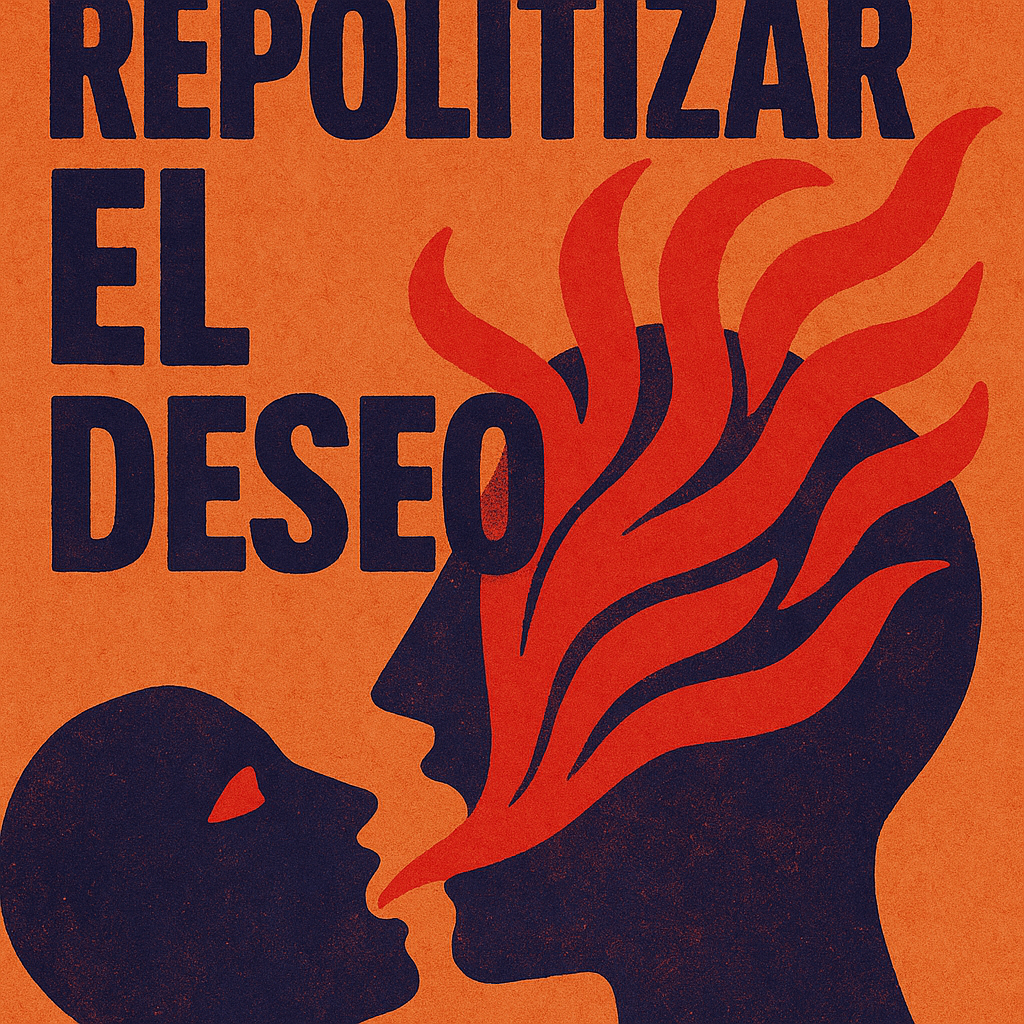
But not all affections mobilize emancipation. Alicia Valdés, with her “Politics of Discomfort”, warns us that the historical repression of emotions associated with the “feminine” has opened the door to their manipulation by reactionary discourses. In the face of technocratic cynicism, Valdés invites us to re-politicize desire, to place affects at the center of political action and to build spaces where collective discomfort finds expressive, not repressive, channels.
In turn, Cynthia Fleury shows us that a democracy that ignores the emotional dignity of its citizens is sick. Untreated wounds manifest themselves as disaffection, resentment and civic fatigue. With her “Dignity Clinic,” she challenges us to treat democracy as a collective body in need of care, recognition and repair. It is not only a matter of designing efficient institutions, but also of healing broken ties and rebuilding shared meanings.
Chantal Mouffe, on the other hand, shatters the myth of consensus like no one else. Antagonism is not a failure of the system: it is its vital energy. Repressing it generates disaffection or transfers it to destructive forms. That is why democratic politics must channel passions, not extinguish them. And to do so from the cultural, the educational, the symbolic: from a pluralist democracy that embraces conflict as a creative force.
Western deliberation - based on legible rationalities - often excludes the languages, memories and ways of life of indigenous and racialized peoples
But if we want to go further, we cannot stay in Europe. With Azucena Morán, researcher at the Potsdam Institute for Sustainability, we immersed ourselves in the links between democratic innovations and coloniality. We learned that Western deliberation, based on legible rationalities, often excludes the languages, memories and ways of life of indigenous and racialized peoples that, without questioning this epistemic architecture, participatory processes can reproduce without breaking colonial power.
Morán leads us to think about what it means to decolonize participation. It is not enough to include identities as diverse decor. It is about taking seriously the demands for land, autonomy and epistemic justice. It is about listening to other forms of governance and not replacing them with imposed state structures. And, above all, to stop being indifferent to the continuity of colonialism: the opposite of affection is indifference.
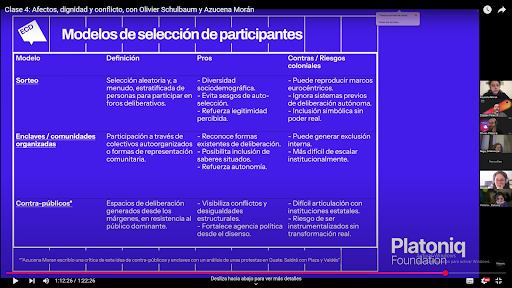
In this sense, we address new ways of designing representation in deliberative processes. We discuss strategies such as the colonization of the algorithm: programming the selection to contemplate complex identity intersections, the oversampling of historically excluded groups, and the continuous evaluation of inclusion as a methodological principle. Because democratic justice is not automatic: it must be programmed, sustained, constantly updated.
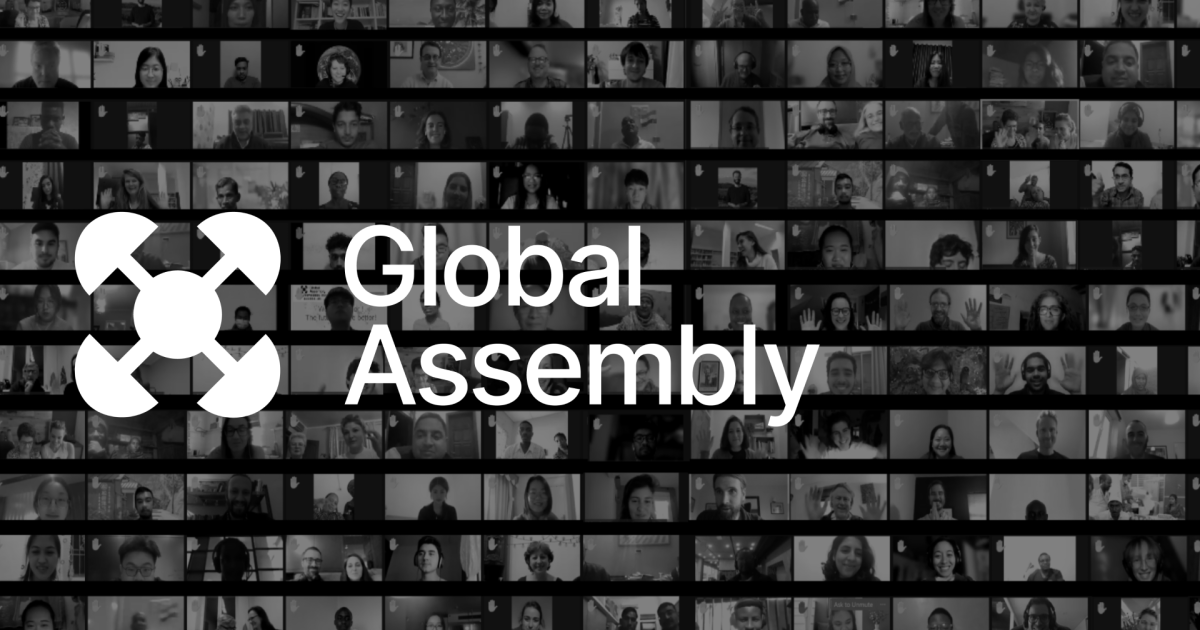
An inspiring example is the Global Assembly, a global assembly held digitally within the framework of COP26, where 100 citizens drawn from around the world deliberated on the future of the planet. More than 1,300 people participated in local assemblies in 41 countries. And yet, what really ignited the deliberation was the experience narrated by a miner. His story, not his data, was what moved the group. Thus we learn that participation is ignited from lived experience, not from expert knowledge.
Classic (and creative) ways to participate in Public Policies: the legislative theatre
On the other hand, Katy Rubin, an expert in citizen participation and founder of Theatre of the Oppressed NYC, proposes another way to place feelings, affections, and dignity at the heart of deliberative processes: Legislative Theatre. Legislative Theatre, derived from Augusto Boal’s Theatre of the Oppressed, is a process of democratic participation in which communities directly affected by unjust or ineffective policies create a play based on their own experiences. This helps identify problems and collaboratively imagine potential public policies to improve the situation.
- What problem do we want to represent?
- Who are the actors involved?
- What is missing from the scene to turn oppression into opportunity?
Legislative Theater seeks to transform imposed norms, specifically public policies, based on the belief that the communities directly affected by a problem are best placed to have a say in the matter. It also fosters a space for collective imagination and active reflection, leading to real and effective public policies, as has occurred in various parts of the world.
Elaboration of a citizen participation process. Step 2: Scripting a social problem
In this journey of emotions, conflict and representation, we conclude the module with a challenge as political as it is poetic: to write a group script to stage a social problem and propose a transformative public policy. The topics are as diverse as they are urgent: access to housing, migration, climate justice, mental health, democracy in the classroom or deep temporalities. This is not just a theatrical exercise: it is an act of radical imagination, a practice of democratic design from the body, the word and the link.
This second module leaves us with new tools to look at and inhabit the conflict. To facilitate is to care, to deliberate is to move, and to create public policies is also to re-enchant the common from the margins. If anything is clear, it is that there is no participation without affection, nor democracy without dignity.