Futures
Using listening circles with children and teenagers to transform digital policies


Some projects simply ask questions… whilst others actually stop to listen. The process launched by the Bofill Foundation to develop a Digital Equity Agenda in Catalonia clearly falls into the latter category.
Its approach goes beyond merely gathering opinions; it aims to transform everyday experiences into shared knowledge and, from there, into proposals capable of influencing public policy.
To this end, we were tasked with leading the methodology and facilitation of several listening processes involving children and teenagers, aimed at understanding what they think, feel and worry about regarding the digital dimension and the impact it has on their lives.
The aim was not to draft a grand manifesto or to create a new platform on which to publish results. Rather than the usual approach in such cases, the focus was on listening in classrooms, within families and across communities to understand what is happening with technology.
From there, Platoniq began to weave together a system that connected many different perspectives: children, adolescents, teachers, families, local authorities and experts, without forcing them to fit into a single narrative. Rather than a linear sequence of phases, what emerged was an expanded conversation, where what was said in one space resonated in others. A process where ideas did not flow in a straight line, but were transformed as they encountered other voices.
Starting point: young people’s uses of technology between AI, digital wellbeing and media literacy.
In Spain, connectivity and the availability of devices are widespread: in 2025, 96.9% of 10- to 15-year-olds used a computer, 96.5% used the internet and 67.9% had a mobile phone; furthermore, 97.4% of households had internet access. These figures indicate that the main issue is no longer whether young people are inside or outside the digital environment, but under what conditions they enter it, with what support, and with what critical capacity they interpret what happens there. (INE, 2025)
With regard to artificial intelligence, the picture is particularly significant. Official data from the INE show that in Spain, 37.9% of people aged 16 to 74 used generative AI tools in the last three months of 2025, and that 16.2% did so for formal educational purposes. The critical issue, therefore, is not merely the adoption of AI, but the type of pedagogical relationship that is built with it: whether it is used as a support for understanding, comparing and creating, or whether it becomes an instrumental shortcut that undermines cognitive autonomy.
From the perspective of digital wellbeing, the available official evidence suggests, on the one hand, that digital environments offer spaces for social interaction, entertainment and a sense of belonging; on the other, indicators are beginning to emerge that point to emotionally intense and, in some cases, compensatory uses. The EMOChild study, published by the Childhood Observatory and based on a sample of 5,652 schoolchildren aged 9 to 16 from across Spain, indicates that one in four children and adolescents experienced nervousness or irritability when unable to access their social media, and that more than half used social media as a way to forget their problems, a trend more common in adolescence than in childhood.
As for media literacy, data from the ICILS 2023 study show that Spanish pupils in the second year of ESO scored 495 points in digital competence, above the European Union average of 493, and that Spain also has a higher-than-average European rate of learning regarding the safe and responsible use of ICT. This suggests that the education system is making progress in digital skills, but still needs to consolidate a deeper level of media literacy, capable of going beyond the functional use of tools to incorporate verification, critical reading of content, understanding of algorithmic logic and analysis of the power of platforms.
Overall, the assessment necessarily remains open-ended. Official data do not paint a picture of a passive or technophobic youth, nor do they support an uncritical celebration of digitalisation. What they reveal is a highly connected generation, exposed to platforms from an early age, increasingly familiar with AI and reasonably competent in basic digital skills, yet still grappling with significant challenges regarding emotional wellbeing, critical autonomy and the quality of educational support.
Invisible innovation: how to facilitate a conversation whose outcome we cannot predict
Based on this analysis, at the Platoniq Foundation we argue that to understand the relationship between children and adolescents and technology, we need to create spaces where they can express not only what they do, but how they feel about it and how they integrate it into their lives.
It is on this premise that the innovative methodology of the process was designed, aimed at generating contexts for in-depth conversation that would allow us to go beyond the figures and access the complexity of these experiences.
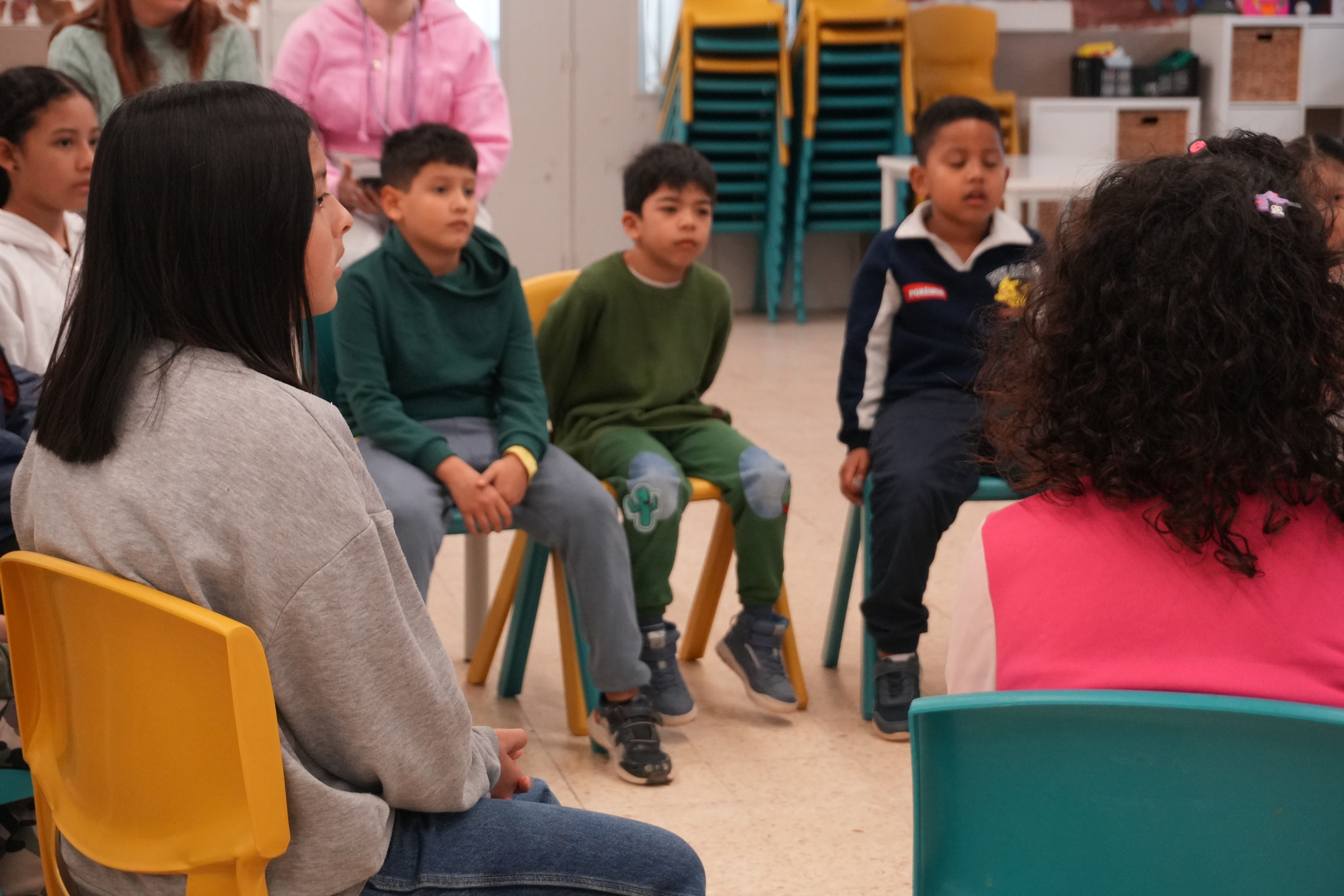
Innovative not only because of how it was organised, but also because of how the conversations were facilitated. The conversations that took place drew on listening circle methodologies and restorative practices, which helped to create a different atmosphere where a space was formed in which listening meant more than simply waiting for one’s turn to speak, and where what each person brought with their experience, their doubts and their contradictions had value in itself.
It is in this kind of environment that things begin to emerge that don’t usually come to light. Unexpected phrases, images, intuitions. Living material that rarely surfaces in more rigid or controlled formats
We were not looking for technical answers, but rather representative experiences that would reveal the symbolic, emotional and ambiguous undercurrents of what is really happening in the relationship between children and technology.
From restorative circles to focus groups
We therefore adapted Belinda Hopkins’ listening circles methodology—typically used in educational and restorative contexts—to work with groups of children and adolescents. This involved moving away from the classic focus group format, which is more geared towards ‘extracting’ answers, to create a space where the priority was not so much to obtain information as to construct it collectively amongst all participants.
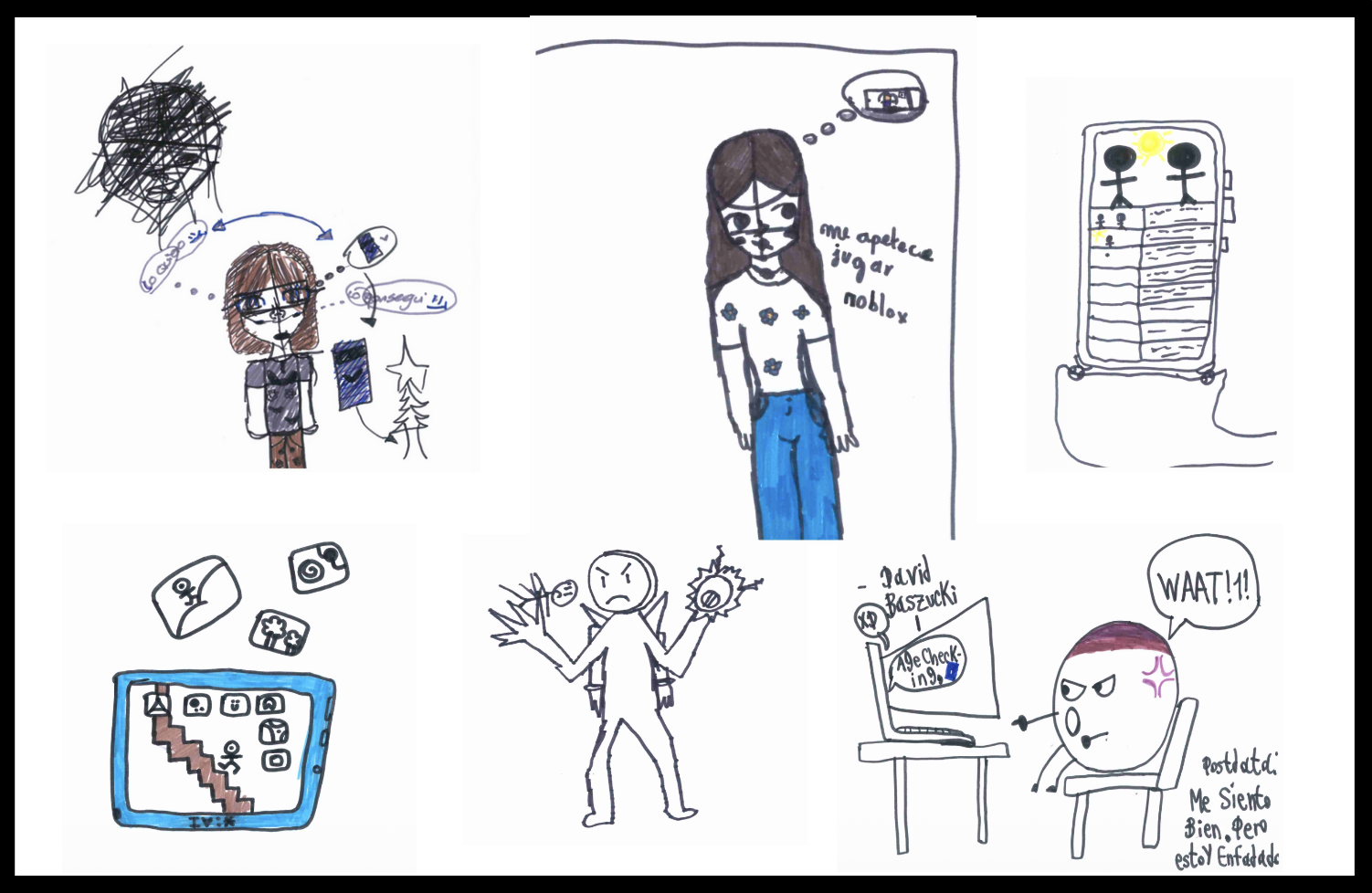
In practice, this resulted in simple yet very powerful dynamics: the use of an object to indicate whose turn it was to speak, rounds of discussion, the option to speak or remain silent, respect for everyone’s time, and the use of other forms of expression such as drawing or body language. Elements which, far from being formal, helped to balance the voices and generate a more measured, more honest and, above all, more inclusive conversation.
As Hopkins suggests, the circle opens up the possibility for each person to express themselves from their own experience and feel truly heard. And that changes many things. Not only in what is said, but in how it is said and what is allowed to emerge. Little by little, trust is built, the most automatic responses are loosened, and something more authentic emerges.
Applied to this process, the effect was very clear: more sincere speeches, less influenced by peer pressure or by what ‘is expected to be said’, and with far more nuances than usually appear in other, more directed formats.
From what is said to what it means
But listening, on its own, is not enough. The trickiest part comes next: how to shape everything that emerges without losing its meaning, how to organise it without oversimplifying. That is where Platoniq’s work takes on particular value. It was not just a matter of recording what was said, but of knowing how to interpret it, connect the dots and present it in a way that remains true to the experience.
The process involved combining different layers: gathering concerns, analysing them in depth, identifying priorities and, finally, translating them into policy proposals.
One teacher expressed it with a clarity that runs through the entire process:
We’re being asked to teach digital skills, but no one had ever asked us before what it’s like for us
This sentence is not just a criticism; it is also a methodological key. Because the project does not start from answers, but from that prior absence of listening.
Three themes, four tensions
Throughout the process, major themes emerged that cut across the contemporary digital experience, but always from the perspective of those who feel affected by it. In the realm of digital wellbeing, for example, the emotional ambivalence linked to screen use emerges strongly.
When I'm playing, I feel fine, but when I stop, I get angry and I don't know why
In the field of artificial intelligence, the perception is equally complex, far removed from both uncritical enthusiasm and outright rejection.
AI can do my homework, but it doesn’t know if I’ve understood it
When addressing media literacy, the tension between trust and doubt in digital environments becomes evident.
If it’s on the internet, it sounds true… but it isn’t always
An unexpected theme was the emergence of techno-anxiety, an emotional condition that seems like an abstract concept, but which children experience as a concrete, everyday reality.
I’m afraid that soon nothing will be real anymore and AI will destroy everything
Voices that are not merely anecdotal, but serve as qualitative indicators of a system in transformation—signals that allow us to read what metrics fail to capture.
From participation to useful knowledge: recommendations from young people
In a context of rapid digitalisation, where decisions are made at breakneck speed and, all too often, far removed from the spaces where their effects are actually felt, this project raises a fundamental question that goes beyond Catalonia and directly challenges how we are building the future: who has the right to define how we want to coexist with technology. Platoniq’s answer is very clear: those most affected, who are none other than the children who describe their relationship with screens through images that reveal dependence, pleasure and disconnection all at once. Furthermore, the teachers who, day in, day out, support a transformation for which they do not always feel prepared; and the families who manage limits, usage and tensions at home as best they can.
A whole range of voices that rarely take centre stage in decision-making processes and yet are the ones that best describe what is happening. Their recommendations focus less on grand technological solutions and more on changes in how we support digital use. They are calling for more opportunities to understand what they do and why they do it, not just rules or bans. They are asking to be able to speak openly about their experiences with screens, about how they feel, about what draws them in or makes them uncomfortable. Ultimately, their proposals point to something simple yet profound: they do not need more technology, but better conditions for living alongside it.
Call for a Citizen Dialogue on technology led by young people
cc-by-sa Platoniq
Inspired by the work of Katie Reid, a specialist in children’s rights and child participation, at Platoniq we believe it is time to truly listen to those who are experiencing the impacts of digital policies first-hand: young people. With this in mind, we propose promoting the Citizens’ Dialogues (Youth Agora) as an innovative, safe and representative space where young people from across Catalonia can deliberate, co-create and propose concrete solutions to urgent challenges such as disinformation, cyberbullying, digital anxiety and gender stereotypes.
Through this process, we will address four key areas: polarisation and disinformation, cyberbullying and artificial intelligence, digital anxiety, and gender self-perception, with the aim of translating the dialogue into tangible results: training programmes to combat disinformation, proposals for regulating the use of AI among young people, strategies for addressing diversity in digital environments, and gender equality frameworks applied to the digital world.
This is a call to jointly develop actionable recommendations that can be incorporated into public policy, generating a real impact on the lives of young people.
That is why we wish to call upon all key organisations and networks such as Digitalfems, Lafede.cat, the Bofill Foundation, Xnet, the Ferrer i Guardia Foundation, Young IT Girls, Learn to Check and Verificat, as well as all those organisations, groups and professionals in the technological, educational and social sectors, to join this initiative. Now is the time to forge alliances and harness collective intelligence capable of building a fairer, more inclusive and democratic digital ecosystem for future generations.