In a context where digital technology is rapidly transforming the way we live, organize and participate, the third module of the School of Creativity and Democracy, Radical Technologies: Digital Democracy for a Broken World, leads us to reflect on a key dilemma: are we using new tools to do the same old politics?
New tools for the same old politics
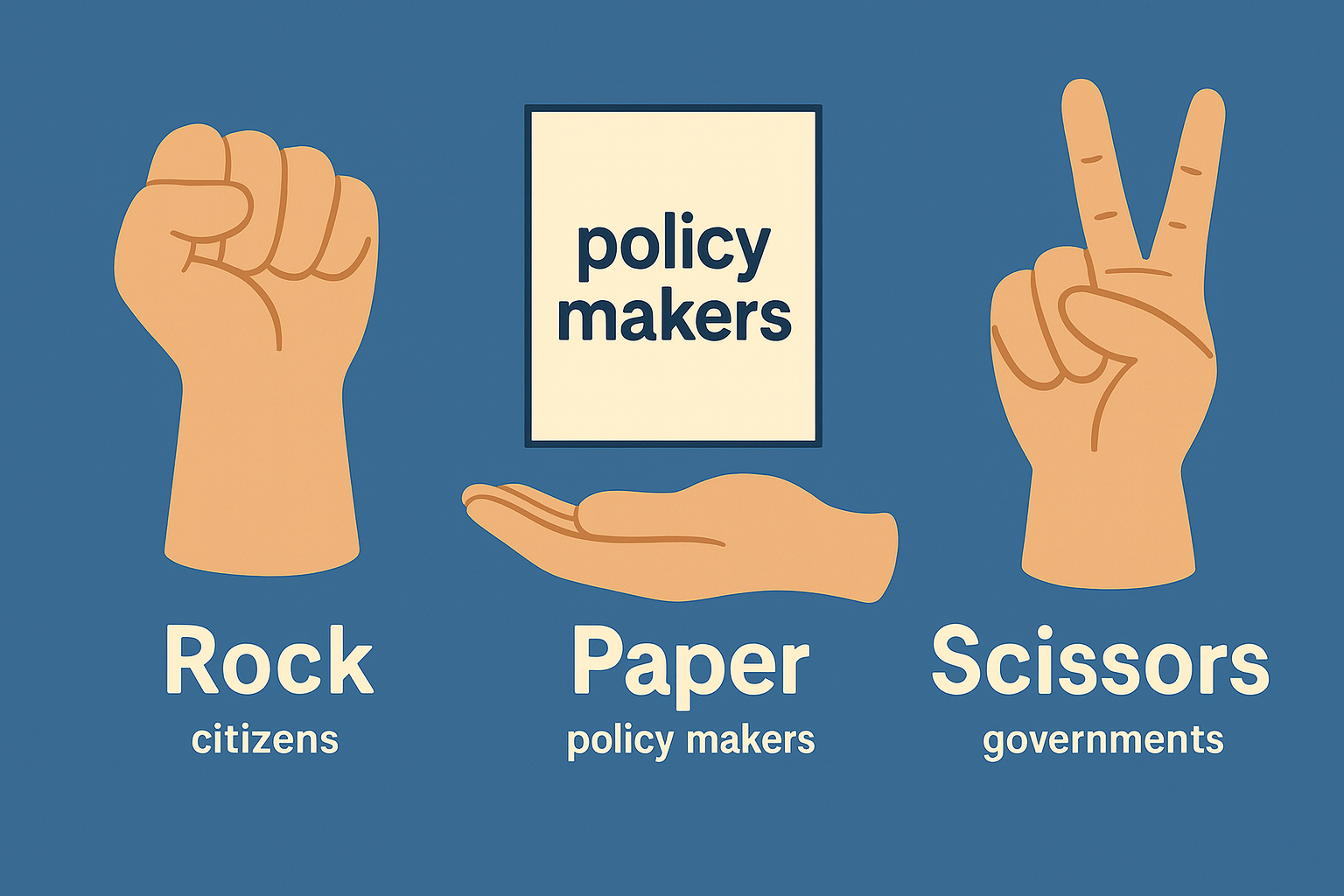
Olivier Schulbaum, Strategic Director of Platoniq, opens with an evocative background image and an activity that already hints at the critical and playful tone of the meeting: Are you rock (citizenship/social movements), paper (policy makers), or scissors (governments)? A direct way to talk about alliances, tensions, and power structures. And a crucial warning: many participatory platforms, such as Decidim, are born from institutions, not from the affected individuals. Therefore, the risk is real: reproducing traditional power structures in “new” digital formats.
Fractal democracy: political architecture of the 21st century
In this context, Marta Poblet, research director at The Data Tank, proposes a new way of understanding democratic synergy: fractal democracy.
In contrast to the “techno-feudalism” described by Yanis Varufakis, an era in which large digital platforms exercise a new economic and political dominance based on the massive extraction of personal data, Poblet proposes another vision: a political architecture in which democratic principles are replicated recursively at multiple scales. From the local to the global, passing through multiple intermediate layers (families, neighborhoods, communities, networks).
Inspired by figures such as Condorcet, Eleanor Ostrom and Aristotle himself, Poblet claims that collective intelligence was not born with the internet and that politics is not scale-free. As Nassim Taleb says, a political system cannot be evaluated without specifying its scale: the macro and the micro feed back on each other and reproduce structures in a fractal way.
Participatory spaces are already hybrid: they combine the physical and the digital, the institutional and the informal
Participatory spaces, as Poblet demonstrates, are already hybrid: they combine the physical and the digital, the institutional and the informal. From constitutional processes such as that of Mexico City to social movements such as Catalan independence, democratic participation today takes place between screens and streets. But, as he reminds us, the choice of platforms is never neutral: it has political, social and ethical consequences.
Care and safe digital spaces: from refuge to resistance
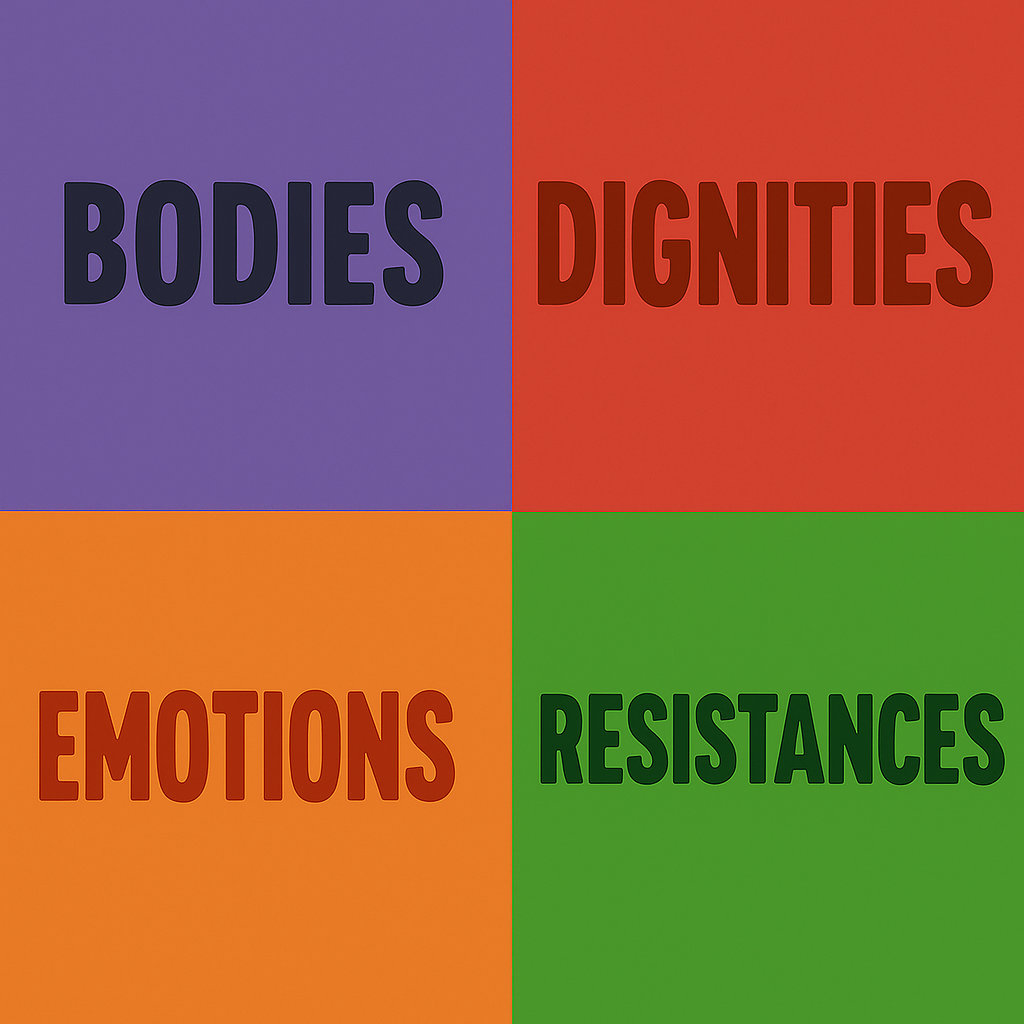
The second session of the module invites us to explore a vital but often overlooked aspect: the affective and political dimension of digital spaces. Led by Nadia Nadesan, a researcher with the Platoniq team, the class proposes a shift in focus: it is no longer just about technology and structures, but about bodies, dignity, emotions and resistance.
We start from a fundamental idea: safe spaces are not bubbles, but structures that are necessary for certain people to exist and express themselves without violence. Nadesan traces the historical origins of these spaces to queer, feminist and anti-racist struggles, from the gay bars of Los Angeles in the 1960s to breastfeeding support groups and hairdressers for black women. These spaces were not neutral or risk-free places, but tactical refuges where collective power and shared dignity were woven together.
Today, many of these spaces have been displaced or rebuilt in the digital environment. But it is becoming clear to us: the internet is not only a field of freedom, it is also one of surveillance, censorship and structural violence.
The internet: between liberation and control
The class takes an in-depth look at the EROTICS project, led by the international network APC, which investigates how people who are most vulnerable to regulatory systems experience the internet: young women, LGTBIQ+ people, people with disabilities, among others. In countries such as Sri Lanka, Bangladesh and Nepal, the internet is often the only space where they can claim their rights, explore their identities or build communities. But it is also an environment full of invisible barriers: family control, precarious infrastructure, gender-based violence, cultural or linguistic censorship.
Access to digital devices does not guarantee freedom or security of expression. Class, gender, location, language, caste, or disability
Thus, it is clear that access to digital devices does not guarantee freedom or security of expression. Class, gender, location, language, caste, or disability profoundly condition the type of digital experience a person can have. Often, anonymity, informal networks of trust, and careful use of content are survival strategies.
As Nadesan argues, the need for safe spaces arises from the fact that no one can live under constant surveillance. And although certain sectors accuse these spaces of being “minefields” where there is no debate, the truth is that they are not echo chambers, but environments of empathy, listening and shared power.
AlgoRace: when violence is encoded in data
Our next guest, Youseff M. Ouled, journalist and coordinator of the AlgoRace project, which addresses the most brutal and opaque side of the digital dimension: algorithmic violence. AlgoRace was created to denounce how artificial intelligence and automated systems are reproducing structural racism under the guise of technological efficiency.
From biased police data collection to the use of drones and sensors at borders, to predictive surveillance of migrants, the picture is clear: AI is the same old racism, with new tools.

Youseff explains how criminal prediction systems, such as Eurocop or Data Web, are based on historically biased data, creating a cycle in which non-white bodies are disproportionately monitored and criminalised. This is no accident: technology is designed, programmed and applied in contexts marked by power hierarchies.
Furthermore, the colonial dimension of technology cannot be overlooked: the resources needed to build and power these systems often come from impoverished former colonies, where the extraction of materials and waste management have serious environmental impacts.
Weaving resistance, inhabiting the internet
Against this backdrop, not everything is dystopian. As the session highlights, response networks are emerging: collectives such as ResistencIA, Grupo Semilla, Liken, IA Ciudadana and the Red de Autodefensa Feminista Online (Online Feminist Self-Defence Network), which work from the perspective of intersectionality, cyberactivism and ethical hacking to challenge digital power.
These networks create campaigns, training materials, political advocacy and spaces for support in both digital and face-to-face environments. They do so from the recognition that virtual spaces are not divorced from the real world, and that the struggle for a fair internet is inseparable from the struggles for social, climate, racial and gender justice.
Developing a citizen participation process. Step 3: from theory to prototype
The module culminates in a collaborative challenge: to design a hybrid participatory process that responds to a democratic dilemma, integrating criteria of algorithmic justice, inclusive design, digital security and fractal logic. Using Decidim as the base infrastructure and tools such as Miro, participants deployed their creativity to imagine a digital democracy that is not extractive, but transformative.
Inhabiting the internet as a safe, fair and shared space requires critical thinking, organised affectivity, ethical structures and communities that challenge control with proposals. Because it is not just about participating, but about radically redefining how we participate.