
In times when deliberative participation is increasingly promoted as a solution to democratic crises, it is urgent to stop and think about from where, for whom and under what frameworks these processes are designed. What does it mean to participate if the rules of the game are imposed? What does it mean to talk about inclusion without talking about deliberative autonomy, material conditions and community times?
From the School of Creativity and Democracy, we approach these challenges from the perspective of ‘temporal justice’ and the critique of the coloniality of forms of participation. In this framework, the conversation with Azucena Morán - a researcher at the Research Institute for Sustainability (RIFS) and the European University Institute (EUI), and an expert on institutionalised deliberative processes in Central America - provides essential keys to thinking about deliberative autonomy beyond the logics of European institutional design.
In this dialogue, which moves between the struggles for autonomy of indigenous peoples and the deliberative processes convened and legislated by government, time management and the analysis of the algorithms of selection by lot, questions emerge that make us uncomfortable and at the same time open up possibilities for imagining other modes of democracy. Far from ‘colourful’ practices that mask exclusion, in the wise words of María Jacinta Xon, Azucena invites us to think seriously about the colonial dependencies of certain participatory and deliberative instruments - and their possible effect on communities that defend life, land and processes of collective and autonomous decision-making.
From the Latin American experience to the clash with European ‘innovation’.
Olivier: To begin with, tell us a little about how you came to work on these issues. What led you to become interested in democratic culture and deliberation?
Azucena: Well, I started a long time ago working with LATINNO, a database on participatory and deliberative processes in Latin America. I worked there for a couple of years, and of course, the approach is very different: the approach from Latin America versus the European approach to deliberative democracy. The cases are very different. From that work, my knowledge was always: ‘There’s a lot of this, it’s hyper-mega re-contra hyper institutionalised, there are decades of experience, this has worked, this hasn’t worked so much, these are the problems’.
But when I stopped working with LATINNO and moved to the institute where I am now, RIFS, and started to learn more about the European approach, I came across something that surprised me a lot. Most experiences of participation and institutionalised deliberation are not known. For me it was like: ‘what? I came from seeing these processes almost from a historical perspective: this is what was done in the nineties, this is how they evolved, how governments also dissipated or co-opted these forms of participation.
So I think this is my background: this clash between the Latin American view and the European enthusiasm for something that is part of a long, sometimes painful history of participation, resistance and also frustration.
Deliberation in the face of decolonisation understood as the defence of life, land and deliberative autonomy
Olivier: In Europe, and in many international debates, the concept of decolonisation has entered the vocabulary, but often in a rather superficial or symbolic way. From your experience, what does it really mean to decolonise participation, especially in the field of deliberation?
Azucena: I think the term ‘decolonisation’ has been used a lot in recent years, but it has been disconnected from the concrete struggles for decolonisation that many indigenous and Afro-descendant communities carry out. At the academic level, it has been reduced to saying: ‘Let’s read beyond the canon’ or ‘Let’s adapt Western practices to include others’. Maria Jacinta Xon has a brilliant article where she calls it ‘colourful practices’: those elements that are added to hide the exclusion that these processes continue to reproduce.
Somehow, in order to hide the coloniality that these processes entail, these ‘colourful elements’ are added.
If we really talk about decolonisation, then we have to talk today, for example, about the great political and academic contradictions and complicities: about Palestine, about Sudan, about the land struggles of Mayan communities, about deliberative autonomy, about the contradictions that systems of participation have brought about by displacing autonomous forms of indigenous governance. As Gladys Tzul Tzul and many other indigenous scholars have repeated over and over again: this is not about a romantic past, it is about living processes, about struggles that continue every day to defend life, autonomy and land.
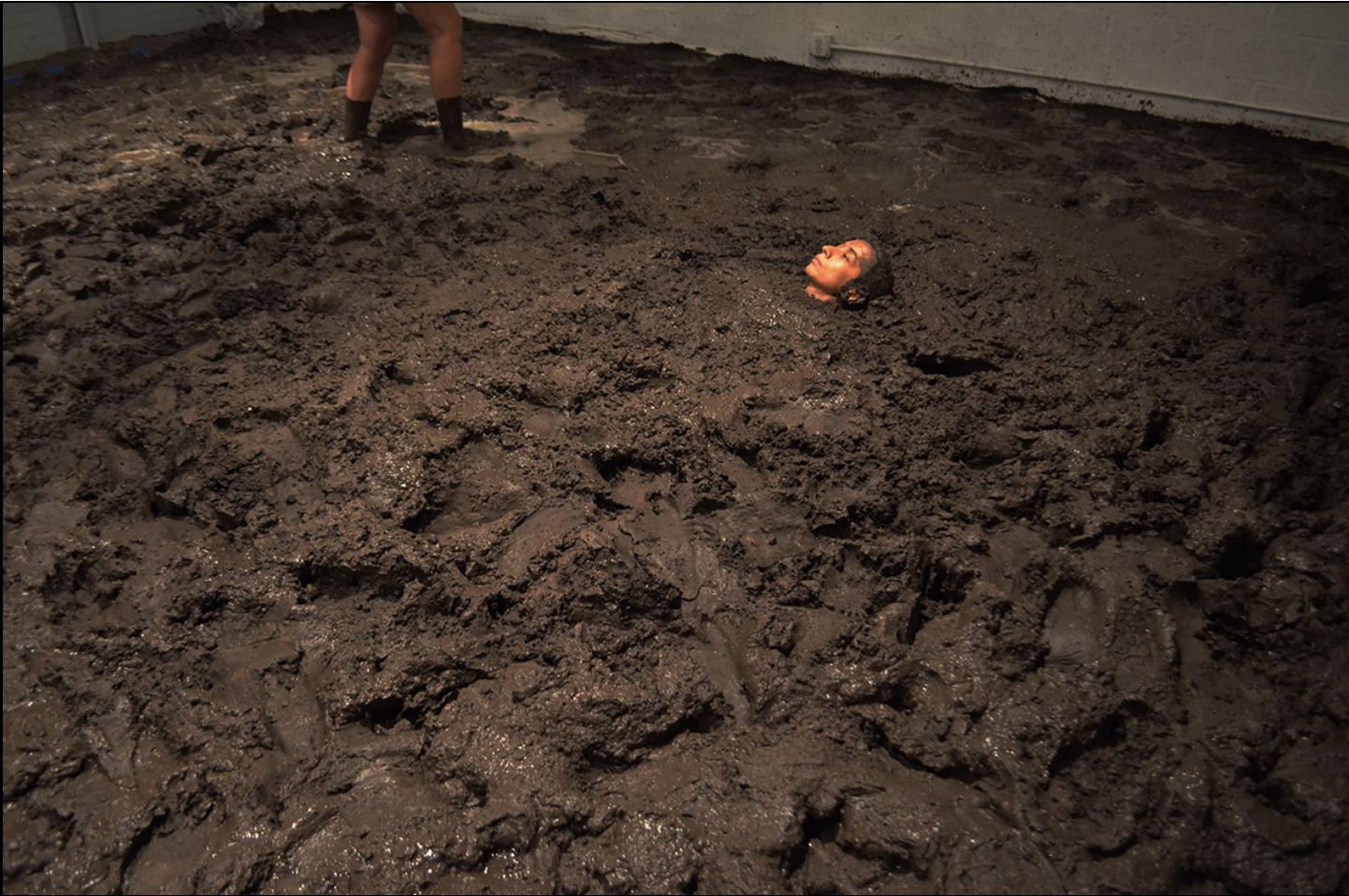
Regina José Galindo, Nadie atraviesa la región sin ensuciarse (2015)
Fotografía de Jorge Chirinos y Alan Gutierrez
If we disconnect decolonisation from these struggles, we erase the anti-colonial project. We erase the possibility of imagining a world outside the framework of Europe as a project.
There is so much history, so many movements, so many systems of collective, deliberative, autonomous organisation present, that I don't think the approach should be: ‘this practice is decolonised’. It is not a question of correcting three mistakes in a state institution to say that it is now decolonised. The point is: what processes continue to defend the anti-colonial struggle today?
In the School, this position forces us to question our own practices: are we really making space for these struggles or just adding ‘colourful practices’ to existing methodologies?
Perfect, I continue then with the next block, maintaining the same level of depth and respect for Azucena’s answers. Here goes:
Time, Autonomy and the Traps of the Institutional Clock: Towards Temporal Justice
Olivier: In the framework of a paper we are preparing in the context of the INSPIRE project, Democracy Takes Time: Intersectional Temporalities in Participation and Deliberation, we propose the idea of mapping the mismatches between institutional rhythms and the times lived by individuals and communities. In several parts of our conversation you have pointed out how time is also a dimension of power. How do you see this tension between the times of institutions and the times of communities?
Azucena: Time is absolutely central, especially in state consultation processes. The state arrives and says: ‘You have until such and such a date to deliberate and give us an answer’. But these deadlines do not respect the collective decision-making rhythms of the communities. If the communities say they cannot respond in that time, then the state accuses them of not wanting to participate. But this is a trap. Imposed time is a form of violence.
If they refuse to enter in that imposed time, the state says: ‘We invited them, but they didn't want to participate’. It's a trap.
There is also another dimension, which is historical. Institutional consultations are often presented as the starting point for dialogue, ignoring the long trajectories of resistance and deliberation of the communities themselves. As if history begins when the state decides it begins.
Temporal justice is not just about giving enough time. It is to recognise the long times of struggles, of resistances, of autonomous organisations
Olivier: How can we imagine processes that are really open to other times? Because even when you want to be flexible, processes tend to remain small adjustments to the timetable, without touching the heart of the matter.
Azucena: This brings us back to the issue of autonomy. The participatory processes that respect the rhythms of the communities are those where the communities themselves decide how to organise those times. It is not a question of giving them ‘a little more time’ within the state calendar. It is about allowing the process the time it needs, according to how those communities deliberate and organise themselves.
And this also means respecting their own forms of communication, their own languages, their own spaces. If we force the communities to deliberate in Spanish, or in an online format that they do not use, we are already limiting the process, even if we ‘offer time’.
Time, space and language are material conditions of deliberation. If you don't respect these conditions, the process is just decoration
This is very evident in the climate assemblies. There is a lot of talk about climate justice, just transition… but where are the voices of the territories where the minerals for that transition are going to come from? Who is deciding on that, and in what timeframe?
Technology, participation and the false promises of neutrality
Olivier: In Europe and other contexts in the global North, digital democratic innovations - online participation platforms, hybrid deliberations, voting tools - are presented as the great promise for broadening participation. From your experience, how do you see these technological discourses, what potentials and risks do you identify?
Azucena: I think the main problem is to assume that technology is neutral. And it is not. A platform can be useful, yes, but as long as it is designed from the practices and material conditions of the communities that are going to use it. We have seen it many times: a digital platform is designed that seems modern and participatory, but ends up leaving out those who do not have a stable connection, or those who do not handle these technological languages. On the other hand, when processes are based on what already exists - for example, community radio, neighbourhood assemblies, hybrid forms adapted to each context - then there can be real participation.
If you impose the format, even if it is digital, even if it is democratic, what you do is reproduce inequalities. It is not neutral. It never is.
This is important to underline, especially at a time when the fetishism for digital tools sometimes overshadows the deeper meaning of participation. If we do not look at the material conditions - time, connectivity, languages, organisational practices - then democratic innovation is just decoration.
At the School of Creativity and Democracy, we share this critique of the illusion of technological neutrality. Rather than looking for the ideal tool, we ask: who designs the formats? Who do they serve? What bodies and what times do they recognise?
Between Algorithms, Representation and Autonomy: The Limits of Deliberative Engineering
Olivier: In our research on civic lottery and deliberative process design, the question often arises as to whether the selection algorithms should be adjusted according to the issue at hand or according to who is most directly affected. I am thinking, for example, of an experience in Canada that John Gastill told me about, where, when discussing land use, a specific roundtable was set up for representatives of native communities. However, I can’t find many documented examples of processes that have really broken with the classic principle of representativeness. What do you think about this idea of adjusting deliberative processes under the logic of ‘positive discrimination’? Do you know of any experience that has gone beyond this?
Azucena: I don’t know if I would call it ‘positive discrimination’, conceptually. I think it’s much more important, depending on the context, to talk about autonomy and not positive discrimination. Because if we keep using that language, we keep thinking that we are doing people a favour when we include them. And that is deeply problematic if we don’t question the roots of the system of governance that we are operating.
Here it is key to think about how coloniality has structured our systems from the beginning. Not just in terms of physical violence, but how coloniality created the basis for our current system of governance. Spain had consultations in its colonies, the United States also had parliaments and elections in its colonies. This already existed, but always within deeply colonial frameworks.
Thinking about how rooted our current governance system is in coloniality is very important to stop believing that we are doing vulnerable people a favour when we ‘include’ them in our processes
When we think of Latin America, we see decades of left struggles, of indigenous movements, and often the achievements of that mestizo left have been precisely the mechanisms of participation and deliberation that, paradoxically, have displaced the forms of autonomous governance of indigenous peoples.
Therefore, the point of the current struggles is not to say: ‘we want to be part of your deliberation’. The point is to assert: whose land, whose process, whose deliberative autonomy is this land, whose process, whose autonomy is this deliberative autonomy? Who runs the process and who implements it?
The problem is not who is in the room, but who designs the space, who sets the rules, the times, the languages
If you keep these structures intact, even if the algorithm is ‘perfect’, we are still operating under the same colonial logics.
From the School of Creativity and Democracy, this reflection confronts us with a fundamental question: to what extent are our own deliberative frameworks control devices, however well-intentioned? What does it really mean to open up the possibility that rules, times and languages are not given in advance?
Olivier: That resonates with debates we have about the formats of the assemblies: the thematic tables, the rigid timings, the speaking turns… Sometimes we discuss how to improve the algorithms of the drawing of lots, but we don’t question the very architecture of the process.
Azucena: Exactly. You can have the most balanced algorithm, but if you continue with thematic tables that don’t allow the conversations to flow, or if the time is still imposed from outside, the result doesn’t change. We have not transformed how conversations unfold and how voices are actually heard.
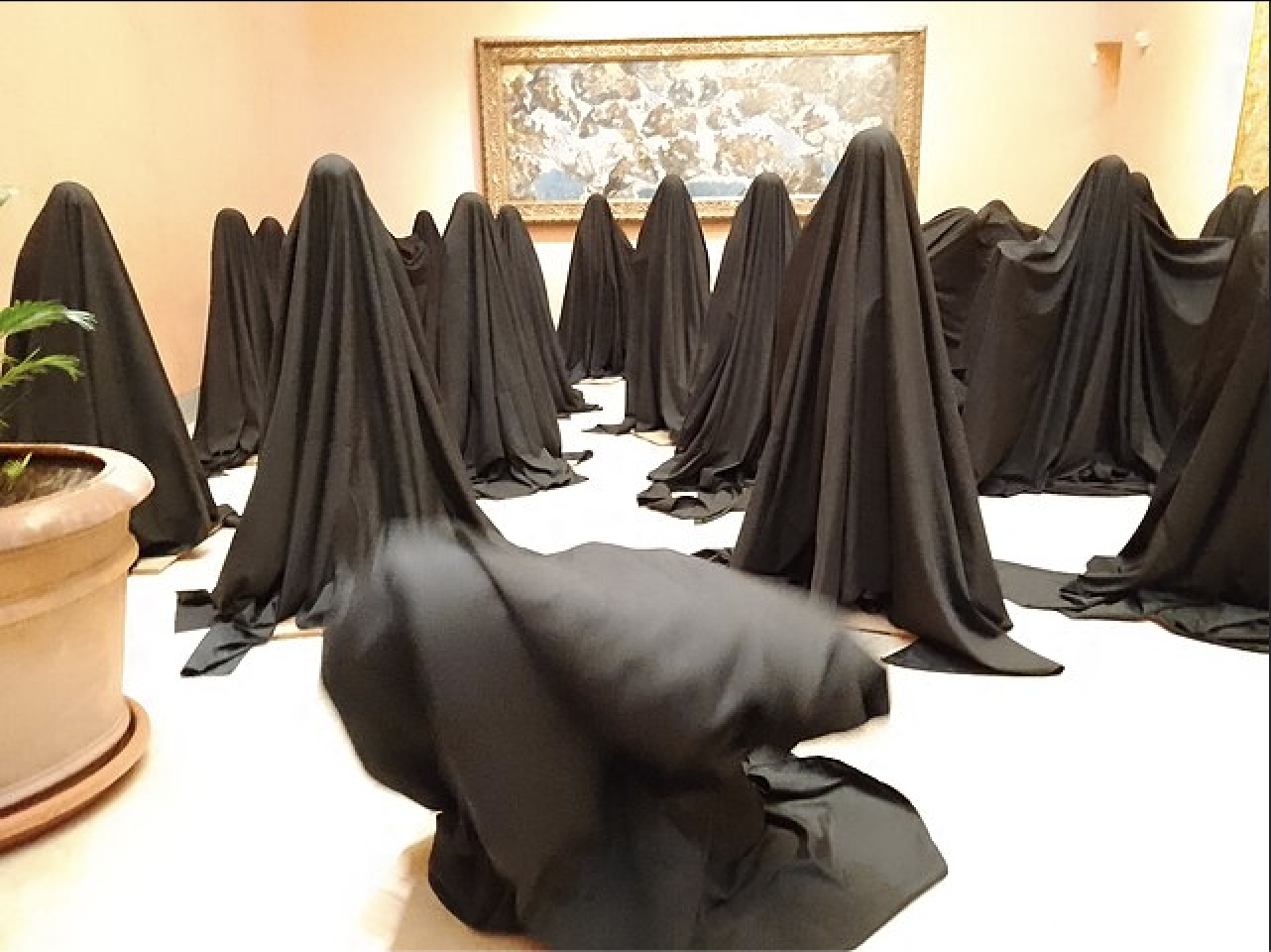
Regina José Galindo, Nuestra mayor venganza será estar vivas (2022)
Fotografía de Milenaenapuros
And there is another very important layer: how power dynamics that exist outside deliberative spaces are replicated within them. There is a lot of research that shows how men speak more, how women adapt their opinions, how racial hierarchies are reproduced even in these ‘participatory’ spaces. Often, the most vulnerable people are forced to take on the role of representing their community, without really feeling chosen or legitimate to do so.
The problem is that we continue to force the most vulnerable person to represent his or her community, without that person necessarily being recognised as a legitimate spokesperson.
This always brings us back to the question of autonomy: who should decide on what? Not only from a historical perspective, but also from the present and the future: who will be most affected by these decisions?
I see this very clearly in the climate issue. Assemblies on energy transition often forget where the minerals for this transition are going to come from. We are again talking about peasant territories, indigenous territories, whose governance systems are not even recognised by the states that organise these assemblies.
There, participation is just a decoration. Consultations are simply mechanisms to legitimise decisions that have already been taken.
The participation process ends up being a façade. A consultation that is pure decoration, with no real recognition of autonomous decision-making systems
From the School of Creativity and Democracy, this critique challenges us directly: how can we build processes that do not reinforce the fiction of participation while perpetuating the monopoly of design and control? What would it mean to renounce, from the outset, to decide the framework in the name of neutrality?
Rethinking deliberative design: recommendations from autonomy and history
Olivier: To close, I would like to ask you: what would you say to those who design deliberative processes from Europe, especially in urban contexts, about how they could learn from anti-colonial struggles and autonomous practices? What recommendations would you give so as not to fall into the traps we have been discussing?
Azucena: I think the first thing is to stop thinking that deliberation is a recent invention. There is much to learn from deliberative practices that have existed for centuries in other parts of the world. That requires humility, and also a willingness to listen.
The second recommendation would be to question whether the system from which they are designing these processes is legitimate for the people they want to include. If the very structure of the process already denies the autonomy of these communities, then any attempt at inclusion is superficial.
And the third thing is to recognise that often the best answers already exist. Communities have their own forms of organisation, their own ways of deciding, and they do not always resemble what we in Europe mean by deliberation. Listening to those forms often means being willing to give up control.
It is not about including the excluded in our systems. It is about asking whether those systems are legitimate in the first place
From the school, this invitation to radical humility that Azucena launches at us, accompanies us as a permanent exercise: not only to open up space, but also to learn to leave the centre, to listen, to decentre our certainties. Only in this way can we imagine other forms of democracy, beyond the borders of our own framework.
This interview is part of the series of conversations promoted by the School of Creativity and Democracy, a space for training and critical thinking that seeks to reimagine forms of political participation based on listening, care, creativity and intersectional justice. Faced with the temptation to reduce participation to technical design, we defend the need to open up time, space and language for deliberative autonomy, aware that to decolonise democracy is also to decolonise our own practices.