Interviews
Katie Reid When it's all about children's voices. On children's participation in public policy-making (with Esther and Oisin)

Following a workshop organized by Coglobal we attended in Malaga, we interviewed Katie Reid, a children’s rights specialist with nine years of experience in child and youth participation in (inter)national governance, advocacy, deliberative democracy, planning and environmental/climate justice. Thanks to your mediation, we also have statements from some of the young members of the Assembly.
So, let’s start at the beginning, why do we need to listen to children, and why don’t we usually do it?
Katie: Children, all those under the age of 18, have the right to have a say in matters that affect them, and those views should be given due weight. This is one of the fundamental rights outlined in the United Nations Convention on the Rights of the Child (CRC), which is actually the most widely ratified international treaty, with all countries in the world except one—the United States of America—having signed it. This is significant because it sets out the promises governments have made to ensure that children can grow up happy, healthy, and safe and have a voice. Involving children and ensuring they can share their views is not just a nice thing to do—it’s a fundamental human right. For me, that’s where it all starts: respecting children’s competencies, their agency, and their ability to contribute as experts in their own lives.
As for why it doesn’t happen enough, I think there are several reasons. One is a real concern, which is valid, about protecting children. This concern can make people hesitant to involve children in participatory processes because they worry it might compromise their safety. While I respect this concern, it shouldn’t be an excuse for not involving children. From a rights-based perspective, children’s right to participate doesn’t trump child protection rights; these things go hand in hand.There are ways to ensure children can participate safely.
Another reason is the long-held systemic and cultural attitudes about how we view children and childhood. Many cultures see children as “becoming,” not as full humans or full citizens, because they’re still growing and developing the competencies needed to participate. But if we look at how we view adults, particularly in the context of deliberative democracy, one of the core arguments is that any adult can be involved, regardless of their knowledge or capabilities. So, it’s hard to justify why children can’t be involved in deliberative processes too, especially since they are also developing their thinking and are open to learning and exchanging new ideas.
Schools should actually be seen as an opportunity for children to engage in civic and democratic education
Finally, there’s a lack of creativity and confidence in making these processes work for younger members of society. We often think of schools as the main place where children are involved, which can prevent them from engaging in broader civic life. But schools should actually be seen as an opportunity for children to engage in civic and democratic education. Creativity is needed to make democracy relevant to children’s lives, something often overlooked.
Thank you. We’ll talk more about the Scotland experience later, but let me address the work with children. One of the reference models for working with children is Professor Laura Lundy’s model, which focuses on creating spaces for participatory dynamics with children. What should we particularly consider when creating safe and inclusive spaces for working with children?
Katie: Absolutely. Professor Lundy’s model is a great example of how we can understand children’s right to be heard(Article 12 of the CRC)- what upholding this right looks like in practice. Lundy’s model is useful because it reminds us that involving children doesn’t just end with them sharing their views. Children’s participation is an ongoing process. It starts with creating a space that’s inclusive, supportive, and allows children’s voices to be heard in many different ways. But it goes beyond that, ensuring there’s an audience for their views, and most importantly, that their views have influence. These views should be taken seriously, and where they can’t be acted upon, children should receive feedback on why. This feedback loop is vital so that children understand the impact of their participation.
We’re seeing increasing levels of apathy among children and young people toward the political system. It could be partly because they don’t see the real impact of their contributions. That’s why it’s so important to remind children that their contributions matter and explain the outcomes. It’s a responsibility for duty bearers and decision-makers to make sure they provide that feedback.
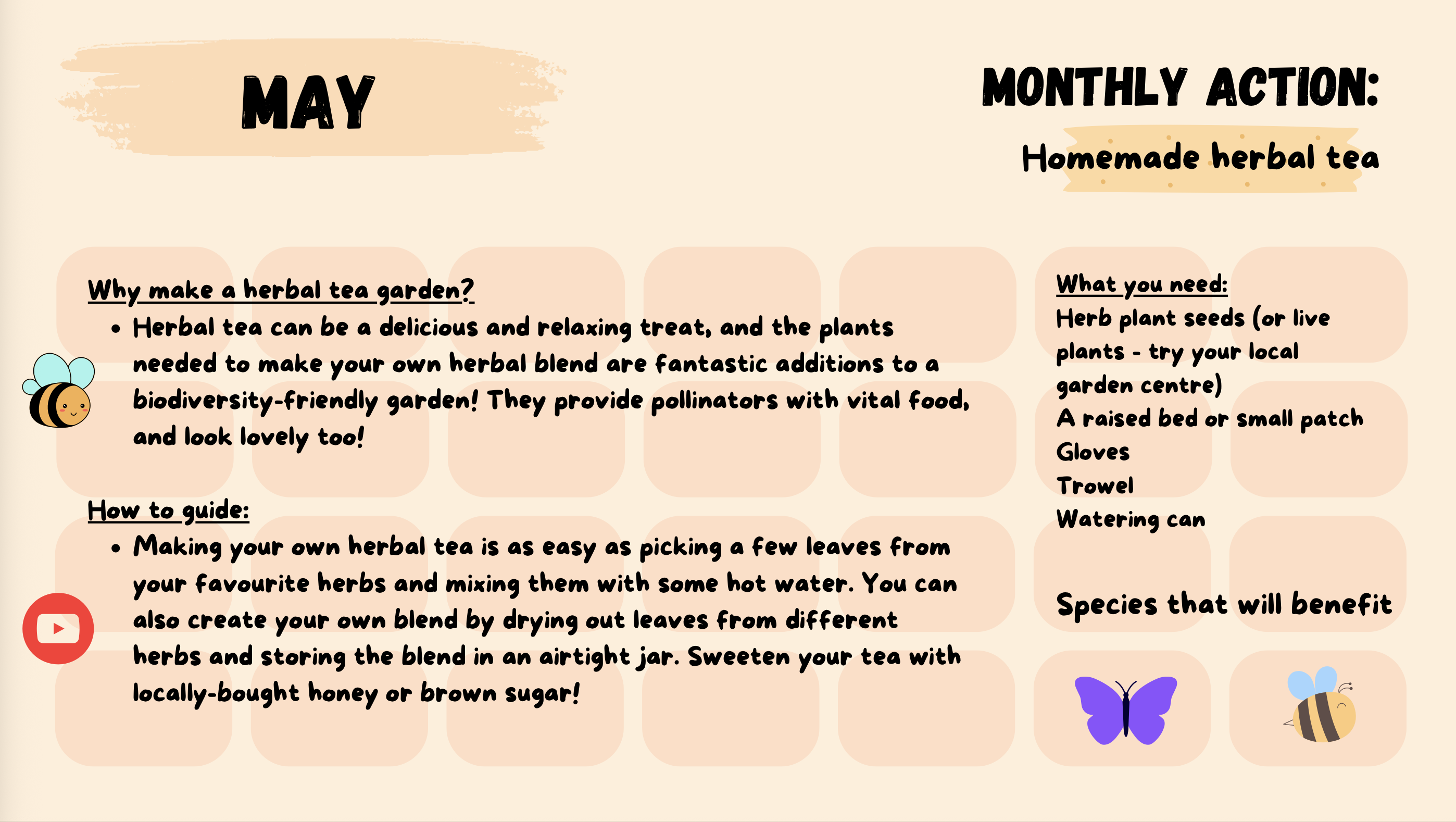
Biodiversity Activity Calendar (Resources)
Children and Young People’s Assembly on Biodiversity Loss
You mentioned that a lack of creativity is a barrier when working with children. Based on your experience, what resources or creative methods have you used to encourage children to participate? Can you share some formats that have worked for you?
Katie: I previously worked in Scotland with the Children’s Parliament, a fantastic children’s rights organization that’s been running for over 30 years. The Children’s Parliament is amazing at bringing creativity into how it involves children. One example is Scotland’s Climate Assembly, where we worked with children to incorporate their perspectives into the adult assemblies’ climate deliberations. We designed a parallel process where children could learn about the climate emergency, just like the adults, and then come up with ideas and calls to action through creative activities. These children learned about the crisis, connected with their communities, and engaged in community mapping and interviews.
We also took advantage of the great outdoors. In Scotland - and also in Ireland where I was involved in Ireland’s Children and Young People’s Assembly on Biodiversity Loss -, we used outdoor activities and nature walks to connect children to their environment. In Ireland, a guide helped children explore the national parks, while in Scotland, we encouraged them to connect with nature, especially during the COVID period. Creative methods like arts and drama also work well—using role play, murals, future visioning exercises storytelling gives children multiple ways to express themselves beyond speaking or writing. It allows us to use our imaginations to come up with solutions for creating better worlds.
Since everything revolves around children’s opinions, I have a tricky question: How can we ensure that we’re not manipulating children?
Katie: I often get asked this question, and I think it comes from a place where we assume children are easily manipulated. That stems from cultural views of children as evolving beings. But, of course, children can be manipulated, just like adults. In deliberative processes, we have to be critical of how children, like adults, are receiving information and ensure they are supported to develop skills like critical thinking, mutual respect, empathy, and dialogue. These skills can help prevent manipulation.
We need to be careful not to project our own ideas onto what children are telling us
The challenge comes when adults interpret children’s views through their own lens. For instance, when adults look at children’s artwork, it’s important that children have the opportunity to explain what they’ve created. Their interpretation should be the one that’s understood, not an adult’s interpretation of their artwork. The risk of manipulation is higher when adults twist children’s words to serve their own agenda. So we need to be careful not to project our own ideas onto what children are telling us.
One of the conclusions from your workshop in Malaga was that participatory processes reduce negative group interactions and strengthen the sense of group unity. Do you think this type of process with children helps them better understand democratic values?
Katie: I think so, yes. And I think this would be a great question to ask the children you’ll be meeting to get their perspective on it. I’ve worked on two citizens’ assemblies directly, and I’ve also been advising on several others involving children. Additionally, I’m researching how children participate in assemblies, mapping the processes and the outcomes. It’s fascinating to see the impacts emerging, particularly at the interpersonal level—such as strengthening group dynamics and fostering connections between children from different backgrounds.
I think the model of citizens’ assemblies is quite unique when applied to children, especially because children areplaced in environments where they meet children they may not know at all. These children could be from entirely different parts of the country or region, and that can be daunting if the process isn’t facilitated in a way that helps them build friendships and connections, which will support their journey as assembly members. Other participatory processes might involve children who already know one another, particularly if the assembly is held within a school. But citizens’ assemblies, due to the nature of random selection, bring children together who wouldn’t typically meet.
I do think this model lend itself well to supporting children in understanding people from different backgrounds’ opinions, and perspectives. It helps them develop new friendships and relationships that they might not otherwise have the opportunity to form. And that’s a valuable experience.
Additionally, citizens’ assemblies help children develop tangible skills like how to deliberate, think critically, develop solutions based on diverse sources, navigate misinformation, and assess the pros and cons of different issues. Finally, learning how to develop consensus is also very important. These are skills that children and young people can benefit from in many areas of their lives, even beyond the civic participation aspect.
From what we’ve seen in Ireland, children who participated in the assembly at ages 7 to 17 over two weekends in October 2022 are still very enthusiastic about their experience. It’s now March 2025, and they still love talking about it and look forward to coming together again, as they come from all across the country. The strength of the group dynamics was truly cultivated during the experience.
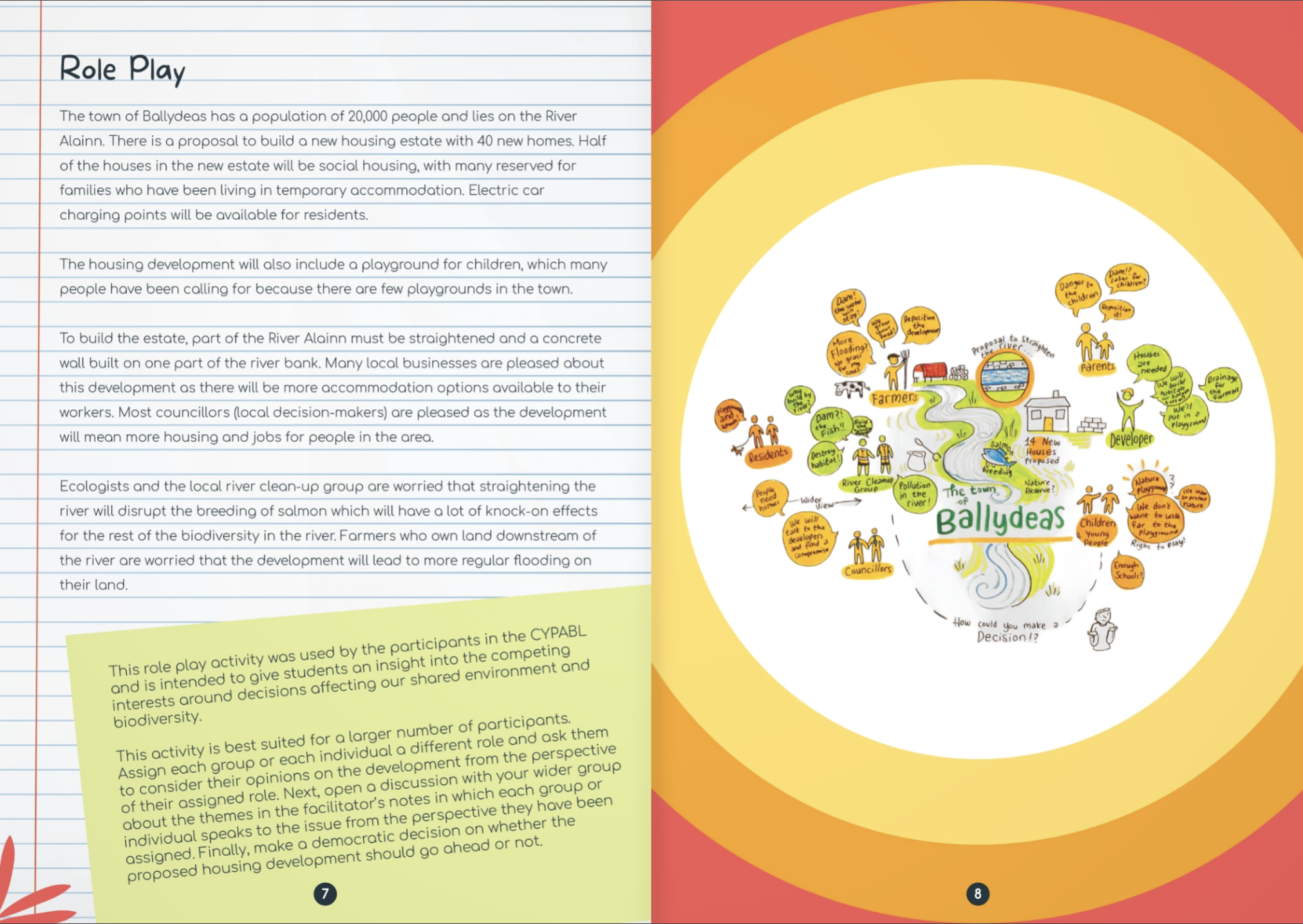
Activity Book (Resources)
Children and Young People’s Assembly on Biodiversity Loss
In this sense, and tying back to something you mentioned earlier, what potential do you see for children to play an active role in facilitating or contributing to deliberative assemblies or participatory processes in general?
Katie: Children as facilitators? Yes, absolutely. First and foremost, children should be involved in every aspect of the assembly process, especially in designing and facilitating the process to ensure it aligns with what children and young people themselves would want to participate in. This makes the process more authentic and engaging for them.
For example, in Ireland, we had a Young Advisory Team consisting of nine 8-16-year-olds selected through an open application process. We reached out across Ireland to engage children who were already active in biodiversity-related or children’s rights initiatives. It was crucial for us as facilitators—both researchers and practitioners from University College Cork,Dublin City University and terre des hommes (whom I worked for at the time)—to have an intergenerational team for designing and facilitating the Assembly.
The Assembly would have been very different without our Young Advisors
The Assembly would have been very different without our Young Advisors. They added immense value, and the positive group experience was largely a testament to their contributions.
How do institutions respond to these processes with children? Do you think they take the conclusions of these processes seriously?
Katie: I can speak from experience in both Scotland and Ireland. The key to success is engaging the relevant decision-makers or authorities from the very beginning, so they buy into the process before it starts. If you involve them at the end when the recommendations are just being presented, it’s easier for them to feel detached from the process.
In Scotland, it was particularly interesting because this was the first citizens’ assembly to directly involve under-16s in such a way. The process included parallel activities for children and adults, and their recommendations were submitted together. This meant the Scottish Government had a legal responsibility to respond to both the adults’ and children’s recommendations.
The children had opportunities to meet with key political figures, including members of the Scottish Cabinet, to discuss their calls to action, which reinforced the idea that children’s views were just as important as those of the adult assembly members.
Similarly, in Ireland, Minister Malcolm Noonan, responsible for biodiversity loss, instigated the process when theadult citizens’ assembly on biodiversity loss was underway. He was very invested from the start and made a point to attend the final Assembly weekend to receive the recommendations personally. He has continued to amplify children’s voices on biodiversity at national and international events like COP15 and COP16.
Moreover, the children in both Scotland and Ireland had the opportunity to speak in Parliament and give evidence to parliamentary committees, showing that their views were taken seriously and were part of the national conversation.
Moving beyond climate-focused assemblies, how can we integrate children’s opinions on other topics, such as migration, war, and justice reform? How can we include their voices in these social debates?
Katie: Absolutely. This is where the child rights perspective is especially useful, as all of these issues—migration, war, justice reform—are deeply relevant to children and their lives. The UN Convention on the Rights of the Child (CRC) states that any issue affecting children is one where they should have a voice.
I would struggle to find an issue that doesn’t somehow relate to children. While there may be a few exceptions, I think citizens’ assemblies on all topics should consider how to include the perspectives of under-18s. Children are often the most vulnerable members of society when it comes to major issues, and their rights are frequently compromised.
It’s essential that assemblies consider how their recommendations will impact vulnerable groups like children. Whether or not children are assembly members, we should find other ways to bring their voices into these processes. I’m excited to see how democracy can evolve to mainstream children’s participation across a wider range of issues.
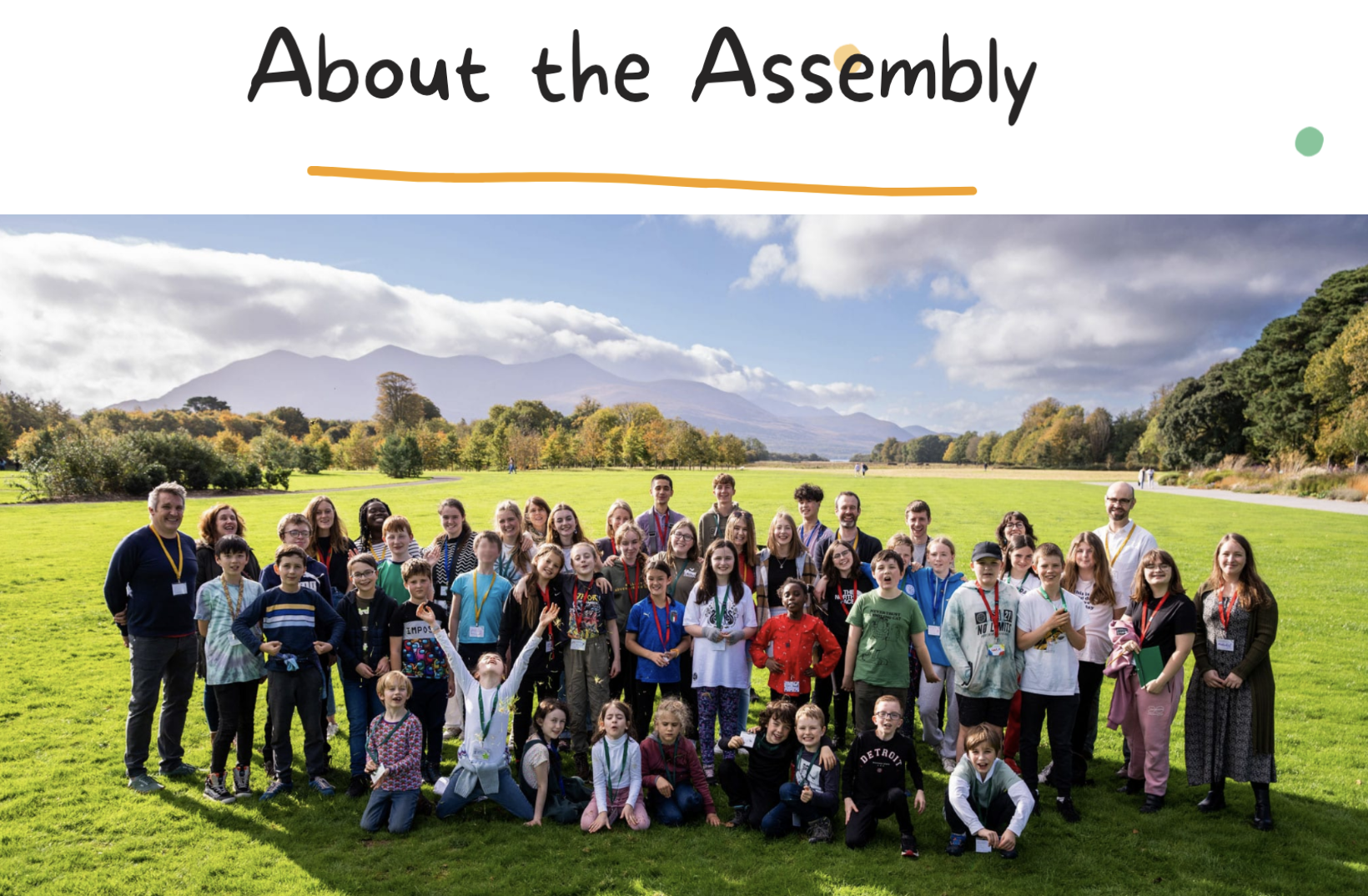
Assembly members
Children and Young People’s Assembly on Biodiversity Loss
We had the pleasure to interview two young members of the Irish Assembly, Oisin and Esther, who kindly answered some questions about their experience.
Oisin: So, I’m Oisin. I’m 15 years old and I live in Galway, Ireland. I was an Assembly member for Ireland’s Children and Young People’s Assembly on Biodiversity Loss. I was one of many children selected to represent the voices of young people in Ireland. We discussed biodiversity loss with other children from across the country and developed ideas to present to the government.
Esther: And I’m Esther. I live in Cork, and I was also a member of the Assembly. As Oisin said, we worked on getting our ideas to the government, sharing our experiences with biodiversity, and exploring how we can stop biodiversity loss from a child’s perspective.
- Why do you think it’s necessary to listen to children? And why do adults often fail to do so?
Esther: I think it’s necessary to listen to children on matters like biodiversity loss because it’s our future. Adults living now won’t be around forever, so we should have a say in shaping what happens for our generation and the ones that follow. I think adults sometimes underestimate children and assume we don’t know as much as they do. But in some cases, children might actually know more about biodiversity than certain adults.
Oisin: I completely agree. Children bring a unique perspective because we haven’t been exposed to as many efforts to downplay the risks of biodiversity loss. We’ve grown up in a time where it’s acknowledged and widely discussed. We’ve seen the consequences during our lifetimes, both in Ireland and globally through climate change. Adults often don’t take us seriously because we’re younger and they believe their experience gives them more knowledge. But, as Esther said, our insight adds a different and valuable element to the conversation.
- Did the Assembly feel like a safe space to express your ideas? What was your experience like during the dialogues and debates?
Oisin: Yes, it felt like a safe space. Everyone was respectful, and since we were surrounded by like-minded people who shared our passion, our ideas weren’t criticised. The Young Advisors especially helped the younger children feel more comfortable sharing their thoughts because they were closer in age.
Esther: I thought it was a really nice experience. The adults and Young Advisors were all very kind and supportive. That made a big difference.
- How do you define a "safe space"?
Esther: A safe space, for me, is somewhere I can share my ideas without judgment, and where everyone is kind and welcoming.
Oisin: I agree completely. It’s a place where children feel comfortable speaking up. That was one of the best parts of the Assembly—if it hadn’t felt safe, some children might have been too shy to speak, and their valuable ideas might have been lost.
- Do you think all children can participate in processes like this, or do they need to have certain ideas already formed?
Oisin: All children should be given the opportunity to participate. We need a mix of opinions—if we only hear one type of voice, we might miss out on key solutions. It’s essential to include children from different backgrounds and parts of the country to truly understand what young people want.
- You used different methods like stories, drawings, and walks to express yourselves. Which activities were your favourites?
Esther: I really liked the hikes. Being out in nature helped me see firsthand what we’re at risk of losing. It was peaceful and inspiring.
Oisin: Same here. Experiencing nature up close reminded us of the beauty we’re trying to protect. We also did drawings and used other methods on the final day to help everyone—whether they preferred speaking or writing—share their ideas.
- Did you participate in designing the Assembly? Was there anything you felt was missing?
Esther: Yes, we were very involved through the Young Advisors. They helped shape the Assembly into something kid-friendly and accessible. We even helped develop the 58 Calls to Action and six key messages. One of the key messages was mine: “We must treat the Earth like a member of our family or a close friend.” The Taoiseach mentioned it, which was amazing!
Oisin: The Young Advisors were crucial in designing the Assembly. They knew what children needed to feel comfortable and engaged. They included games and fun activities so it wouldn’t feel like schoolwork, which helped keep everyone interested, especially the younger kids.
- Was it difficult to manage such a large group?
Oisin: There were around 30 members, so not too large. The Young Advisors and adult facilitators helped manage everything smoothly. Everyone respected each other, which made it easier.
- What was the most important conclusion you reached at the Assembly?
Esther: There were 58 Calls to Action, grouped into different themes. I still have the poster with them! For me, the most important message was to conserve what we still have and build on it. Even if we can’t restore everything, we can protect what’s left and try to rebuild as much as we can.
Oisin: I agree. For me, the key point was the importance of education. At first, some Assembly members didn’t fully understand biodiversity loss, but by the end, we all did. If people don’t know what the problem is, they won’t take action. Education is the first step to real change.
- What was it like speaking with government officials or politicians?
Esther: There were two Assemblies—one for kids and one for adults. I met some of the adults, including the Minister for Biodiversity, who was very kind and encouraging. It was a good experience.
Oisin: A year later, I spoke at the Oireachtas (Irish Parliament) with other Assembly members and Young Advisors. We shared our insights with politicians and have since participated in webinars and other events to keep spreading the message.
- Is there anything else you’d like to share?
Esther: I’m on my school’s Green Committee. We’ve organized fun activities around recycling and green practices. I also spoke to a newspaper about pesticide use in my village—and now people have stopped using them! If you feel strongly about something, speak up. Someone will listen.
Oisin: I’m now in higher-level schooling, so I’m not in Green Schools anymore, but I’ve done other things. I entered science competitions with eco-projects, and I worked on a project called TRYBE with other Assembly members to create free biodiversity resources for schools across Ireland.
- Do you think participating in the Assembly helped you understand democracy better?
Oisin: Yes. It showed me the importance of listening to everyone—especially children. We’re citizens too, and our voices deserve to be heard.
Esther: Exactly. Even though we can’t vote, we helped create something powerful that the government actually listened to. Everyone’s voice matters.
- What do you think about online climate denial or misinformation? How do you deal with that?
Oisin: It’s definitely an issue. People can believe whatever they want, but we must educate them with facts. Scientific evidence shows that biodiversity loss is real and happening every day. If people ignore it, we risk the collapse of ecosystems—something that affects all of us.
Esther: I try to stay calm when I hear denial online. One clear example of biodiversity loss in Ireland is how, years ago, people used to scrape bugs off their car windshields in the morning—but not anymore. That shows how much insect life has declined. If you do your research and look around, the evidence is clear.
- What future do you imagine for the planet?
Esther: If we don’t act, things will get worse—more hurricanes, fires, and disasters. But if we hold companies accountable and encourage small actions like planting micro-forests or dandelions for bees, we could see real improvement. We don’t have much time before the effects become permanent.
Oisin: Exactly. If we don’t act soon, it’ll be too late. Losing species like bees would be catastrophic. But if people are educated and make small changes, and companies reduce emissions and adopt eco-friendly practices, we can restore balance. The planet could return to its natural beauty, and people could live happier, safer lives.
Child Rights International Network (CRIN) is a creative human rights organisation that uses research, policy, art and advocacy to press for rights - not charity. We campaign for a genuine shift in how governments and societies view and treat children. Our goal is a world where children’s rights are recognised, respected and enforced, and where every rights violation has a remedy.
Children’s civil and political rights and democratic participation has long been a core focus of our work. In response to growing needs and interest across the deliberative democracy and children’s rights sectors, we are championing children’s inclusion in deliberative democratic processes, providing decision-makers, civil servants and practitioners with the knowledge, tools and skills on how to do this meaningfully, safely and creatively. Find out more about our work on children’s rights and deliberative democracy here.
Further information can be found about Children’s Parliament collaboration with Scotland’s Climate Assembly here, and Ireland’s Children and Young Peoples’ Assembly on Biodiversity Loss here. You can also download guidance on involving children and young people in climate assemblies created by Katie Reid for the Knowledge Network on Climate Assemblies here.