Futures
Proposal for a permanent Citizens’ Council to strengthen democracy through participation


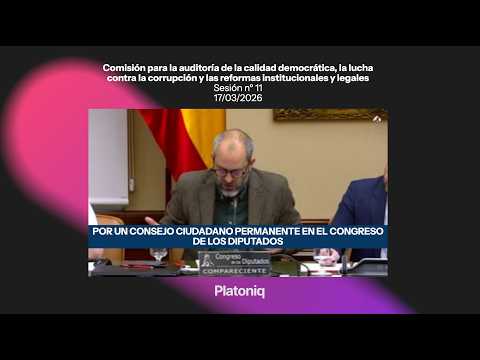
We appeared before the Committee on the Audit of Democratic Quality, the Fight against Corruption, and Institutional and Legal Reforms of the Congress of Deputies on 17 March to present our proposal for a permanent Citizens’ Council [Session No. 11 – 17/03/2026]
We began by recalling the work of Jürgen Habermas, which is particularly relevant today, arguing that democratic legitimacy is not based solely on the act of voting, but on the quality of the public deliberation processes that precede it. And that well-designed citizen participation helps to improve the legitimacy of public decisions, strengthen institutional trust and integrate distributed social knowledge into policy-making.
Experiences that are already transforming democracy
Building on this framework, the presentation included references to current experiences that demonstrate how citizen deliberation can be effectively integrated into institutional functioning:
- Ostbelgien, in Belgium, and its Citizens’ Council linked to the regional parliament, tasked with regularly initiating deliberative processes.
- Ireland, where citizens’ assemblies have played a significant role in shaping constitutional reforms.
- Open Ministry, in Finland, has enabled citizens to participate directly in legislative processes with concrete outcomes. An example of how deliberation can become a stable infrastructure if supported by digital participation platforms, demonstrating that cultural practices are also democratic practices.
Current limits of democratic participation
The data reinforces our interpretation. Only 22.5% of the population has actively participated in politics in the last year, despite the fact that over 80% would be willing to get involved if given the opportunity. This discrepancy does not point to a lack of interest, but rather to a shortcoming in the design of existing mechanisms. We therefore propose an analysis based on three main areas of action:
Firstly, the gap between participation and real influence on public decisions. Although participatory channels have multiplied, we argue that there is not always a clear connection between citizens’ contributions and their impact on the political process. A disconnect that, in the long run, contributes to frustration and undermines trust in institutions. This is something we must avoid at all costs.
Secondly, we highlight the need to strengthen democratic culture through applied education. Effective participation requires skills that are not always sufficiently developed, particularly among younger people. Democracy involves competencies such as deliberation, listening and the collective development of solutions, which must be learnt and practised.
Thirdly, we emphasise the importance of diversifying participation formats. Traditional forms are not always accessible or meaningful to all social groups. Therefore, the incorporation of methodologies based on cultural practices, such as legislative theatre, allows for the expansion of the languages of deliberation and facilitates the involvement of more diverse audiences.
Proposal: towards a Citizens’ Council of the Congress
We therefore propose exploring the creation of a Citizens’ Council of the Congress of Deputies. A permanent body where citizens selected by civic lottery could set an agenda for public deliberation on complex public issues by convening assemblies or citizens’ dialogues, which would submit their recommendations in a binding manner (at least to be debated and voted on) to the relevant parliamentary committees.
This body would be composed of citizens selected by civic lottery and would have the function of initiating deliberative processes on relevant public issues, setting work agendas and forwarding its recommendations to Parliament for consideration in the legislative process.
The proposal aims to move towards a model in which citizen participation is not sporadic, but rather stably integrated into the institutional framework. To this end, it is considered essential to ensure the continuity of processes, the traceability of citizens’ contributions, and the combination of digital tools with diverse participatory methodologies.
Strengthening democracy requires recognising that society’s collective intelligence constitutes an essential resource for public decision-making. Integrating it effectively is not merely a matter of institutional innovation, but a prerequisite for ensuring the legitimacy and resilience of the democratic system in the future.