During the Commons Convergence Retreat, co-organised by the Convergence of Commoners group—led by David Bollier, Director of the Reinventing the Commons Programme at the Schumacher Centre for a New Economics—and the Platoniq Foundation, in collaboration with the INSPIRE project, we came together to explore the possibilities and challenges of the digital commons, data democracy, and creative activism. Through debates, experimental methodologies, and collective reflections, we sought to rethink digital participation and its impacts on our communities.
Beyond concepts and tools, the retreat urged us to interrogate the affective and material dimensions of participation: What does exclusion feel like? What happens when infrastructures designed for care fail? How can we build spaces—both digital and physical—that truly sustain communities?
In this context, there was a moment of absolute clarity, where discussions on participatory democracy, data governance, and inclusion condensed into a single image.
A Moment of Recognition
The most powerful image of the retreat was captured by photojournalist Victoria Rovira, who documented the devastating floods in Valencia with unparalleled depth and sensitivity.
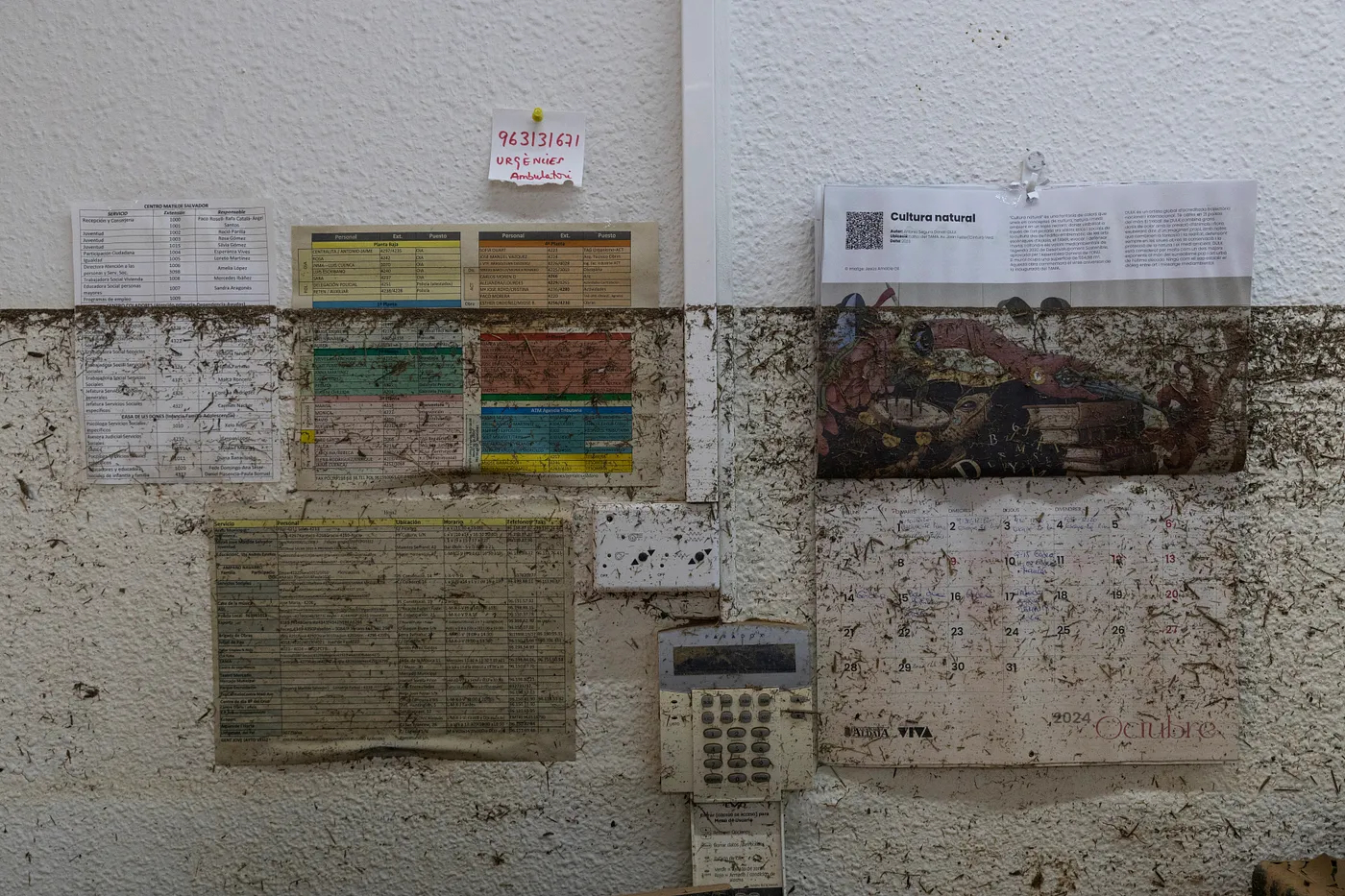
Valencia’s Floods (Aldaia, 4 Nov 2024)
Photo by Victoria Rovira Casanovas (permission granted by author)
There are moments when an image transcends mere documentation, imprinting itself on the body, carrying an affective weight that lingers long after the first viewing.
During Marta Poblet’s talk, New Models of Digital Participation and Data Governance, this image surfaced. Taken in the aftermath of the DANA floods in Valencia in 2024, it depicts the interior of an elderly care home—a space meant for protection. A thick, dark, and unrelenting line of mud rises above the height of a wheelchair user, stark and silent testimony to the devastation.
The brutal clarity of this mark, more than any report, flood map, or dataset, speaks of loss and abandonment. It is a document, yes—but also a scar. A vestige of suffering, a demand to be felt as much as analysed.
Affect and Commons: The Revelation
Much of our work in democratic innovation, participation, and commons-building revolves around structures of care—digital, institutional, and social architectures designed to make people visible, heard, and protected. Yet this image laid bare the limits of these structures in the face of catastrophe.
A home for the elderly—meant to safeguard the most vulnerable—became a trap. The infrastructure designed to protect ended up imprisoning. The image starkly exposes inequalities of mobility, preparedness, and survival.
And yet, within the wreckage, the traces of the commons endure: a handwritten emergency number, timetables that once structured shared life, a calendar still bearing the weight of ordinary days now irreversibly disrupted. Fragments of a web of care that worked—until it was submerged.
Beyond Data: The Power of Physical and Digital Space
The retreat was rich with discussions about data—how to collect it, visualise it, and make it actionable. We talked about platforms, dashboards, and participatory mechanisms to track policy change.
And yet, this image offered the retreat’s deepest lesson. It exposed what data often flattens: the materiality of disaster, the embodied vulnerability, the way catastrophe embeds itself into spaces and lingers in textures.
Data can tell us how many people were affected; an image reveals what it felt like to be trapped, to be abandoned, to see the residue of disaster climbing the walls of a familiar space.
Data can advocate; images like this haunt us.
Beyond data, this moment illuminated the limits and possibilities of both physical and digital spaces. We often frame participation in terms of digital infrastructures, commons-based platforms, and data governance. Yet this image reminds us that participation is always bodily, always tied to the spaces we inhabit—and the ways they can become safe or perilous.
Digital spaces create possibilities, but they can never replace physical presence, material conditions, and the tactile realities of exclusion and care.
The Most Inspiring Flash
This was the moment when everything converged.
The debates on participatory democracy, the need for inclusive design, the role of affective knowledge in decision-making—all crystallised here.
This image is not just about a flood. It is about who is vulnerable, who is cared for, and who is forgotten when systems fail. It is a stark reminder of the ethical obligation of participation: that democracy, at its core, is about ensuring no one is left below the mud line.
A powerful lesson emerged from the retreat:
- That the commons are not only digital; they are material, affective, and deeply tied to the right to survive.
- That while data informs, lived experience transforms.
- That digital participation must remain accountable to physical realities and the embodied nature of exclusion.
- That the most profound learnings are not always found in reports but in those flashes of recognition that force us to see, feel, and act differently.
As we move forward, this image will stay with me. Not as mere evidence, but as a demand.
A demand for a democracy that does not abandon. For a commons that truly sustains. For a commitment to affective knowledge as a central—not peripheral—axis of our work.
Note:
*Marta Poblet, Stefaan Verhulst, and Anna Colom have explored this image in greater depth in a recent article for The Data Tank, analysing how data can serve as emergency signals, mobilise solidarity responses, and reinforce governance mechanisms in disaster contexts. Their reflection underscores the importance of data management as an act of collective care and highlights the urgency of participatory structures that not only gather information but also activate effective and equitable responses. You can read the full article here: Access, Signal, Action: Data Stewardship Lessons from Valencia’s Floods.*