Interviews
Ismael Peña-López Robust governance, organisation and talent: necessary ingredients for a democratic cultural shift


We spoke with Ismael Peña-Lopez, who was director of the School of Public Administration of Catalonia for three years and Director General of Citizen Participation for the Government of Catalonia. He is currently a professor at the Open University of Catalonia, specialising in the transformation of organisational governance, particularly multi-actor and multi-level governance.
Youth and the functioning of politics
Let’s start with the famous disaffection of young people. What do you think: are young people failing politics, or is politics failing young people?
Ismael Peña-López: I think politics is failing everyone. Young people may be more or less disaffected than other generations, but in reality the problem is widespread. It is not a problem of youth, but of politics.
Added to this is the generational change in which new generations socialise and communicate in a very different way thanks to technology. The cultural chain that existed before, in which people shared similar ways of life, has been broken. I am 52 years old, and my children were born into a different paradigm.
Both things come together, but if I had to choose, I would say that the political system is falling apart at the seams. That is the main problem.
And, consequently, if you had to point out one major flaw in the political system, what would it be?
Simplifying things is always complicated, but if I could fix one thing, it would be the administration’s ability to manage and deliver on its promises. I have the impression that institutions have become self-referential, turning their backs on the public.
There is a huge gap between institutions and ordinary people. We lack a layer of public managers who are prepared to diagnose, plan and implement policies. In such a complex world, this is essential. Some will call it technocracy, but it is not that: it is efficiency. We need dedicated, trained and representative people, and right now we do not have that balance.
From your experience at the School of Public Administration of Catalonia, what skills should future civil servants have in order to integrate a more deliberative culture?
There is enormous interest in doing so. I would say there are three main groups of skills: first, technical or “hard” skills: administration, economics, strategic planning, human resource management; second, interpersonal or “soft” skills: leadership, communication, empathy, teamwork. Knowing how to deal with people and the environment is as important as knowing the law or numbers; and third, a more methodological or model block, which in recent years has been called many things: new public governance, open government, quadruple helix, mission-oriented policies or robust governance.
It is not just a question of knowing how to deliberate, but of applying a more horizontal, collaborative and less hierarchical model of public policy
This third section focuses not so much on individual competences as on how they are put into practice: with whom, in what way and in what sequence. It is not just a question of knowing how to deliberate, but of applying a more horizontal, collaborative and less hierarchical model of public policy.
Deliberative democracy in Catalonia
In recent years, many deliberative processes and citizens’ assemblies have been promoted in Catalonia. However, the institutions seem incapable of taking on board their results. What is going wrong?
The short answer would be: instead of adding participation at the end of the political process, it should be integrated from the outset: in the diagnosis, the analysis of actors, the formulation of strategies and the evaluation. It is not a question of adding tools, but of incorporating them into the public policy cycle.
But let’s look at it in detail. First, planning. Deliberation is not about filling rooms with people with sticky notes, but about being clear about what you want to solve and how. Without a strategic plan, a vision or a theory of change, any process will fail. Second, real will. There is a lot of “participation washing”. According to data from the Generalitat, 85% of participatory processes have no return, either technical or political. This shows that, in most cases, there was no real intention to continue them. And third, model. The participatory tools we have: assemblies, mini-publics, participatory budgets, do not fit into the current system. They can patch things up, improve something, but without changing the underlying model, they are useless. It’s like treating a serious illness with band-aids: either you change the structure or everything will remain the same.
Do you think that in Catalonia we devote enough time to participation and democratic culture within institutions?
The question is not whether we devote time, but whether we use it well. There are thousands of people who devote hours every week to their school’s AFA, neighbourhood associations or volunteering. Then we ask them to also participate in municipal processes, and it is logical that they say no.
People do participate, but in other spaces. The challenge is not to make them devote more hours, but to take advantage of the hours they already devote so that they count as political participation. As I said before, the administration does not know how to recognise or connect these forms of involvement. As long as we continue to operate with structures that do not communicate with the social ecosystem, we will have to continue opening “holes in the walls” of the system instead of redesigning it from scratch.
Deliberation professionals talk about the deliberative future of democracy as something inevitable. Do you think governments are willing to give real power to assemblies and participatory processes? Or is it just an academic ideal?
There is broad consensus among experts and academics that the system must change. Even many politicians acknowledge this in private. But the way political parties operate creates incentives that run counter to such change. It is a prisoner’s dilemma: everyone knows that reaching an agreement would be better, but because they do not trust each other, everyone loses.
The important thing here is to understand that the problem cannot be solved by creating more participatory processes. In government, there is a belief that for something to count as participation, there must be public initiative, a specific project and a defined structure. But there are many forms of participation that do not meet these three conditions.
A mass demonstration, a crowdfunding campaign, a viral hashtag or a children's assembly at a school are also forms of political participation
A mass demonstration, a crowdfunding campaign, a viral hashtag or a children’s assembly at a school are also forms of political participation. If we are unable to read and incorporate them, we are leaving out a huge part of democratic reality.
We need to break with old assumptions and turn the approach on its head: instead of asking “how will I carry out the participatory process?”, we should ask “how will I make the diagnosis?” or “how will I evaluate the impact?”. Participation must be integrated naturally, not as a formality.
If we are so clear about this, what is preventing this change in methodology?
Here I would say there are two major obstacles. The first is political will. Many public officials perceive opening up participatory processes as a loss of power. They believe they have been voted in to decide, not to share decisions. And that is a mistake. They do not understand that the power of those who create the platform, the rules of the game, is enormous. Look at Google or Apple, they control the system without having to do everything.
The second problem is that we still do not have a solid theoretical model. Classical bureaucracy worked, and the new public management of the 1980s also had a clear framework. Today, so-called robust governance is a mixture of theories and instruments — open government, mission-based policies, systems analysis — but there is no coherent synthesis. And without that framework, it is difficult to transform institutions.
State of health of the Decidim platform
Let’s talk about Decidim, a platform you know well. What would you highlight about it and why do you think it has been so successful?
Decidim is an excellent tool for managing participation. It allows you to organise processes, budgets, assemblies, legislative planning, transparency, all in the same digital environment. And its success comes not so much from citizens as from public managers themselves, who have seen it as a powerful tool for coordinating and documenting participation. Like Word or Excel, but for participatory processes.
Some say that Decidim has become bureaucratic and lost its open spirit. Do you agree?
No, I think it has matured. It has a steep learning curve, yes, but when used properly it is very effective. Remember what happened with WordPress: at first it was easy to experiment, but over time the really useful features became established and the experiments disappeared. The same thing has happened with Decidim. It is now a more stable and complex tool, with thousands of contributors around the world. To keep it alive, it needs order, governance and clear rules. And that’s not bureaucracy, it’s sustainability. I am convinced that it has a long future, even without the direct support of Barcelona City Council.
Recognising its value and effectiveness, it still needs to be integrated into official administrative systems Is the Decidim platform interoperable?
Very little. In Catalonia, there are some 3,000 administrations, and integration is practically non-existent. In some cases, you can upload registers or make basic queries, but there is no real connection between Decidim and the administrative systems.
But that does not speak to the culture of participation, but rather to the digital culture of the administration. We still do not have a single digital architecture like Estonia’s, with digital identity, interoperability and efficient data management. There is still a lot of work to be done.
All innovation, including social innovation, is geared towards AI, but without sufficient critical reflection. How should this be addressed from the perspective of politics and citizen participation?
There are two different issues here: the use of AI by the administration and the public procurement of AI-based solutions. In the first case, there is a problem of purpose: what is it for? We see many solutions without a clear problem to solve. And secondly, the type of supplier, the platform, how it is purchased, tendered, integrated, where the data resides. The European framework is not bad, but it is so demanding that it is impossible to comply with it with current resources. There is no technical capacity to evaluate, audit or supervise AI as required by law. Administrations will end up relying on large consulting firms, which will not be able to do everything either, or on insufficient internal teams.
The alternative is to open up the process: involve citizens, human rights experts, and organised groups before, during, and after each implementation. It is difficult, but necessary. We are embracing the use of AI too quickly, and the potential damage could be irreversible.
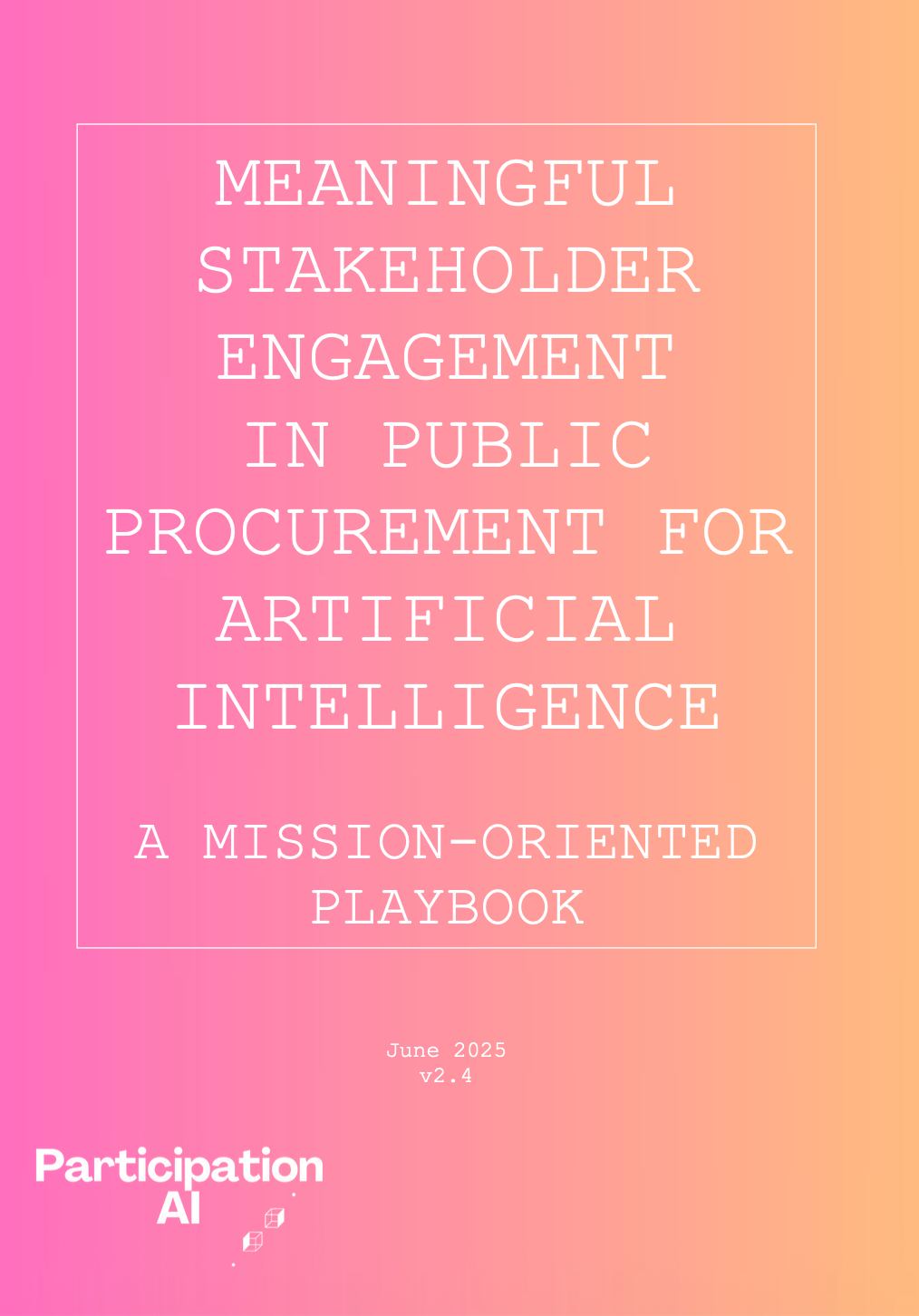
See the latest publication by Ismael Peña-López, [here,] (https://ictlogy.net/articles/20250630ismael_pena-lopez-_meaningful_stakeholder_engagement_in_public_procurement_for_artificial_intelligence.pdf) and stay informed about his activities at ICTlogy.
____
This interview was made possible thanks to the collaboration of the Open Society Foundations.