Learnings
Goteo, a platform energizing the rural world through social and environmental impact


We delved into Goteo’s many projects to find the keys to successful environmental and rural campaigns. We spoke to three of them: Preparando la tierra, Stop Agroparc and Foodcoop, so they could tell us about their experience in running a successful crowdfunding campaign that brought the rural and urban worlds together. Here are some of the ideas they shared with us.
Preparando la tierra
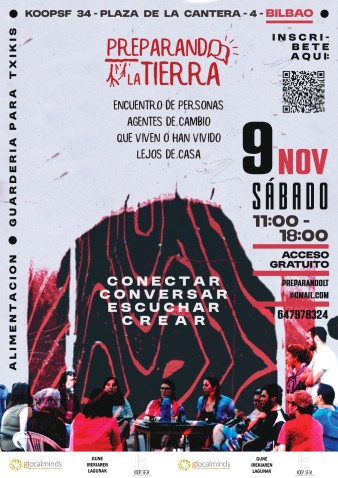
Preparando la tierra seeks to bring together change agents in Bilbao (Basque Country, Spain) who live or have lived far from home. They refer to those people who are cultural, artistic, social, economic and/or educational agents who are taking creative action in the Basque Country far from their networks, traditions and place of origin. We spoke to Joaquín, its main promoter, about the importance of the project, his motivations and the lessons learned during the process.
Alex: Why do you think this meeting between agents of change in the Basque Country is important specifically?
All countries are receiving migratory flows. So we are only seeing the tip of the iceberg. But beneath the iceberg, of course, there are many things that we could summarise as international stability. I mean, within each nation, of course, but also between nations. So this was like a call, like a film. And we didn’t call anyone. That is, we called on a specific profile of people. And there are two definitions. The first is changemaker, people who take creative action to solve social problems. We are referring to those people who are cultural, artistic, social, economic or educational agents, no matter what specific fields. We wanted that profile to understand the importance of networks, to understand the importance of being and creating spaces for collaboration, and to see the value of these spaces.
But we are not only calling on changemakers. We are calling on changemakers who now live far from home. We wanted to call on change agents who are natives of the Basque Country but who have lived far from home at some point in their lives. We wanted to connect through this shared experience.
What motivated you to launch it as a crowdfunding campaign?
As I am not originally from here, I had no resources, no important network to collaborate with and carry out projects and manage them. At first, our challenge was to design a basic idea based on the principles of recycling and ‘less is more’. We had almost nothing, nobody knew us, but we wanted to do it. We knew we could do something. We knew we had talent and skills, and our goal was to do it with minimal energy impact. Something easy to manage and possible with few resources. Otherwise, it would have been impossible, you know. So we wanted to make a call without expecting great results, without any guarantee of continuity for further activities, because we didn’t have the capacity to sustain it. So crowdfunding was, in short, the only way to get funding, given the context I have just described.
If you had to give advice to other future project owners, what would it be?
Do creative workshops. And follow the principle of the smaller the energy footprint, the better. How? Less time, resources and energy. You know, every decision in a campaign will be connected to the implementation phase. You know, because of the life and system we live in, we are used to making a lot of unnecessary efforts that generate waste and consume unnecessary energy in the actions and products we design. Do we need that? No.
Stop Agroparc
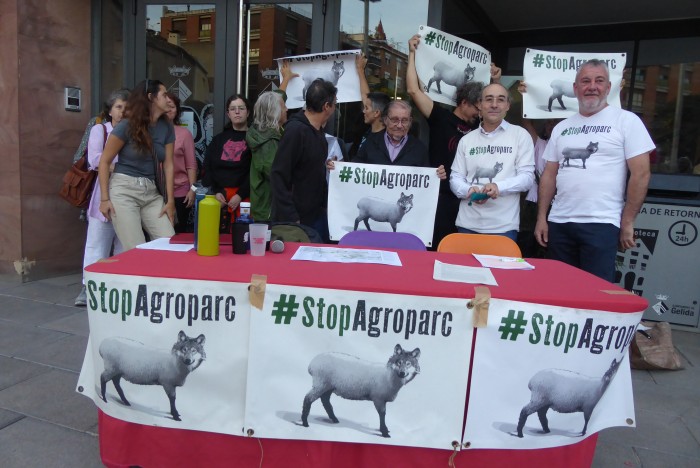
Their website states: “We are a group of people who have come together to prevent the construction of the Agroparc. Most of us are from Gelida and Sant Llorenç de Hortons, but we also come from other towns and cities. We are all different kinds of people with a common goal: to stop the Agroparc.”
The aim of the platform, as they tell us, is to stop a 250-hectare project in the Penedès region, which is designed to serve elementary macro-industry in a natural space that should be protected but is not. What we have done with GOTEO is to raise money to file an administrative appeal to prevent this change to urban and municipal planning.
How important has all this visibility and the social and environmental impact generated by this project been for you?
We are very happy, firstly because we are a very small group, the driving force behind the project is a very small group, but thanks to Goteo and also thanks to the fact that we have carried out various activities over the years to raise our profile, we have been able to expand a little beyond our village and our region. We have also reached people in Barcelona and beyond, which was also good because the encounter between the city and the rural world is sometimes a little more complicated due to the realities we live in, which are a little isolated, but in the end, the Ametller project is about supermarkets, that is, what people consume. It is also about becoming aware that what you were consuming in that supermarket has an impact on the outskirts, because everything around Barcelona, for example, is a great natural lung, we are a lung, and we are increasingly being trapped by the more industrial part, right?
What would be the difference between crowdfunding in a rural environment and doing it in an urban environment?
Stop Agroparc: We think it’s much more difficult in a rural environment, much more difficult, yes. Not only because it’s harder to reach people, who are more scattered, but also because it’s an environment that can be very large in terms of space, but very small in terms of people. And when you’re in a conflict, even if it’s environmental, it’s still a conflict.
The problem is that this is a smaller community where everyone knows each other, and if there is a conflict, some people prefer to stay out of it and not get involved.
In this sense, we believe that it is easier in a city, where people are more anonymous and can apply, offer support, attend meetings and obtain information more freely.
Here it was more difficult to communicate the project. You call people, but they don’t come. I think it’s more word of mouth, going to visit, going to see. You go and see the farmers here or you go and see the people in the houses there, and then they contribute through Goteo.
Any other specific aspects of rural areas worth mentioning?
Stop Agroparc: Yes, the economic situation is different. Our big problems now are the companies, the big ones, agribusiness, everything that wants to set up in rural areas, and also renewable energy issues. Now there are European policies on renewable energy, photovoltaic and wind power, which require agreements, signed documents, to know where to install them. With all this going on, we are faced with a problem: there is an ageing population that is no longer working the land, and they are being told, “Look, we’re going to put these panels up, and we’re going to give you some money.
Therefore, we have to be very careful about how we run our campaigns in the villages, because everything is very sensitive. And it’s a big problem. What we have here is a big problem that, because you can’t see it, because these 300 hectares are not yet visible, people have no idea of the impact that having a biogas plant here will have, a road with lots of lorries going up and down, on a small road that no one is talking about whether they are going to modify or not, well, all the impacts it may have, a lesser spotted eagle that is in danger of extinction and lives here with us. Let’s say that this project is going to have a very big impact, but as it is not yet visible, people have no idea.
For now, we have managed to stop them with legal arguments, but we know that this is temporary and that they will continue, and that we will need to mobilise again.
Foodcoop
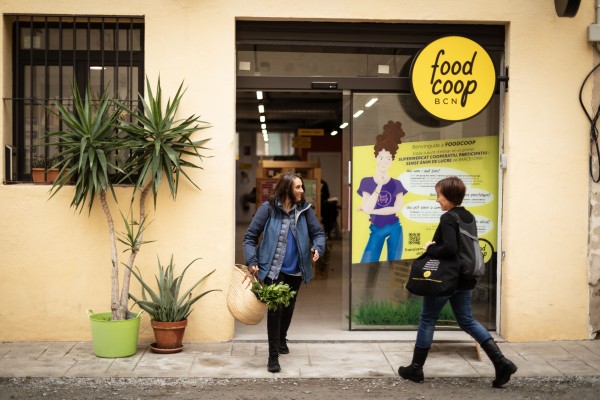
Foodcoop BCN, Barcelona’s first cooperative and participatory supermarket, opened its doors in February 2022. It is committed to food consumption based on sustainability, the nutritional value of products, the reduction of waste and food waste, respect for the land and those who work it, and for biodiversity and natural resources. One of its partners, Edgar, explains how the campaign has helped them and the value of cooperative supermarkets in large cities.
What kind of impact do you think crowdfunding has had on your project and also on the local area?
It was essential to be able to carry out this project through Goteo because it gave us the short-term viability we needed and we had no other alternative.
It’s true that we didn’t manage to mobilise our entire membership base, but the core group of members who were most involved in projects and who gave their all to this particular project did generate some very positive synergies within the community. This has enabled us to continue developing different projects to grow the supermarket and bring it closer to more people.
What kind of content have you used on social media and in a more analogue format to tell the story of the project?
In the case of social media, we have quite a few followers on Instagram and Twitter, but we realised that although we were running a campaign on social media, we weren’t really reaching the people who were really important. As it is a local project that has an impact insofar as you go to that supermarket to shop and it has a whole impact on the value chain, perhaps the digital part was not the best channel to make the campaign successful.
In fact, that’s where we focused most, and then we realised that it probably hadn’t been the most efficient approach.
On the analogue side, beyond contact, let’s say impacting with different types of communications, WhatsApp, Telegram, email, we didn’t do much more to our social base.
Now it occurs to me that perhaps we could have done some poster advertising. For example, when we run communication campaigns to promote supermarkets, we use these mechanisms because we are very interested in our shoppers, our members, being from the neighbourhood. After all, if you live half an hour away from the supermarket by tube, it is difficult to go shopping there regularly. We could have used some of these techniques, which we didn’t really do.
What is the relationship between rural and urban areas in your project? How do you promote rural areas from the cooperative, if you do?
Right now we are involved in some projects that are promoting agroecological farming, proximity, seasonality and so on.
There are many great projects in the countryside that have a clear vision, but the problem with many of these projects, and the reason they have often contacted us to collaborate on small projects, is that they encounter difficulties when they try to sell their products or reach the large population in the Barcelona metropolitan area, which is obviously a very important market, both in terms of selling and generating income, and in terms of expanding the projects so that they have an impact on many more people. This is where FoodCoop plays a key role.
We are currently attempting to connect these two worlds in the centre of Barcelona, in Eixample Esquerra, and although it is complicated, more people are signing up every day and we are growing, so in that sense we are very pleased.
We need time, but we are on the right track and we believe we are moving in the right direction.
So, is it possible to unite the urban and the rural in an agroecological project?
We are trying to bring these two worlds together, which sometimes seem so far apart. It’s all about local rural suppliers who also try to offer high-quality organic products, and we’re connecting them with the urban world and also with a cooperative project that allows us to make collective decisions among all the companies that are part of it, but also allows us to decide at any given moment to adjust margins as much as possible so that these high-quality, organic, local products reach as many people as possible at the best possible price.
It sounds a bit utopian in a world of big brands, but somehow we are convinced that there is that sensitivity in the city of Barcelona, in the urban environment, there is that sensitivity not only to consume better products, but also to have a positive impact on the environment, on the people who are growing those products and somehow to connect those two worlds, to connect the urban with the rural, which sometimes seem very distant, but in the case of food, it is key.
Without the rural world, obviously, we would not be able to eat in the cities.
We always say the same thing: we want to be an alternative to conventional supermarkets, and we have started in Barcelona, but we will try to have the greatest possible impact, and that means looking the big supermarkets in the eye and telling them there is another way of doing things. We are going to try to get as many people as possible on board to make it a reality and to make it economically viable, socially viable, but also to grow and to stand up and say, look, here is another type of supermarket and there is another way of doing things, based on the collective and on respect for people and the environment.
__
At Goteo.org, we believe in the power of crowdfunding to drive projects with social and environmental impact. Every day we see how many initiatives succeed thanks to citizen mobilisation, and we know that campaigns focused on sustainability and rural revitalisation have specific challenges and opportunities.
If you are thinking of launching an environmental project or a project in a rural area, this ten-point guide to best practices will help you design an effective campaign, mobilise support and ensure the success of your initiative.
This article is part of the project “Strategy and promotion of SSE initiatives with social and environmental impact through Goteo.org” and is subsidised by the Ministry of Labour and Social Economy.